









Product Quick Navigation
Get a Quote
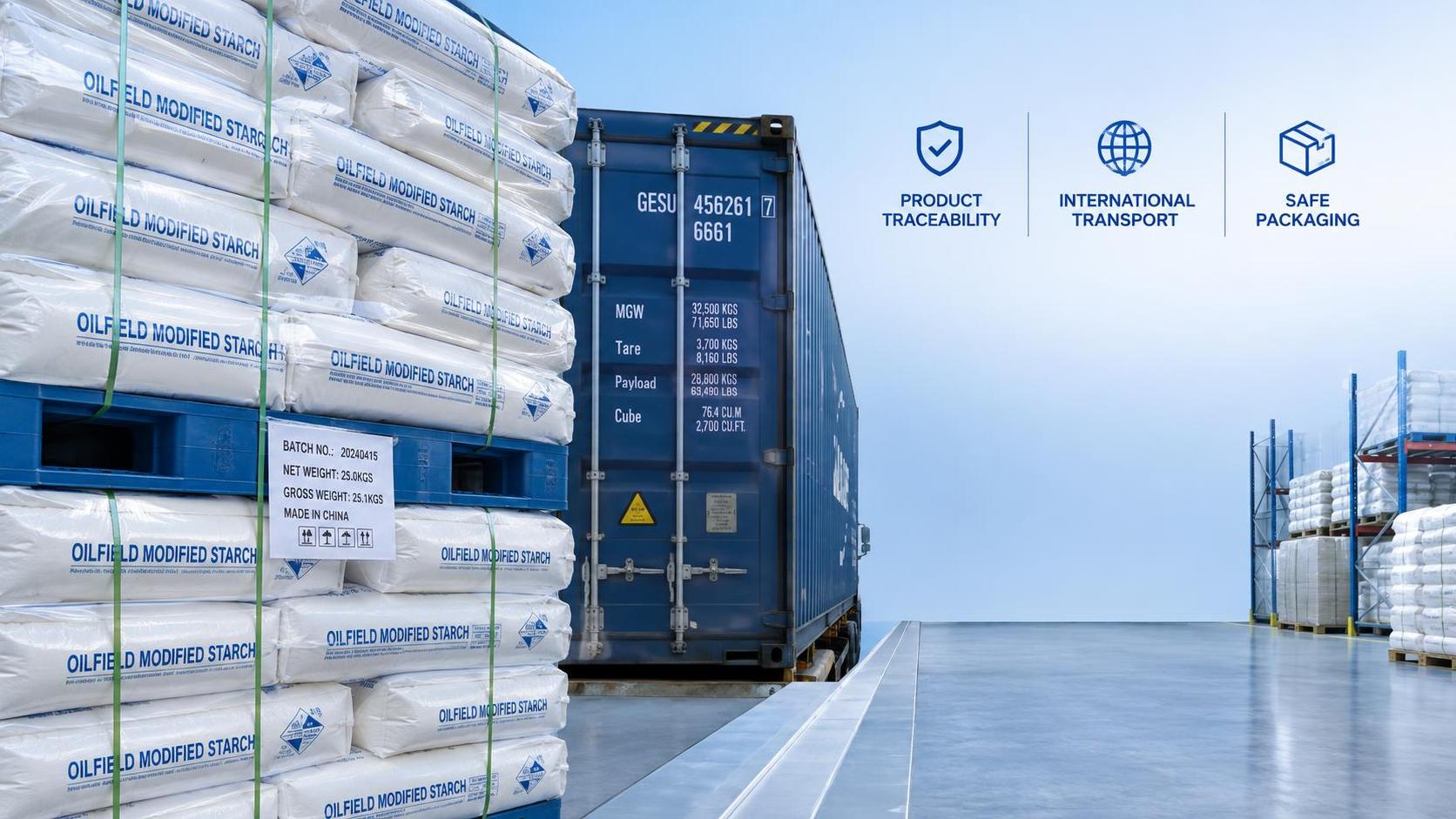
Does Oilfield Modified Starch Require Special Export Documents?
Introduction: Does oilfield modified starch need special export documentation? For chemical buyers and distributors sourcing internationally, the answer depends on product classification, destination-country regulations, and shipment requirements.
Huafeng Chemical helps overseas customers navigate export compliance, product documentation, and reliable supply coordination for oilfield modified starch and other chemical materials.
Short Answer: Usually No Single “Special Certificate,” but Documentation Matters
Oilfield modified starch does not automatically require one universal special export certificate simply because it is used in drilling, completion, or fluid-loss-control applications.
However, exporters and importers still need a complete documentation package that reflects the product's actual chemical composition, customs classification, transport status, and intended market.
The central question is not whether the material is called “oilfield modified starch.” The relevant question is how the specific grade is classified under applicable regulations.
A product based on starch may be non-hazardous for transport, yet still require detailed safety information, customs declarations, certificates of origin, and destination-market compliance evidence.
For buyers, assuming that a natural or starch-derived product has no regulatory obligations can create delays, unexpected costs, customs holds, or rejected deliveries.
The most reliable approach is to review the product specification, Safety Data Sheet, tariff code, packaging configuration, and destination-country requirements before issuing a purchase order.
What Overseas Buyers Are Actually Trying to Confirm
When purchasers search whether oilfield modified starch needs special export documentation, they are usually assessing import risk, logistics feasibility, and supplier readiness rather than asking a purely legal question.
They want to know whether the cargo can move through ports without unusual restrictions, whether the supplier understands export procedures, and whether supporting records will satisfy customs.
Procurement managers also need to estimate the total landed cost. Missing documents can create demurrage, storage charges, inspection expenses, and disruption to drilling-fluid supply schedules.
Distributors may have additional concerns because they must later provide compliant product information to local customers, warehouse operators, regulators, and transportation partners.
Technical buyers often need evidence that export paperwork corresponds exactly with the grade tested and supplied, particularly when performance requirements affect drilling operations.
Therefore, good documentation is not merely an administrative attachment. It is part of product traceability, commercial reliability, and operational risk management.
Start with the Exact Product Composition and Grade
Oilfield modified starch is a broad commercial term. It can describe starch products modified through physical, enzymatic, or chemical processes to improve drilling-fluid performance.
Common functions include reducing fluid loss, improving shale inhibition, supporting rheology control, and maintaining drilling-fluid performance under selected temperature and salinity conditions.
Different modification methods can result in different chemical identities, additive profiles, transport characteristics, and regulatory treatment. Buyers should never rely only on a generic product name.
Ask the supplier for the technical data sheet, full Safety Data Sheet, product specification, composition information, and applicable Chemical Abstracts Service numbers where available.
The Safety Data Sheet is particularly important because it identifies hazards, handling practices, first-aid measures, storage requirements, transportation information, and regulatory statements.
A well-prepared SDS also helps importers determine whether the shipment falls under dangerous goods rules or can be transported as non-dangerous cargo.
If the grade contains crosslinking agents, preservatives, alkaline components, borate compounds, or other functional additives, those ingredients may affect documentation obligations.
Customs Classification Determines Much of the Export Process
Correct Harmonized System classification is one of the most important requirements for exporting oilfield modified starch from China or any other manufacturing country.
The applicable HS code may depend on whether customs authorities view the product as a modified starch, chemical preparation, drilling-fluid additive, or another category.
Classification affects declared duty treatment, statistical reporting, customs review, possible licensing considerations, and the documents expected by the importing country.
Suppliers should provide their proposed HS code, but importers should validate it with their customs broker or local trade adviser before finalizing shipment arrangements.
An incorrect code may not always stop a shipment at origin, but it can trigger reclassification, penalties, delayed clearance, or retrospective duty adjustments at destination.
For recurring orders, buyers should establish an agreed customs classification process early. This reduces inconsistent declarations across separate lots, ports, and supplier facilities.
Documentation should use consistent product descriptions across the commercial invoice, packing list, bill of lading, certificate of analysis, and customs declaration.
Core Export Documents Buyers Should Expect
Even when no special oilfield certificate is legally required, standard export documents remain essential. A professional supplier should prepare them accurately and consistently.
The commercial invoice identifies the seller, buyer, product description, quantity, unit price, total value, Incoterms, country of origin, and payment-related information.
The packing list details bag counts, net weight, gross weight, package dimensions, pallet information, and shipping marks. It must match the actual packed cargo.
A bill of lading, sea waybill, air waybill, or other transport document confirms the shipment arrangement and is often necessary for cargo release.
A certificate of origin may be requested by the buyer, customs authority, bank, or customer. It can also support preferential tariff treatment under relevant trade arrangements.
A certificate of analysis is commercially important for oilfield modified starch because it demonstrates that the shipped batch meets agreed technical parameters and quality limits.
Typical certificate-of-analysis items may include moisture content, pH, viscosity, fluid-loss performance, filtration behavior, particle size, bulk density, and appearance.
Buyers should request batch numbers on both the certificate of analysis and packaging. This makes it easier to investigate quality claims or site-performance concerns later.
When an SDS and Transport Declaration Become Critical
The SDS is often the first document logistics providers review. It helps carriers, freight forwarders, warehouses, and customers understand whether special handling is required.
For many dry modified starch products, transport may be classified as non-dangerous. This does not remove the need for an accurate SDS and proper packaging information.
If the product is classified as dangerous goods, additional rules may apply under IMDG, IATA, ADR, or domestic transportation regulations, depending on the route.
Possible requirements can include a dangerous goods declaration, UN number, hazard class, packing group, approved packaging, labels, placards, and emergency-response details.
Some starch powders may create combustible-dust concerns during handling, even where they are not regulated as dangerous goods for international transport.
That distinction matters. Warehouse and industrial safety practices may require dust control measures, while customs and transport documentation may still describe the material as non-hazardous.
Buyers should ensure that the SDS revision date is current and that transport information aligns with the planned shipping mode, packaging, and port of loading.
Destination-Country Requirements Can Create Additional Obligations
Export documentation requirements do not end at the exporting country’s border. Import compliance often depends on national chemical regulations and customer-specific obligations.
In the European Union, importers may need to assess REACH responsibilities, substance registration status, downstream-use considerations, and classification, labeling, and packaging requirements.
In the United States, importers may need to consider TSCA status, Occupational Safety and Health Administration hazard communication obligations, and state-level requirements.
Other markets may require local-language SDS documents, chemical inventory confirmation, import registration, pre-notification, conformity records, or special labeling before sale or distribution.
Oilfield customers may also impose vendor qualification requirements beyond legal customs rules. These can include quality-system certificates, audit questionnaires, and traceability records.
For example, a national oil company, drilling contractor, or mud-service provider may request product performance reports before approving a starch grade for field use.
These customer requirements are not necessarily export documents, but failing to identify them early can prevent the product from being used after arrival.
How to Check Whether a License or Permit Is Needed
Most standard oilfield modified starch exports do not require an export license solely due to their product name. Still, exceptions must be checked case by case.
Controls may arise from hazardous constituents, restricted chemicals, dual-use considerations, controlled destinations, sanctions screening, or changes in local trade regulations.
Suppliers should review current export control rules in the origin country. Importers should separately verify permits, registrations, and restricted-substance conditions in their own market.
Do not rely on an outdated shipment file from another product grade. Similar trade names do not guarantee identical compositions or identical regulatory treatment.
For sensitive destinations or unusual formulations, obtain written guidance from qualified customs, legal, or regulatory professionals before confirming delivery commitments.
Buyers should also screen counterparties, banks, vessel routes, and final destinations where trade compliance procedures require sanctions or restricted-party verification.
Packaging and Labeling Must Match the Documents
Documentation errors often begin with inconsistent packaging details. The invoice may describe twenty-five-kilogram bags while the warehouse loads twenty-kilogram bags or bulk containers.
For powdered oilfield modified starch, packaging should protect against moisture, tearing, contamination, and product loss during loading, sea transport, unloading, and storage.
Labels should clearly identify the product name, grade, batch number, net weight, manufacturing date where applicable, storage guidance, and supplier contact information.
Where hazard labeling applies, labels must follow the relevant transport and destination-market rules. They should not contradict statements contained in the SDS.
Wooden pallets may also require ISPM 15 compliance markings when used for international shipments. This issue is separate from the chemical product itself.
Buyers should request pre-shipment packing photographs for new suppliers, first orders, or project cargoes with strict receiving and warehouse requirements.
A Practical Pre-Shipment Documentation Checklist
Before cargo is released, buyers should confirm the product identity, batch documentation, packaging details, customs code, shipping route, and country-specific compliance requirements.
First, compare the purchase order description against the commercial invoice, packing list, SDS, certificate of analysis, and product labels for exact consistency.
Second, verify that the SDS identifies the correct product grade and revision date. Generic SDS files may not adequately cover modified formulations.
Third, confirm whether the freight forwarder accepts the cargo as non-dangerous or requires dangerous goods booking procedures, declarations, or supporting test information.
Fourth, ask the customs broker to validate the HS code and identify any import permits, taxes, inspection requirements, or documentary conditions before shipment departure.
Fifth, ensure the certificate of analysis reflects the actual production batch. It should not be a sample report from an unrelated batch or historical production run.
Sixth, determine whether a certificate of origin, legalization, embassy certification, chamber certification, or other document authentication is needed for the destination market.
Finally, retain a complete electronic shipment file. This supports customs audits, customer inquiries, insurance claims, quality investigations, and repeat-order efficiency.
How Huafeng Chemical Supports Documentation and Supply Coordination
Huafeng Chemical serves overseas chemical customers that need more than product availability. Reliable export coordination requires accurate documents, responsive communication, and disciplined order execution.
For oilfield modified starch inquiries, the first step is confirming the required grade, technical application, destination, shipping method, packaging preference, and expected documentation package.
Providing this information early allows the supplier to identify potential compliance questions before production, packing, booking, or port delivery schedules become fixed.
Huafeng Chemical can coordinate commercial documents, packing information, product quality records, SDS documentation, and export logistics communication according to the agreed transaction terms.
Buyers should clearly communicate whether their internal compliance team, customs broker, end customer, or drilling contractor requires a specific document format or certification.
Early alignment is especially valuable for first-time shipments, new destinations, private-label orders, and projects where delivery timing affects drilling-fluid inventory planning.
A capable chemical export partner helps reduce uncertainty, but importers still remain responsible for understanding the laws and approval requirements in their destination market.
Common Mistakes That Delay Oilfield Modified Starch Shipments
One frequent mistake is using a broad commercial name without providing a technical grade designation. Customs and logistics teams need enough information to identify the product correctly.
Another problem is treating a non-dangerous transport classification as proof that no other export or import documents are needed. These are separate compliance questions.
Buyers also sometimes request certificates after the vessel has departed. Some documents require original signatures, local issuance, or pre-shipment processing time.
Inconsistent weights, missing batch numbers, incomplete consignee details, and mismatched product descriptions can all create avoidable clearance complications.
Do not assume destination requirements are identical to those of a neighboring country. Chemical registration, language, labeling, and customs rules often vary significantly.
Finally, avoid selecting a supplier only on quoted price. In chemical exports, poor documentation can quickly erase an apparent price advantage through delays and claims.
Conclusion: Make Documentation Part of Your Sourcing Decision
Does oilfield modified starch need special export documentation? In many cases, no unique industry-specific certificate is automatically required, especially for non-dangerous modified starch grades.
Nevertheless, the shipment still needs accurate core trade documents, technical records, an up-to-date SDS, correct customs classification, and destination-specific compliance review.
The exact requirements depend on composition, HS classification, transport status, packaging, destination regulations, customer specifications, and the final use of the material.
For buyers and distributors, the practical goal is simple: verify documentation before ordering, not after cargo reaches the port or warehouse.
By working with an export-capable supplier such as Huafeng Chemical and confirming regulatory expectations early, purchasers can reduce clearance risk and maintain dependable oilfield material supply.
Send Us Your Inquiry Today
