









Product Quick Navigation
Get a Quote
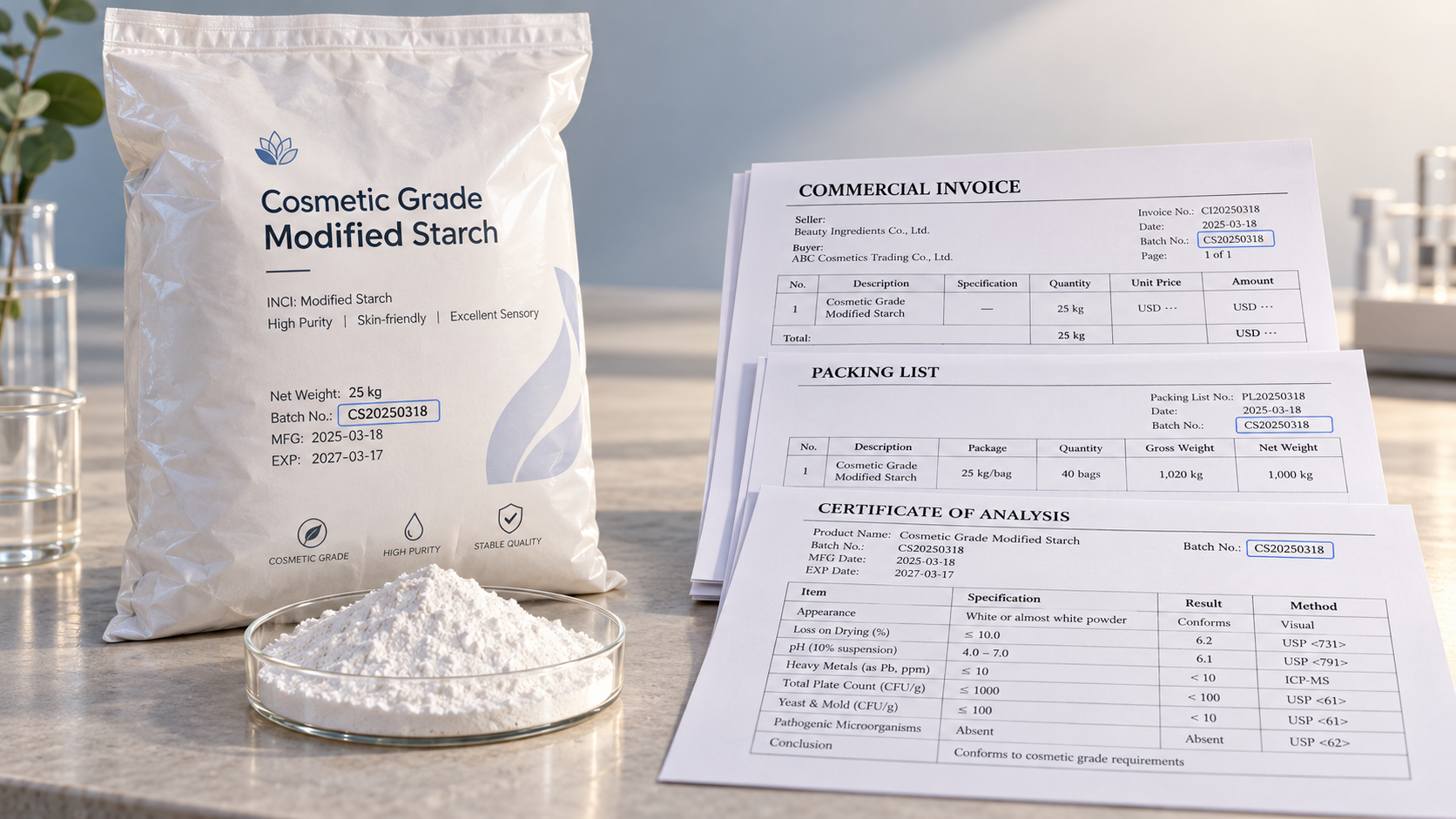
A cosmetic modified starch shipment can be held up when the invoice, packing list and product documents describe the same material differently. Before dispatch, the buyer and exporter should agree on the exact product identity, customs classification and document set required for the destination. The usual starting package includes a commercial invoice, packing list, transport document, product specification and batch certificate of analysis; an SDS, certificate of origin or other declarations may also be needed depending on the product and transaction.
The distinction between commercial paperwork and evidence of cosmetic suitability matters. A customs release document does not establish that an ingredient is suitable for a particular formulation, while a certificate of analysis does not replace an import declaration. Requesting both types of information early gives distributors and agents time to identify gaps before the cargo is booked.
Start with a precise product identity
“Modified starch” describes a broad group of materials rather than one uniform substance. The starch source, type of modification and intended use can affect classification, technical review and the documents a buyer requests. A cosmetic-grade material should not be assumed to have the same documentation or specifications as a food-grade or industrial-grade product with a similar commercial name.
Ask the supplier for the product’s trade name, applicable INCI name, chemical identity or CAS number where available, starch source and description of the modification. Record the grade and intended cosmetic use on the purchase order. The description on the commercial invoice should be recognizable against the specification and other supporting documents, even if a document uses a trade name alongside a technical name.
A mismatch does not automatically mean the goods are incorrect. Trade names, INCI names and chemical names can differ legitimately. The supplier should nevertheless provide a written link between them, particularly when the consignee, customs broker or end customer cannot verify that the documents refer to the same material.
Documents that follow the shipment
The shipping file should be assembled around the actual transaction, not copied unchanged from a previous order. At a minimum, review the following documents against the purchase order and the physical cargo.
The final transport document is issued after the carrier or its agent receives the relevant shipment information. Before issuance, check the draft against the agreed consignee instructions. Amendments after departure may be possible, but the process, cost and timing depend on the carrier and the document involved.
Delivery terms also deserve attention. The agreed Incoterms rule and named place should be consistent with the sales contract and invoice. They allocate certain delivery obligations, costs and risks; they do not by themselves determine who owns the goods or eliminate the need to agree on customs responsibilities.
Product documents: specification, analysis and safety
Specification versus batch certificate of analysis
A product specification states the agreed acceptance criteria for a grade, such as appearance and relevant physical, chemical or microbiological limits. A certificate of analysis, or COA, reports results for an identified batch against stated methods or limits. One is a description of what is acceptable; the other is evidence about the batch supplied. A general specification should not be substituted for a batch COA when the purchase agreement calls for batch-specific results.
Check that the COA names the correct product and includes the batch or lot number, test results, applicable limits and an authorized issue or approval reference. The lot number should be traceable to the package labels. Depending on the material and buyer’s requirements, the document may also show the manufacturing date, retest or expiry date, and testing methods. These dates should be interpreted according to the supplier’s stated storage conditions rather than treated as interchangeable.
For a shipment made up of several batches, request the corresponding COA for each batch. If the shipment is repacked or relabeled, agree in advance on how the original manufacturer’s lot will remain traceable to the new packaging and documents.
Safety data sheet and transport status
Request the current safety data sheet for the exact grade and review the identification, hazards, handling, storage, transport and regulatory sections. An SDS may be required under applicable rules or requested by the buyer, carrier, warehouse or insurer even when the material is not classified as hazardous. The required format and language depend on the relevant jurisdiction and use.
Do not infer transport classification from the word “chemical,” or assume that every modified starch is non-dangerous. Compare the SDS transport section with the material being shipped and ask the supplier to clarify any discrepancy. Carrier acceptance and dangerous-goods requirements depend on the actual classification, mode of transport and applicable rules.
Cosmetic compliance is destination-specific
A supplier’s statement that a product is intended for cosmetics is useful, but it is not a universal approval. Requirements depend on the destination, the ingredient’s identity and use, and the finished cosmetic product. The importer and the party responsible for placing the finished product on the market should determine which evidence they need before confirming an order.
Depending on the formulation and destination, the buyer may request information on composition, impurities, residual processing substances, microbiological quality, allergens or source materials. Some information may be commercially sensitive. Where a full composition is not disclosed, agree on an appropriate declaration or confidential exchange that gives the receiving party enough information for its assessment.
For the European Union, for example, finished cosmetic products are subject to the EU Cosmetics Regulation, including responsibilities for safety assessment and product documentation. An ingredient COA alone is not a finished-product safety assessment. Other markets apply their own frameworks, and the documentation needed for a particular ingredient should be checked against the current local requirements.
Statements concerning animal origin, genetically modified material, allergens or other customer policies should be requested only where relevant. Each declaration should identify the product, explain its scope and come from a party able to substantiate it. A declaration about one production site or grade should not automatically be applied to another.
Customs classification and origin need separate checks
The HS classification affects customs declarations and can influence duties, controls and statistical reporting. Modified starches may be classified differently according to their nature and the applicable tariff schedule. Ask the exporter for its proposed code and supporting product description, then have the importer or customs broker check the destination-country classification. A code used for export from China is not automatically sufficient as the complete import code elsewhere.
Country of origin is also more specific than the country from which the shipment departs. The applicable origin rules determine whether processing confers origin and whether any preferential treatment is available. A non-preferential certificate of origin and a document supporting a tariff preference serve different purposes; one should not be assumed to replace the other.
Before requesting an origin document, provide the exporter with the destination, intended use of the certificate and any required wording or form. The parties should confirm eligibility and documentary requirements rather than promise a duty benefit in advance.
Build a traceable file before the cargo leaves
- At quotation: identify the exact grade, destination, intended cosmetic use and proposed delivery terms. Ask which technical and commercial documents are available.
- Before order confirmation: compare the specification with the buyer’s acceptance criteria. Agree on batch testing, document language, original-document requirements and any declarations that must be issued before shipment.
- Before dispatch: reconcile the invoice and packing list with the order; match batch numbers to labels and COAs; review transport-document instructions and any required certificates.
- After dispatch: send the agreed document set to the importer or broker in time for pre-arrival review. Retain the final versions and communicate corrections through the relevant issuer.
Document control is particularly important when a distributor supplies several downstream customers from one imported lot. Keep the supplier’s batch reference linked to the receiving record, any internal lot number and the quantities subsequently dispatched. If a customer raises a quality question, that link makes it possible to identify the relevant COA and stock without treating every shipment of the same trade name as the same batch.
Use the same discipline for other ingredients, without transferring their requirements to modified starch. For example, Lycopene CAS#502-65-8 is listed as a red to very dark red powder with food and beverage applications. Its own specification, storage instructions and intended use need separate review; neither its customs code nor its product information should be used to classify or document a starch shipment.
Resolve discrepancies before changing documents
When a document does not match, first establish whether the discrepancy is clerical or reflects a change in the goods. A misspelled address may require an amended invoice; a different batch number requires confirmation of which material was actually packed. Do not alter a supplier’s COA or an issued transport document internally. Ask the authorized issuer for a corrected version or a written explanation, and preserve the superseded version in the transaction file.
Where identity, classification, origin or safety information remains unresolved, hold the affected declaration or dispatch decision until the responsible parties have checked the evidence. A clear exception record—showing the issue, affected documents and resolution—helps prevent the same mismatch from being carried into the next order.
Send Us Your Inquiry Today
