









Product Quick Navigation
Get a Quote
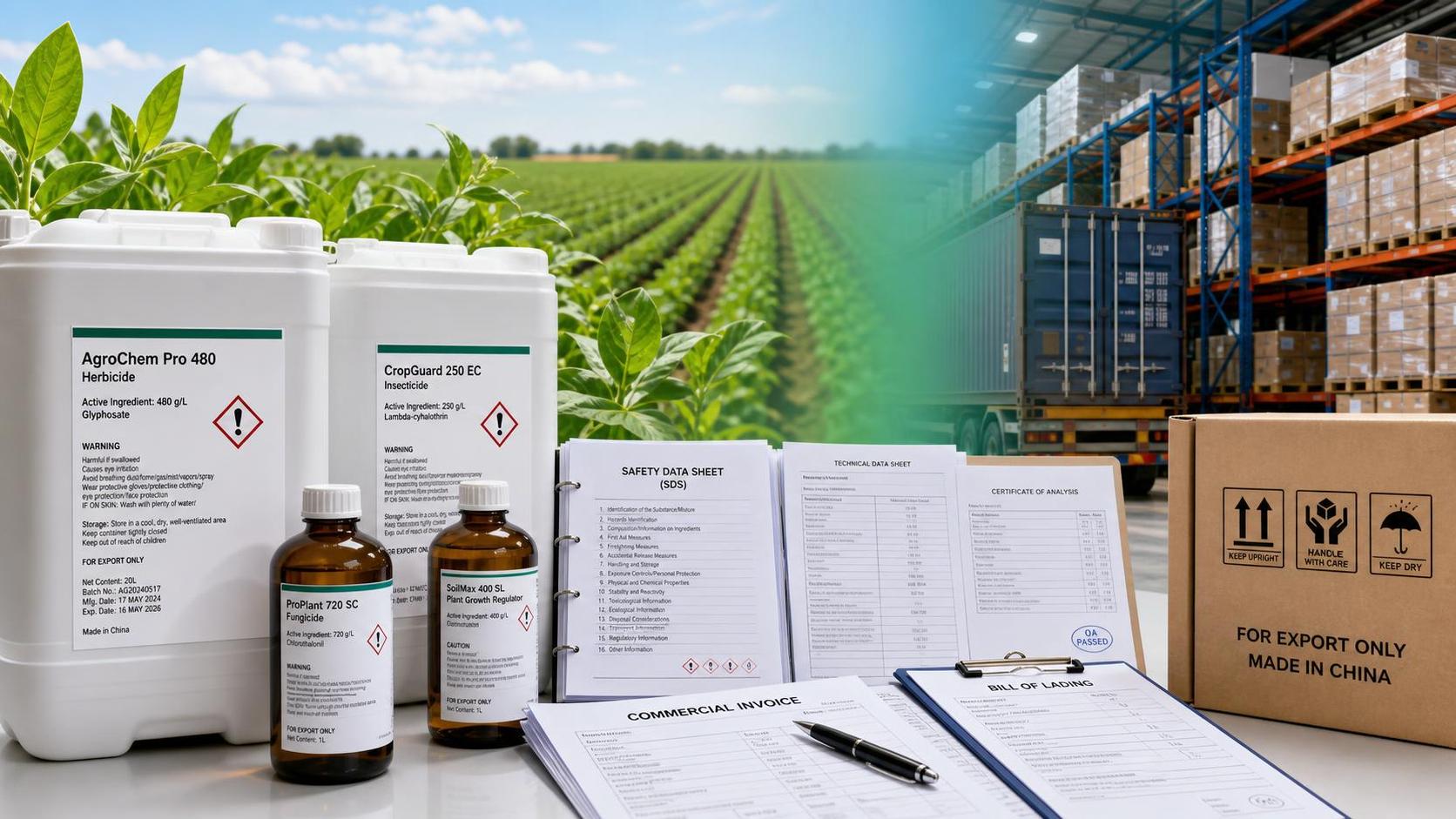
How to Check Agricultural Chemical Requirements by Destination
Exporting an agricultural chemical is not simply a matter of confirming the active ingredient, arranging production, and booking freight. A formulation that is legally sold in one market may be unregistered, incorrectly labeled, restricted for a specific crop, or unsuitable for local climate and pest pressure in another. For importers, distributors, and agricultural input companies, the first question should therefore be: can this exact product be placed on the market and used as intended in the destination country?
That question has several layers. It includes product authorization, active-substance status, formulation type, crop use, residue expectations, language requirements, package design, hazardous-goods classification, and the documents needed at customs. It also includes an agronomic question that is sometimes overlooked: what problem is growers’ fields actually showing? Understanding crop disease control early warning signs helps buyers avoid importing a compliant product that does not fit the season, disease cycle, or local application practice.
As agricultural supply chains become more international, regulatory accuracy and response speed matter as much as product availability. Huafeng Chemical, based in Shandong Province, a major chemical manufacturing region in China, supports overseas buyers through comprehensive foreign-trade services and a broad chemical portfolio. In practical terms, that work starts with clarifying the destination requirements before a shipment is committed—not after containers are ready for dispatch.
Start with the destination, not the product name
A trade name is rarely enough for a regulatory review. Agricultural chemicals are normally assessed by the destination authority according to their active ingredient, concentration, formulation, intended use, registrant, and label claims. Two products described commercially as the same fungicide may differ in co-formulants, dosage, crop scope, or hazard classification. Those differences can change their import and use status.
Before requesting a quotation or selecting packaging, prepare a product identity file. At minimum, it should identify the active ingredient or ingredients, CAS number where applicable, formulation code, concentration, intended crop and target organism, proposed pack sizes, manufacturer, country of origin, and expected annual volume. The buyer should also state whether the goods are intended for commercial sale, local registration, research trials, re-export, or industrial processing. These routes may be treated differently.
The destination itself must be defined precisely. “Europe,” “Africa,” or “Latin America” is not a regulatory destination. Requirements are set by individual countries and, in some cases, by regional frameworks supplemented by national rules. A product accepted in one neighboring market should not be assumed acceptable in another. Even where regulatory concepts appear similar, label language, local representative requirements, import permits, and customs procedures can diverge.
Separate registration status from import documentation
One of the most costly misunderstandings in agricultural chemical trade is treating customs clearance as proof of market authorization. They are related, but they are not the same.
A customs authority may require commercial documents, transport documents, product classification, and possibly an import permit. The agricultural, environmental, health, or pesticide regulator may separately require that the product be registered before it can be offered for sale or used on farms. In some jurisdictions, import of an unregistered crop-protection product is restricted except for approved trial, research, or emergency arrangements. A buyer needs to verify both paths.
For example, the United States regulates pesticide registration through the Environmental Protection Agency, while the European Union operates an approval framework for active substances and national authorization procedures for plant protection products. These examples illustrate a broader principle rather than a shortcut: an active ingredient’s presence in a market does not automatically authorize every formulation, supplier, crop use, or label claim. The current status must be checked through the relevant official authority or a qualified local regulatory adviser.
Ask the local partner to confirm four points in writing where possible: whether the active ingredient is permitted; whether the proposed formulation can be registered or is already covered by an authorization; who will hold or support the registration; and whether the planned import route requires a permit, prior notice, or local license. This prevents a common dead end in which commercial negotiations advance while the regulatory owner has not been identified.
Check the label as a legal document, not a packaging exercise
The label is where regulatory approval, agronomic instructions, and risk communication meet. It should be reviewed early because label changes can affect artwork, carton marking, printing lead time, and the suitability of existing stock.
Destination-specific label requirements commonly address the local language or languages, registrant details, product registration number, active ingredient declaration, hazard statements, precautionary instructions, first-aid information, storage directions, disposal instructions, net contents, batch traceability, and approved crop uses. Some markets also specify label format, minimum text size, color use, or mandatory local contact details. The final text should not be copied from another country’s label without review.
Claims deserve particular caution. Statements such as “controls,” “prevents,” “systemic action,” “broad spectrum,” or “safe for” may be regulated claims rather than ordinary marketing language. A claim that exceeds the local authorization can create problems even if the active ingredient itself is allowed. The same applies to recommended dose, spray interval, maximum applications, pre-harvest interval, re-entry period, and target crops. These instructions should match the destination approval, not merely the supplier’s standard technical literature.
Use field signals to define what the market actually needs
Regulatory compliance alone does not make a product commercially relevant. Importers also need a realistic view of disease risk, crop calendar, application equipment, and grower behavior. This is where crop disease control early warning signs become useful in product planning.
Early warning does not mean diagnosing every disease from a single leaf symptom. It means monitoring the conditions that justify a preventive or rapid-response program: prolonged leaf wetness, frequent rainfall, rising humidity, unusual temperature patterns, recurring disease history, infected crop residue, dense canopy growth, volunteer plants, and nearby outbreaks. Crop scouts may also notice early lesions, leaf spotting, mildew-like growth, wilting, stem discoloration, or uneven patches in the field. The right interpretation depends on the crop and local disease pressure.
For a buyer, these signals help narrow the regulatory and commercial brief. If growers need protection before a forecasted disease period, the product must have approved preventive use instructions in that market. If the problem is already established, the buyer should not assume that a preventive label claim supports curative use. If harvest is close, residue and pre-harvest restrictions become central. Importing a product with an unsuitable use pattern may leave distributors with stock that cannot be responsibly recommended when demand arrives.
Local agronomists, extension services, and registered advisers are valuable sources for confirming disease pressure. Their input should be connected to the registered label and resistance-management guidance. Repeated reliance on one mode of action can contribute to reduced sensitivity in target pathogens, so product selection should consider rotation options where they are locally approved.
Review formulation, packaging, and transport together
The commercial unit is not just an active ingredient. It is a formulated product in a package moving through a defined transport route. A formulation suitable for one distribution network may be impractical in another because of temperature exposure, pack-size preferences, local storage conditions, or hazardous-goods handling capacity.
Confirm whether the proposed formulation type is acceptable for the intended market and whether its composition is consistent with the regulatory dossier. Water-based liquids, emulsifiable concentrates, suspension concentrates, wettable powders, water-dispersible granules, and other forms have different handling characteristics. Co-formulants can also matter. A destination may impose requirements on substances beyond the principal active ingredient, particularly where hazard classification or environmental assessment is involved.
Packaging must protect product quality and meet applicable transport and local-market requirements. Buyers should confirm container material, closure type, tamper evidence where required, outer-carton configuration, palletization, and labeling placement. Compatibility between the product and its container should be assessed through the supplier’s established quality process; it should not be presumed because a similar package was used for a different formulation.
For sea, air, road, or rail shipments, dangerous-goods status must be established from the product’s current safety information and transport classification. The Safety Data Sheet is essential, but it is not a substitute for destination registration or a compliant product label. Depending on the route and classification, shipping documentation may require details such as the UN number, proper shipping name, hazard class, packing group, and marine pollutant status. Freight forwarders should receive accurate, current information early enough to plan the booking.
A practical destination-check sequence
This sequence works best when the importer, regulatory specialist, supplier, label designer, and logistics provider exchange information before final production. It is much harder to correct a missing local statement or an unsuitable carton after goods have been filled and packed.
Build flexibility into the supply decision
Agricultural demand is seasonal, but compliance work rarely follows a simple seasonal timetable. Registration reviews, document legalization, label approval, and shipping schedules can take longer than buyers expect. A sensible procurement plan separates what is already confirmed from what remains conditional. It also avoids promising delivery dates before product specifications, artwork, and shipping classification are stable.
Suppliers should be asked for the technical and trade documents needed for the proposed transaction, while buyers retain responsibility for obtaining destination-specific regulatory confirmation through the appropriate local channel. This division is especially important when regulations change, when a product is being introduced into a new market, or when an importer intends to make crop-protection claims under its own brand.
Huafeng Chemical’s position in Shandong gives overseas partners access to a broad chemical supply base, but successful export service depends on more than product sourcing. It requires disciplined communication between technical, commercial, documentation, packaging, and freight teams. For agricultural chemicals, the most reliable next step is to submit a destination-specific product brief, validate the regulatory route locally, and only then align formulation, label, pack size, and shipment timing with the crop season.
The objective is not merely to move a compliant container through a port. It is to ensure that the product arriving in the destination market can be documented, stored, sold, and used according to local requirements when growers need it—particularly when early disease signals are already shaping the season’s decisions.
Send Us Your Inquiry Today
