









Product Quick Navigation
Get a Quote
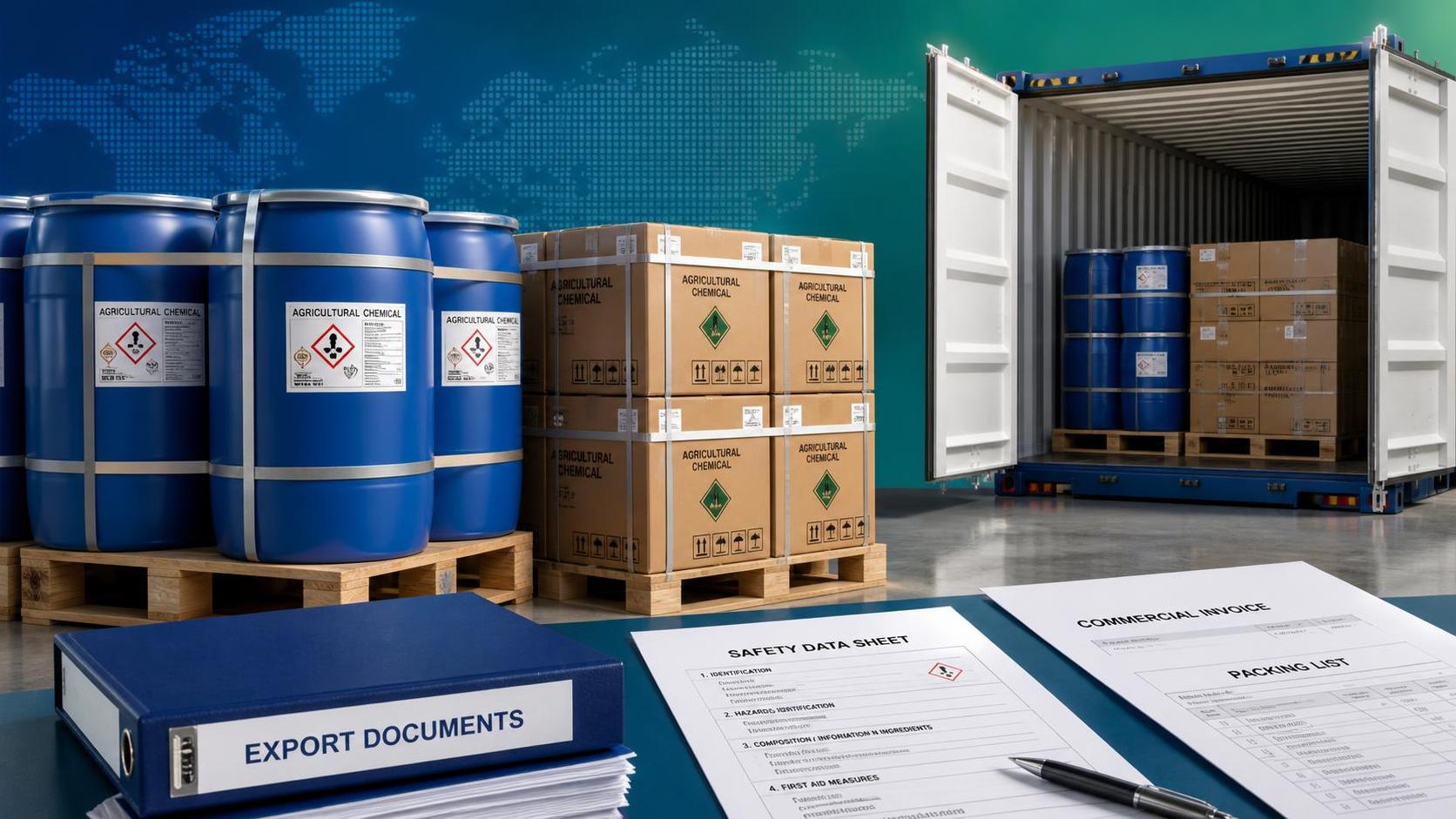
Moving an agricultural chemical from domestic distribution into export trade changes the job completely. What are the key differences between agricultural chemical export and domestic sales requirements? Domestic sales usually focus on meeting the rules of the country where the product is made and sold. Export shipments must meet those home-country obligations and the importing market's rules on registration, labels, packaging, hazardous-goods transport, customs documents, and often product stewardship.
The practical difference is simple: a compliant product for the local market is not automatically a compliant product for another country. A batch can meet its domestic specification, carry a valid local label, and still be stopped at the destination port because the active ingredient is not registered there, the language is wrong, or the shipping documents do not match the cargo.
What Are the Key Differences Between Agricultural Chemical Export and Domestic Sales Requirements?
The main distinction is that domestic compliance is usually based on one regulatory system, while export compliance is based on a chain of linked requirements. The exporter must control the product itself, the destination-market authorization, the shipment classification, the documents, and the information passed to the importer. Missing one link can delay customs clearance or make the goods unsellable after arrival.
Registration Is the First Gate, Not a Post-Shipment Detail
For crop protection products, plant growth regulators, adjuvants, fertilizers, and other agricultural inputs, registration is often the first question that should be answered. Many buyers assume an existing registration in the exporting country proves the product is acceptable abroad. It does not.
Each market may assess active ingredients, formulation types, impurities, toxicology data, efficacy claims, residue considerations, environmental impact, or permitted uses differently. Some countries regulate a product as a pesticide, while another market may classify a similar formulation under fertilizer, biostimulant, industrial chemical, or dangerous-goods rules. The commercial name on the drum is not enough to determine its regulatory path.
This creates a common and expensive mistake: production begins before the buyer, exporter, and importer have confirmed whether the exact formulation can legally enter and be sold in the destination market. “Similar to a registered product” is not the same as registered. A small change in concentration, solvent, co-formulant, pack size, or intended claim can affect the approval position.
Before accepting an export order, verify the product name, active ingredient or nutrient composition, formulation, intended use, destination country, and local importer status. The importer may hold a registration, but the exporter still needs written confirmation that the supplied product matches the authorized specification. Where official approval is required, current information should be confirmed through the relevant authority or qualified local regulatory adviser.
Labels Must Work at the Destination, Not Just at the Factory
Domestic labels are often designed around local laws and familiar distribution practices. Export labels have a different purpose: they must allow local regulators, customs officers, distributors, farm operators, and emergency responders to identify and use the product correctly in the importing country.
The destination market may require local-language content, specific hazard wording, a registration or authorization number, local emergency contacts, the name and address of a local responsible party, storage conditions, disposal instructions, batch traceability, and approved use directions. Some markets also control the claims that can appear on the label. A claim that is ordinary in one country may be treated as an unapproved pesticide claim elsewhere.
Translation deserves more attention than it usually receives. A literal translation can turn a technically correct label into an unsafe or non-compliant one. Units, application rates, hazard phrases, crop names, and first-aid instructions need technical review. The person translating marketing copy may not understand agricultural chemical terminology, and the person preparing transport papers may not know what appears on the retail label. These tasks need to be connected.
A good export control point is to compare the final artwork against the destination-market registration, safety data sheet, and commercial invoice before printing. The product name, net quantity, batch number format, and manufacturer or exporter information should not contradict one another.
Export Packaging Has to Survive the Supply Chain
Packaging for domestic delivery may only need to withstand short-distance handling in familiar conditions. Export packaging must survive warehouse transfers, container loading, sea or air movement, port exposure, customs inspection, unloading, and inland delivery. Agricultural chemicals may face heat, humidity, vibration, pressure changes, stacking, and long transit times.
That is why export packaging is not simply “stronger packaging.” It must be appropriate for the product's physical and transport characteristics. For hazardous materials, the packaging type, closure system, marks, and outer packaging may be governed by applicable dangerous-goods transport rules. For non-hazardous materials, leakage prevention, pallet stability, moisture protection, and clear identification still matter because damaged cargo can trigger claims or rejection.
Small details cause real disputes. A cap may perform well in a domestic truck delivery but loosen during container vibration. A carton may be acceptable in a dry warehouse yet lose strength in humid port conditions. A pallet pattern that looks efficient can make inspection difficult or compromise load stability. Exporters should validate packaging against the planned transport route, not only against factory handling.
Transport Classification Changes What Must Travel With the Cargo
Agricultural chemicals are not all transported under the same conditions. Some products may be classified as dangerous goods for road, sea, or air transport; others may not. The classification depends on the actual product and applicable transport rules, not on whether the product is marketed as an agricultural input.
Where dangerous-goods requirements apply, shipment preparation can involve correct classification, proper shipping name, UN number where relevant, packing group, package marks, labels, declarations, container loading practices, and carrier acceptance procedures. An inaccurate safety data sheet can create problems here. So can using a generic transport description copied from an older shipment without confirming that it applies to the current formulation.
Domestic distribution teams sometimes rely on established routes and familiar carriers, so documentation gaps remain hidden. International carriers and ports have less tolerance for ambiguity. They need documents that match the goods, the packing, and the booking. A mismatch between the invoice, packing list, SDS, and dangerous-goods declaration can stop a shipment even when the product itself is legitimate.
Customs Documents Are Evidence, Not Paperwork for Its Own Sake
In export business, documents tell the same story from different angles. Customs authorities, shipping lines, banks, insurers, and buyers all use them to identify the goods and assess whether they can move and be cleared.
A typical shipment may require a commercial invoice, packing list, transport document, certificate of origin where requested, safety data sheet, product specification, export declaration, and destination-side permits or registration evidence. The precise set depends on the product, destination, contract terms, and transport mode. It is risky to treat any checklist as universal.
The important discipline is consistency. Product description, quantity, package count, net and gross weight, batch information, country of origin, and consignee details should align across documents. If a product is sold by trade name but customs needs a chemical description, both should be clear enough to avoid confusion. Vague descriptions such as “agrochemical product” can invite questions when a more accurate description is available.
The Importer Is Part of Compliance
Exporters sometimes focus entirely on what leaves the factory. Yet the importer controls a critical part of market access. In many destinations, the importer, local registrant, or distributor must hold permits, maintain records, report incidents, manage local labeling, or meet storage obligations.
That does not mean the exporter can hand over all responsibility. It means responsibilities must be agreed before the first order. Who confirms registration status? Who approves the local label? Who supplies the emergency contact? Who handles a customs query? Who bears the cost if the shipment is rejected because the importer supplied outdated approval information?
These questions should be addressed in a compliance file and reflected in the sales contract where appropriate. A buyer who only asks for price, lead time, and packaging may still be a capable partner, but the regulatory conversation needs to happen before production is scheduled.
Domestic Flexibility Often Disappears in Export Trade
Local sellers may be able to make practical adjustments quickly: change a label version, use existing packaging inventory, deliver a substitute pack size, or revise a product description after speaking with a distributor. Export shipments are less forgiving. Changes made after documents are issued can affect customs declarations, carrier bookings, letters of credit, destination labels, and registration alignment.
This is particularly relevant for made-to-order products. A buyer may ask for private labeling, a lower minimum fill, or a different formulation. Those requests are commercial changes, but they may also be regulatory changes. Private-label artwork must still comply with destination rules. A revised formulation may require a new safety review. Smaller packaging may alter transport packaging needs.
The right response is not to reject every customization request. It is to separate changes that are commercially simple from changes that need regulatory confirmation. Experienced exporters build this review into quotation and order approval rather than discovering the issue when the container is already booked.
A Practical Pre-Export Check
Before confirming a first shipment to a new country, use a short cross-functional review. It should cover the exact product specification, destination registration status, approved label content, SDS accuracy, transport classification, package suitability, required export and import documents, and the importer’s local responsibilities.
For repeat orders, the same review should be lighter but not abandoned. Regulations, label approvals, carrier rules, and customer details can change. A “repeat” shipment is only routine when the product, destination, documents, and responsible parties are still the same.
Companies such as Shandong Huafeng Chemical, based in Shandong's established chemical manufacturing region, can be useful partners when buyers need an export supplier that understands the connection between product availability, documentation, logistics coordination, and overseas customer response. The relevant test is not a broad promise of export capability. It is whether the supplier can provide clear product information, maintain document consistency, respond to destination-specific questions, and work responsibly with the importer’s compliance process.
FAQ
Can a product registered for domestic sale be exported immediately?
Not necessarily. Domestic registration may allow manufacture or sale locally, but the importing country may require its own approval, permit, or registered importer. Confirm the destination status for the exact formulation before shipment.
Is an English label enough for every export market?
No. English may be accepted in some commercial situations, but many markets require local-language labeling or specific local wording. The destination authority and importer should confirm the final label requirements.
Does a safety data sheet prove a chemical can be imported?
No. An SDS supports safe handling and transport communication. It does not replace product registration, import authorization, customs documents, or local label approval.
Who is responsible if customs rejects the shipment?
Responsibility depends on the reason for rejection and the contract. The exporter, importer, and logistics providers all have roles. Clear pre-shipment verification and written allocation of responsibilities reduce disputes.
Make Compliance Part of the Sales Decision
The most useful answer to What are the key differences between agricultural chemical export and domestic sales requirements? is that export compliance is broader, more document-driven, and more dependent on destination-market coordination. Product quality remains essential, but it is only one part of a successful shipment.
For domestic sales, the central question is often whether the product can be legally supplied and used in the local market. For export, the question becomes larger: can this exact product, in this exact package, with these exact documents and claims, be legally transported, cleared, and sold in the destination country? Confirm that answer before production, not after the cargo reaches the port.
Send Us Your Inquiry Today
