









Product Quick Navigation
Get a Quote
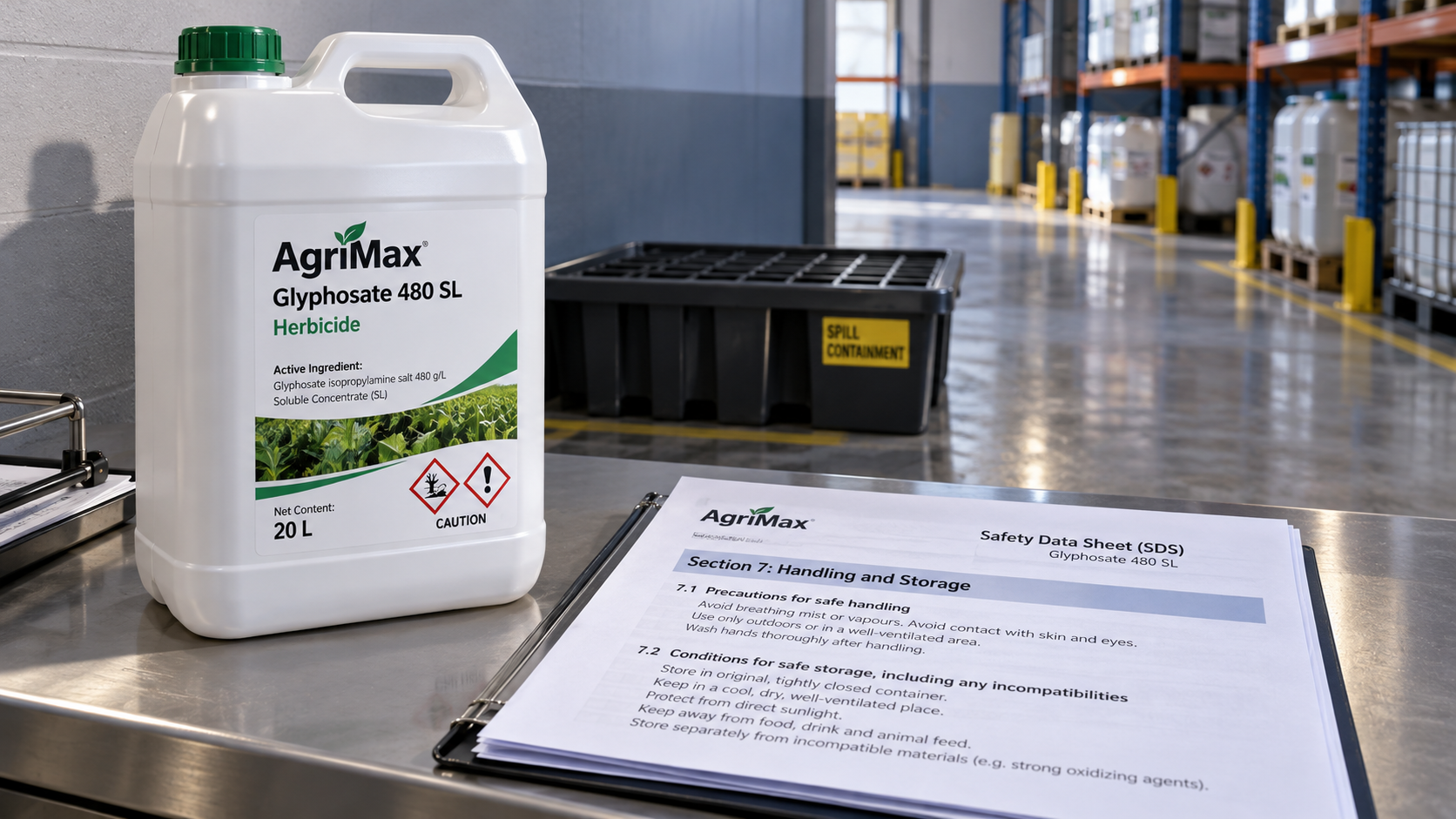
Determine herbicide storage requirements by starting with Section 7 of the product-specific safety data sheet (SDS), then checking its instructions against hazard classification, exposure controls, physical properties, and chemical incompatibilities. Verify the resulting storage conditions against the approved product label and applicable local requirements before authorizing a warehouse location.
A receiving team may encounter two herbicides with the same active ingredient but different formulations, packaging, or suppliers. Assigning both to the same storage bay without checking their documents can create fire, exposure, contamination, or product-stability problems. The storage decision must apply to the supplied formulation—not merely to the active ingredient’s name.
Confirm that the SDS matches the material received
Before interpreting storage language, compare the container label with Section 1 of the SDS. Check the product identifier, formulation or concentration where stated, supplier details, and intended use. A document for a technical active ingredient is not automatically suitable for a formulated commercial product containing solvents, surfactants, or other components.
Check the SDS revision date and confirm that the version is applicable to the destination market. An older date does not by itself invalidate a document, but unexplained differences between the label, purchase specification, and SDS require clarification. Obtain the applicable version from the supplier rather than substituting an SDS found for a similarly named product.
For receiving control, record the SDS identifier and revision alongside the product code. This provides traceability when a supplier changes the formulation or updates hazard information. Keep unidentified, leaking, or incorrectly documented containers in a controlled hold area appropriate to the known hazards until their status is resolved.
Read Section 7 as a starting point, not a complete warehouse specification
Section 7 normally addresses safe handling and storage conditions, including incompatibilities. Extract every instruction that affects the location, package, or operating procedure. Statements such as “protect from frost,” “keep container tightly closed,” and “store in a well-ventilated place” describe different controls; none should disappear into a generic instruction to “store safely.”
Use the other SDS sections to understand why those controls are necessary and whether additional measures are needed.
Sections 13, 14, and 15 can support waste planning, transport review, and regulatory checks. However, a transport classification does not by itself establish a compliant warehouse arrangement, and Section 15 should not be treated as an exhaustive statement of local storage obligations.
Turn temperature instructions into measurable limits
Temperature language is often where a usable storage procedure breaks down. “Cool,” “ambient,” or “protect from heat” may identify a concern without supplying a numerical operating range. Do not convert these terms into a universal temperature limit. Check the label and technical storage information, then request written clarification from the supplier when a measurable range is needed.
Distinguish safety limits from quality limits. A formulation may lose stability, crystallize, separate, or become difficult to redisperse before a temperature-related safety hazard develops. Conversely, an acceptable appearance does not demonstrate that the product remains within specification after an excursion.
- Where freezing is prohibited: assess loading docks, exterior walls, and overnight conditions, not just the warehouse’s average temperature.
- Where heat protection is required: consider roof-level temperatures, direct sunlight, heaters, and containers waiting outdoors.
- Where a numerical range is specified: establish monitoring locations, review frequency, alarm or escalation arrangements, and excursion handling.
- Where recovery instructions are absent: do not improvise heating, mixing, or reconditioning methods to restore appearance.
Refrigeration is not a default solution for chemical storage. For comparison, the supplied information for Amoxicillin trihydrate CAS#61336-70-7, a pharmaceutical material rather than a herbicide, specifies an inert atmosphere and 2–8°C storage. Those conditions belong to that material and must not be transferred to herbicides. The same product-specific discipline applies when reviewing a mixed chemical inventory: establish each material’s requirements before assigning storage space.
Separate ventilation needs from routine handling precautions
A sealed-container storage area and a dispensing station present different exposure conditions. Section 8 may specify local exhaust for operations that generate vapor, mist, or dust; this does not necessarily mean that every unopened package requires the same extraction arrangement. Equally, “keep tightly closed” does not eliminate exposure from damaged packaging or leakage.
Review Section 7 alongside volatility information in Section 9 and the hazards in Section 2. A solvent-containing formulation may require evaluation of flammable vapor accumulation and ignition sources. A powder may require dust controls during handling, with combustible-dust considerations assessed where relevant to its properties. Do not assume all liquid formulations are flammable or all powders have the same dust behavior.
Translate “well ventilated” into a site-specific engineering assessment rather than inventing a standard air-change rate. Relevant factors include storage quantity, enclosure size, expected releases, handling activities, and applicable fire or occupational requirements. Where flammable atmospheres could occur, ventilation equipment and electrical installations also need appropriate review.
Personal protective equipment supports particular tasks; it does not compensate for unsuitable storage. Define separately what is required for routine inspection, unloading, opening containers, and spill response.
Use incompatibility information to design segregation and containment
Section 10 identifies materials and conditions to avoid, while Section 7 may state specific segregation instructions. Translate these into physical arrangements that prevent incompatible contact during normal storage, leakage, or firefighting. Adjacent shelves may not provide meaningful separation if a release can enter a shared sump or flow into another storage bay.
Check the named incompatibilities rather than assigning every pesticide to a single compatibility group. Depending on the formulation, concerns may involve oxidizers, acids, alkalis, or other substances specifically identified in the SDS. The required separation method depends on the hazards, inventory, building arrangement, and applicable rules; the SDS rarely supplies a complete layout.
Preventing cross-contamination is a separate issue from chemical reactivity. Herbicides should not be allowed to contaminate food, feed, medicines, seed, or other sensitive goods. Products that do not react dangerously with one another may still need separate handling equipment or storage arrangements to prevent damaging contamination.
Check where a leak would actually go
Use Section 6 to review containment and cleanup provisions. Assess floor condition, drains, doorways, and shared collection points. Provide containment compatible with the formulation and size it according to the applicable requirements and site risk assessment. A generic percentage should not be copied into the procedure without confirming its legal and practical basis.
Spill materials must also be suitable for the product. Do not assume every absorbent, neutralizing agent, or cleaning chemical is compatible. Define how contaminated absorbents, damaged containers, and washings will be collected and managed, using the SDS and applicable waste requirements.
Keep package integrity within the storage decision
The original approved container is part of the product’s containment system. Follow label and SDS instructions on keeping containers closed, upright, protected from damage, or in original packaging. Do not transfer a leaking product into an arbitrary container: compatibility, closure performance, labeling, and any relevant packaging obligations must be assessed.
Warehouse inspections should look for wet cartons, staining, corrosion, bulging, damaged closures, and evidence of temperature exposure. External contamination can expose workers even when the remaining contents appear normal. Stacking limits and pallet arrangements should come from packaging guidance and the site assessment, not assumptions based on container size.
When deterioration is detected, separate the safety response from the quality disposition. First secure the area and control exposure under the appropriate procedure. Then determine whether the affected material can be released, returned, or disposed of. A sound replacement package does not prove that the contents remain suitable for use.
Resolve document gaps before approving the storage location
An SDS communicates hazards; it is not a certificate that a warehouse complies with pesticide, fire, building, environmental, or occupational requirements. GHS-based hazard communication does not create a single worldwide storage standard. Local implementation, stock quantities, building characteristics, and the approved product label can impose additional obligations.
Where documents appear inconsistent, do not simply choose the most convenient instruction—or assume that the apparently stricter instruction resolves every conflict. A low-temperature condition, for example, may conflict with freeze protection. Apply justified interim controls, restrict affected activities where necessary, and obtain clarification from the supplier or responsible regulatory authority as appropriate.
A useful approval record connects each requirement to evidence and an implemented control:
- Identify the source: record the applicable SDS revision, label, supplier clarification, or local requirement.
- State the control: specify the storage zone, temperature conditions, segregation, ventilation provisions, and containment arrangements.
- Show verification: retain inspection findings, monitoring records, or engineering assessments relevant to those controls.
- Define exceptions: establish who can assess temperature excursions, damaged packages, missing information, or proposed location changes.
Reassess the approval when the formulation, supplier, packaging, inventory quantity, or storage layout changes. An updated SDS may also alter the basis for an existing arrangement. Where a critical limit remains undefined, keep that uncertainty visible in the approval record rather than replacing it with an unsupported warehouse default.
Send Us Your Inquiry Today
