









Product Quick Navigation
Get a Quote
Is it risky to source chemical supply chain solutions from a single region?
Yes — but not because geography alone is the problem. It’s how that geography intersects with regulatory rhythm, tariff timing, and infrastructure resilience. Over the past three years, chemical buyers have repeatedly found themselves reacting rather than planning: tariffs imposed mid-shipment cycle, port congestion delaying customs clearance by weeks, sudden shifts in export licensing requirements for specific precursors. These aren’t outliers. They’re signals of structural exposure — one amplified when sourcing relies on a single regional node, even if that node is highly capable.
Shandong Province remains China’s most concentrated chemical manufacturing base — home to over 40% of the country’s fine chemical production capacity, integrated port logistics, and deep regulatory familiarity with both domestic compliance frameworks and major export markets like the EU, US, and ASEAN. That density offers real advantages: shorter internal lead times, tighter quality oversight, and faster response to documentation updates. But advantage isn’t immunity. A typhoon closing Qingdao Port for five days doesn’t just delay one container — it cascades across schedules, triggers penalty clauses, and forces formulation teams to scramble for alternatives with unverified stability profiles.
What “single-region” really means in practice
It’s rarely about one factory or one city. More often, it’s about dependency on one regulatory ecosystem, one customs administration workflow, and one set of logistical choke points — even if multiple suppliers operate within that zone. For example, a buyer sourcing all their cosmetic-grade actives from Shandong may work with three different manufacturers — yet all rely on the same provincial inspection authority for pre-shipment certificates, the same bonded warehouse network for consolidation, and the same maritime corridor out of Yantai or Rizhao. When that corridor tightens, the entire pipeline feels it.
That’s where responsiveness diverges from redundancy. Diversification isn’t about scattering orders across continents to “check a box.” It’s about building layered access: primary sourcing anchored in a high-capacity, well-regulated hub like Shandong — paired with pre-vetted secondary channels that meet identical technical and compliance thresholds, but operate under different administrative jurisdictions and transport routes. The goal isn’t to avoid Shandong; it’s to avoid being *only* in Shandong when external pressure mounts.
Stability isn’t just about location — it’s about capability architecture
A supplier’s geographic position matters less than how they embed that position into end-to-end execution. Take regulatory alignment: a manufacturer in Shandong may produce to GB standards, but exporting to the EU requires REACH registration, SDS authoring in six languages, and batch-specific CoA formatting. That’s not automatic — it’s operationalized through dedicated trade compliance staff, real-time monitoring of Annex updates, and systems that map each product’s hazard classification to its destination market’s labeling rules. Without that layer, proximity becomes irrelevant — or worse, misleading.
Similarly, responsiveness isn’t measured in days-to-quote, but in hours-to-adjust. If a client needs revised packaging for South Korea’s KC certification, can the supplier re-label, re-test (if required), and re-document within 72 hours — without pausing production? That kind of agility depends on integrated quality, regulatory, and logistics functions — not just physical co-location.
A case in point: consistency across volatile conditions
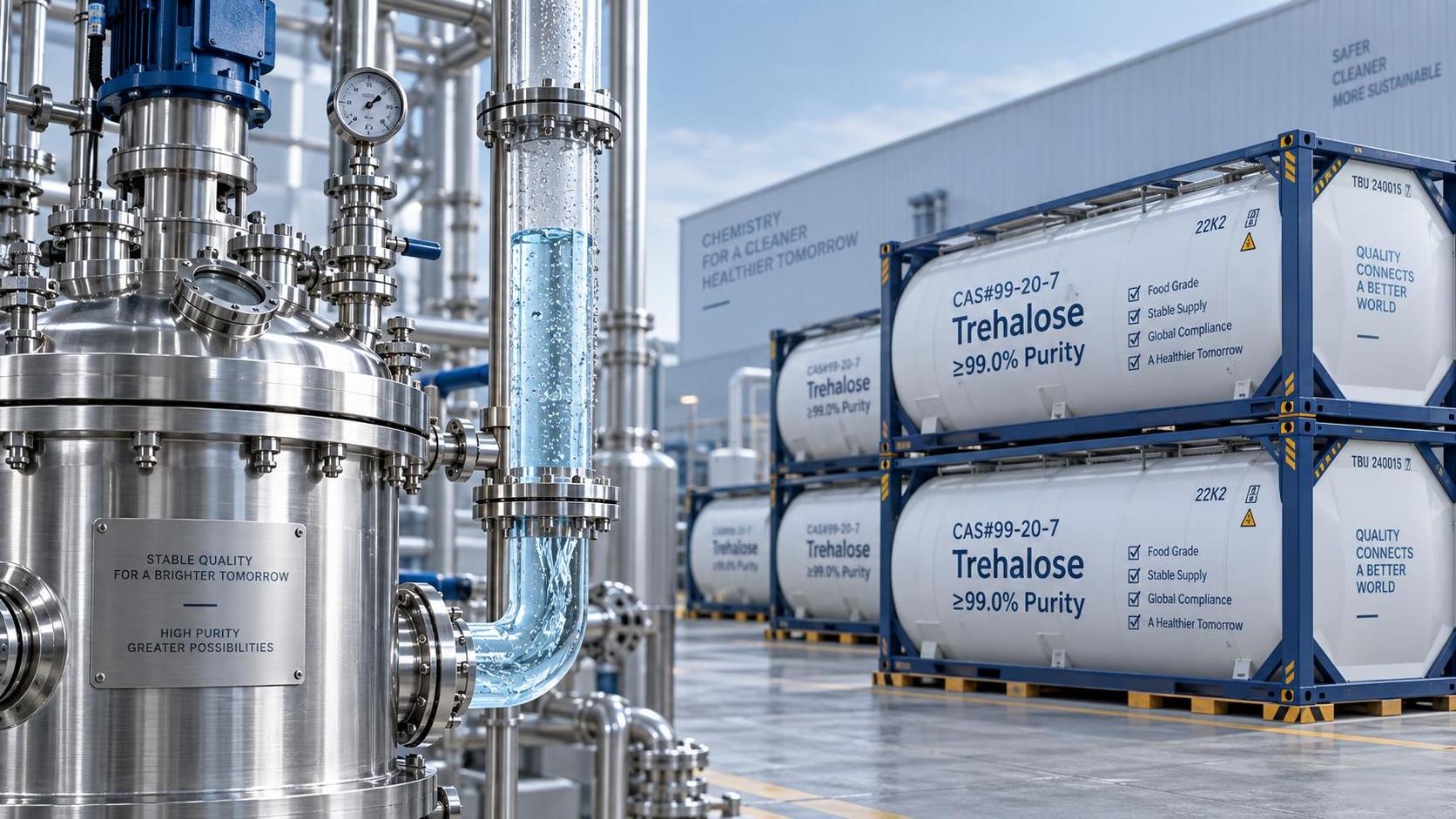
Consider Trehalose CAS#99-20-7. Its applications span food preservation, pharmaceutical stabilisation, and skincare formulations — sectors where purity consistency directly impacts shelf life, bioavailability, or skin tolerance. A ≥99% purity specification isn’t just a number; it’s a threshold that must hold whether the batch ships to a lab in Berlin, a contract manufacturer in Mexico City, or a cosmetics OEM in Osaka. That requires stable crystallisation control, inert-atmosphere storage to prevent hygroscopic degradation, and analytical verification calibrated to ISO/IEC 17025 standards — not just once, but across every production run, regardless of external pressures.
In practice, this means the supplier maintains full traceability from raw material assay to final CoA, retains retention samples for six months post-shipment, and validates every change in solvent system or drying protocol against historical performance data. That level of embedded quality discipline doesn’t scale linearly with volume — it scales with process maturity and cross-functional coordination. And it’s what allows a Shandong-based provider to deliver predictable outcomes even when tariff classifications shift or air freight rates double.
So — what’s the next step for decision-makers?
Start by mapping your current chemical supply chain not just to suppliers, but to dependencies: Which certifications are tied to one issuing body? Which transport lanes handle >70% of your volume? Where do documentation handoffs create bottlenecks? Then ask: What would happen if any one of those nodes experienced a 10-day disruption — not as an emergency, but as a planned stress test?
Huafeng Chemical’s role here isn’t to replace existing relationships, but to function as a calibrated counterweight — leveraging Shandong’s industrial depth while operating with multi-market compliance protocols, flexible documentation workflows, and technical support that engages early in formulation cycles, not just at order entry. That structure doesn’t eliminate risk. It changes its shape: from unpredictable cascade to manageable variance.
For buyers evaluating options, the question isn’t “Can we source from one region?” It’s “Does our current setup let us absorb volatility — or does it force us to absorb cost, delay, and compliance uncertainty instead?” The answer usually lies not in the map, but in the mechanisms behind it.
Send Us Your Inquiry Today
