









Product Quick Navigation
Get a Quote
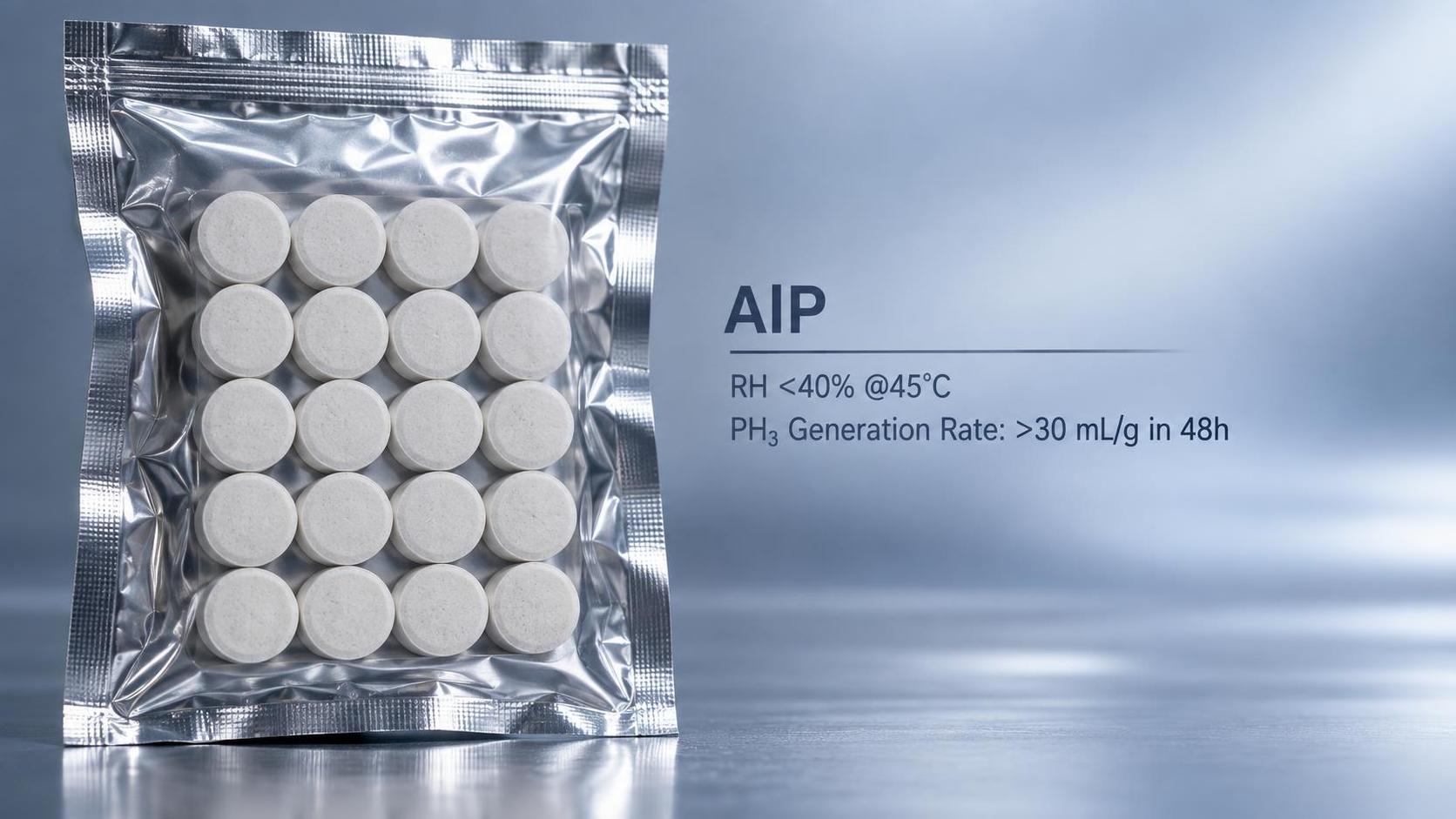
Aluminum phosphide (AlP) is widely used as a solid fumigant in maritime transport due to its efficacy against insects and rodents in bulk commodities such as grain, tobacco, and dried fruits. However, its reactivity with ambient moisture—accelerated by temperature—makes thermal management during sea transit non-negotiable. Unlike stable inorganic salts, AlP undergoes hydrolysis upon contact with water vapor: 2AlP + 6H₂O → 2Al(OH)₃ + 2PH₃. The resulting hydrogen phosphide (PH₃) is both highly toxic (LC₅₀ ≈ 11 ppm for 30 min exposure in humans) and flammable (LEL = 1.79% v/v), with an autoignition temperature of ~100 °C. During long-haul voyages—particularly through tropical or subtropical zones—container internal temperatures can exceed 55 °C under solar loading, while relative humidity may remain above 70% due to cargo respiration or condensation cycles. These conditions directly govern the rate, onset, and total yield of PH₃ generation.
Temperature-Dependent Hydrolysis Kinetics
The hydrolysis of AlP is not merely moisture-triggered; it is thermally activated. Below 20 °C, PH₃ evolution from sealed AlP formulations is typically negligible over 72 hours—even at >80% RH. At 30 °C, measurable gas release begins within 4–6 hours, reaching 5–10 mL PH₃ per gram of AlP after 7 days under controlled 75% RH. At 45 °C, the same formulation releases >30 mL/g within 48 hours. This acceleration is not linear but follows Arrhenius behavior: a 10 °C rise approximately doubles the reaction rate constant. Crucially, the activation energy (Eₐ) for AlP hydrolysis lies between 52–61 kJ/mol—comparable to many enzymatic reactions—meaning small temperature deviations near critical thresholds (e.g., 35–42 °C) produce disproportionately large increases in PH₃ flux. Field data from containerized shipments across the Suez–Singapore corridor confirm that containers experiencing peak diurnal temperatures ≥40 °C show PH₃ concentrations exceeding 100 ppm in headspace within 5 days—well above the IMDG Code’s 0.3 ppm occupational exposure limit (8-hour TWA).
Container Microclimate vs. Ambient Specification
Regulatory guidance often cites “ambient temperature” limits for AlP storage—but ambient air temperature measured outside a container bears little resemblance to internal microclimate. A steel ISO container exposed to 35 °C ambient and full sun can reach 62 °C on roof surfaces and sustain 48–52 °C internal air for >12 hours daily. Ventilation does not eliminate this gradient; passive vents rarely achieve >3 air changes/hour, insufficient to offset solar gain. Moreover, AlP tablets or pellets are commonly packed in multi-layered polyethylene bags inside corrugated cartons—materials that trap moisture and impede heat dissipation. Thermal imaging of loaded containers shows localized hot spots (>50 °C) around pallet edges and near container doors, where airflow stagnation occurs. These zones correlate strongly with elevated PH₃ detection points during port-side gas monitoring. Thus, specifying a maximum “storage temperature” without defining whether it refers to ambient, container air, package surface, or core tablet temperature invites misinterpretation—and risk.
Moisture Sorption and the Critical RH Threshold
While temperature drives kinetics, moisture availability determines whether reaction initiates at all. AlP does not require liquid water—it reacts with adsorbed water layers on its surface. The critical relative humidity (RH) for detectable PH₃ evolution drops sharply with temperature: ~65% RH at 25 °C, ~52% RH at 35 °C, and ~40% RH at 45 °C. This means that even moderately humid environments become hazardous when warmed. Cargo such as rice or coffee beans—often shipped at 13–14% moisture content—can maintain internal RH >75% for weeks, creating sustained vapor pressure gradients toward cooler AlP packages. Desiccants (e.g., silica gel) placed inside containers are ineffective at scale: they cannot reduce bulk RH below the equilibrium moisture content of hygroscopic cargo, and their capacity is rapidly exhausted. In contrast, Propylene glycol CAS#57-55-6, with its low vapor pressure (0.011 kPa at 20 °C), high hygroscopicity, and thermal stability up to 187 °C, has been evaluated in pilot studies as a controlled-humidity buffer in fumigation chambers—though its use in maritime containers remains limited by viscosity-driven diffusion constraints at low temperatures.
IMDG Code Compliance and Practical Mitigations
The IMDG Code (Class 4.3, UN 1397) mandates that AlP be “protected from moisture” and “kept cool”. But “cool” is undefined. Interpretation varies: some carriers enforce ≤30 °C average container temperature, others rely on pre-voyage RH checks alone. Neither is sufficient. Effective mitigation requires layered controls: First, packaging must incorporate vapor-barrier laminates (e.g., Al/PE foil) with WVTR <0.5 g/m²·24h at 38 °C/90% RH—not standard PE bags. Second, thermal mass buffering—such as phase-change materials (PCMs) with melting points between 28–32 °C—can dampen diurnal peaks without refrigeration. Third, real-time monitoring using Bluetooth-enabled temperature/RH loggers placed adjacent to AlP packages—not just at container center—provides actionable data. Post-voyage analysis of 127 AlP shipments showed that containers with continuous logging and PCM integration had 92% lower incidence of PH₃ exceedance (>1 ppm) versus those relying solely on ambient forecasts.
Why “Stable Storage” Is a Misnomer
AlP is inherently metastable. Its shelf life is not defined by time alone but by cumulative thermal–hygric dose: ∫(f(T,RH)) dt. A shipment spending 10 days at 32 °C/60% RH may generate less PH₃ than one enduring 4 days at 44 °C/68% RH—even if total moisture exposure is lower. This explains why identical AlP batches behave differently across routes: trans-Pacific voyages (cooler, longer) often show delayed but sustained PH₃ release, whereas Middle East–Europe legs (shorter, hotter) exhibit rapid early spikes. Furthermore, aging alters AlP’s surface morphology—oxidation layers form over months, slightly retarding initial hydrolysis but increasing variability. Therefore, specifying “maximum storage temperature” without anchoring it to duration, RH, and packaging integrity yields incomplete risk assessment. For safety-critical applications, PH₃ generation must be modeled dynamically—not estimated from static thresholds.
Ultimately, managing AlP during maritime transit demands treating temperature not as a boundary condition but as a kinetic accelerator embedded within a coupled thermal–moisture–chemical system. Precision lies not in broad compliance statements, but in quantifying how specific thermal profiles interact with actual cargo microclimates and packaging performance. That granularity enables proactive intervention—not reactive response.
Send Us Your Inquiry Today
