









Product Quick Navigation
Get a Quote
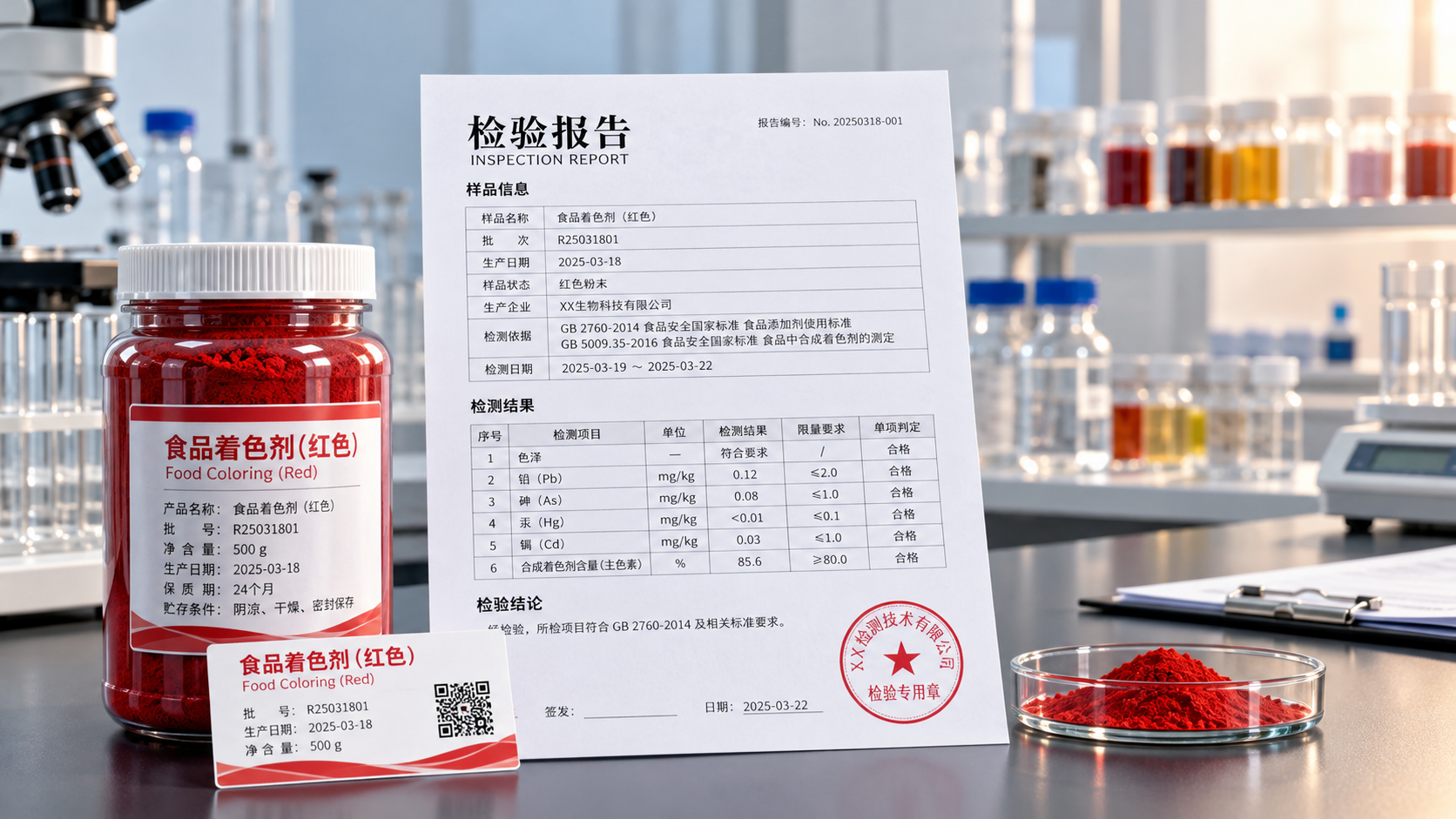
How can I verify a food colorants COA before importing? Start by confirming that the certificate of analysis matches the shipment’s product, manufacturer and lot number. Then compare the reported test results with an approved specification and the requirements of the destination market, including the permitted use, purity criteria and relevant contaminant limits. A COA is valuable evidence, but it is not, by itself, proof that a colorant is authorized or that the shipment is ready for release.
For a quality control or safety manager, the difficult moment often comes when the documents look plausible but do not quite agree: a shortened product name, a missing lot number or a result reported without a test method. The checks below turn those details into a practical import review.
Start with the shipment, not the “pass” statement
A supplier’s COA may describe an excellent product and still be the wrong certificate for the material in your warehouse. Gather the purchase order, product specification, packing list, container labels and COA before comparing individual results. Where available, include the manufacturer’s batch records or a supplier’s traceability statement.
Check that the following information can be reconciled across the documents:
- Product identity: Name, colorant designation, grade, form and relevant chemical identifiers. A trade name alone may not distinguish a pure colorant from a preparation or blend.
- Producer and supplier: The manufacturing site or legal manufacturer should be identifiable, even when an exporter, distributor or repacker issued the commercial documents.
- Lot or batch number: The COA must cover the lot printed on the containers. Record every lot in the shipment; one COA does not automatically cover several batches.
- Dates: Review manufacture, sampling, testing, issuance and expiry or retest dates where applicable. Investigate sequences that do not make sense, such as testing before the stated batch was manufactured.
- Quantity and packaging: Reconcile the number of containers and their labels with the packing list, including any split lots or relabeled packages.
Different lot formats are not necessarily a problem. A manufacturer and distributor may use different codes, but the link should be documented and traceable. Ask for a written cross-reference rather than guessing that two similar numbers represent the same batch.
Establish which requirements actually apply
Before judging a test result, define the regulatory context: the destination country, the colorant’s exact identity, its intended food application and the role of any carriers or other ingredients. Authorization can depend on the food category and conditions of use. A substance accepted in one market is not automatically accepted in another.
Use current official legislation and, where relevant, the applicable identity and purity specifications. For example, the United States has color additive regulations administered by the FDA, while the European Union has rules governing authorized food additives and separate specifications for their identity and purity. Depending on the market and substance, a recognized compendium specification may also be relevant. Confirm the applicable edition and legal status rather than relying on an old supplier template.
Keep three questions separate:
- Is the colorant permitted for the intended food and use level?
- Does the supplied material meet the applicable identity and purity specifications?
- Does it also meet the buyer’s agreed specification and import documentation requirements?
A COA primarily addresses the second and third questions, and only to the extent that it includes reliable, relevant data. It cannot establish the intended use in the finished food or replace a market-specific authorization review.
Read the test results as evidence
A useful COA gives the test, result, unit, acceptance criterion and method or method reference. “Conforms” may be acceptable for a genuinely qualitative identification test, but a blanket statement that the batch passes tells a reviewer little about a numerical purity or contaminant limit. Request the underlying result when the distinction matters to your release decision.
Pay attention to how results are expressed. For example, a limit in milligrams per kilogram should be compared with a result on an equivalent basis; moisture, dilution or a carrier can change the interpretation. Do not convert a result mechanically unless the specification permits the conversion and you have the necessary composition data.
For a result reported as “not detected” or “<” a value, check the laboratory’s limit of detection or quantification and its reporting convention. If the relevant limit is lower than the laboratory’s reporting limit, the result may not demonstrate compliance. Request a sufficiently sensitive validated method or further testing.
Look beyond heavy metals alone
Contaminant checks depend on the colorant. Relevant specifications may address individual toxic elements, subsidiary coloring matters, unreacted intermediates, residual solvents or other process-related impurities. Natural colorants can raise different questions from synthetic dyes, including contaminants associated with source materials and processing. Do not assume that a standard panel for one colorant covers another.
Also distinguish a complete food color preparation from its active coloring component. A diluted product can contain carriers or other additives that require their own identity, specification and use review. The COA should make clear what was tested and whether the results refer to the whole preparation or an individual ingredient.
Who tested the lot, and can the result be trusted?
Identify whether the COA was issued by the manufacturer, a distributor or an independent laboratory. Each arrangement can support a sound control program, but the document trail differs. A distributor-issued certificate should be traceable to the original batch data, especially if the material was repacked or relabeled. Ask who sampled the lot, where testing occurred and whether the listed results are batch-specific, periodic or based on a supplier declaration.
Where laboratory accreditation is relevant, verify it with the accreditation body and check the scope. ISO/IEC 17025 accreditation for one test does not mean every analyte or method on a COA is accredited. An unaccredited result is not automatically invalid, either; its suitability depends on the method, laboratory controls, regulatory requirements and the importer’s risk assessment.
Review the method reference and version when needed. If an in-house method replaces a specified method, request validation or equivalence information appropriate to the decision. Chromatograms, calibration records or full laboratory reports may be warranted for higher-risk imports, unusual results or a new supplier. They need not be requested for every routine lot, but the supplier should be able to explain how the result was generated.
Watch for certificates that look right but do not belong
Document authenticity deserves its own check. Confirm the issuer using contact details obtained independently from an established supplier record, not solely from an email accompanying the COA. Ask the issuer to verify the document number, revision, lot and reported results if anything appears inconsistent.
Warning signs include altered-looking dates, mismatched fonts around critical fields, repeated identical numerical results across unrelated lots, or a certificate that lists a manufacturer unable to confirm the batch. None of these alone proves fraud; templated documents and rounding can have ordinary explanations. They are reasons to pause and obtain an explanation before release.
Use the same discipline when a supplier’s portfolio spans food ingredients and industrial chemicals. For example, Caprolactam CAS#105-60-2 is described for industrial uses such as nylon fibers and plastics; it is not a food colorant. Its presence in a chemical exporter’s range should not be treated as evidence of food-grade suitability or as a substitute for a colorant-specific COA and regulatory review.
Decide what to do when a check fails
Place the affected lot on hold under the importer’s procedure while the discrepancy is investigated. The appropriate response depends on the risk: a missing unit may be resolved through an authenticated corrected COA, whereas an untraceable batch or a result above an applicable limit calls for a more serious assessment. Do not alter the certificate internally or treat a supplier’s informal reassurance as a correction.
Request a revised document with a clear revision date and traceability to the original, or obtain the supporting test report. If identity, contamination or document reliability remains uncertain, consider independent sampling and testing using a suitable method. Define the sampling plan carefully: a result from one container may not represent a heterogeneous lot or a shipment made up of several lots.
For a shipment containing multiple batches, make and record the decision for each lot. A compliant batch does not clear another batch with missing evidence. Where legal noncompliance or a significant safety concern is suspected, follow applicable reporting, rejection, return or disposal procedures with the relevant parties.
Build a release record that survives the next audit
Keep the COA with the approved specification, applicable regulatory assessment, shipment records, supplier correspondence, test reports and final disposition. Record who reviewed the evidence, which specification and version were used, and how discrepancies were resolved. If reliance is placed on periodic testing rather than a test for every lot, document the supplier qualification, risk rationale and verification arrangements.
Huafeng Chemical operates as a chemical export service provider with a broad product portfolio. When working with an exporter or intermediary, importers can ask for the manufacturer’s lot traceability and supporting test documentation early, before the goods are dispatched. That gives both commercial and quality teams time to resolve gaps without putting an incoming shipment under unnecessary pressure.
The most useful COA review ends with a defensible decision, not simply a checked box. Match the lot, confirm the applicable rules, understand the numbers and retain the evidence. If a critical link is missing, hold the material until the question is answered.
Send Us Your Inquiry Today
