









News
Product Quick Navigation
Get a Quote
Why yellowing deserves investigation
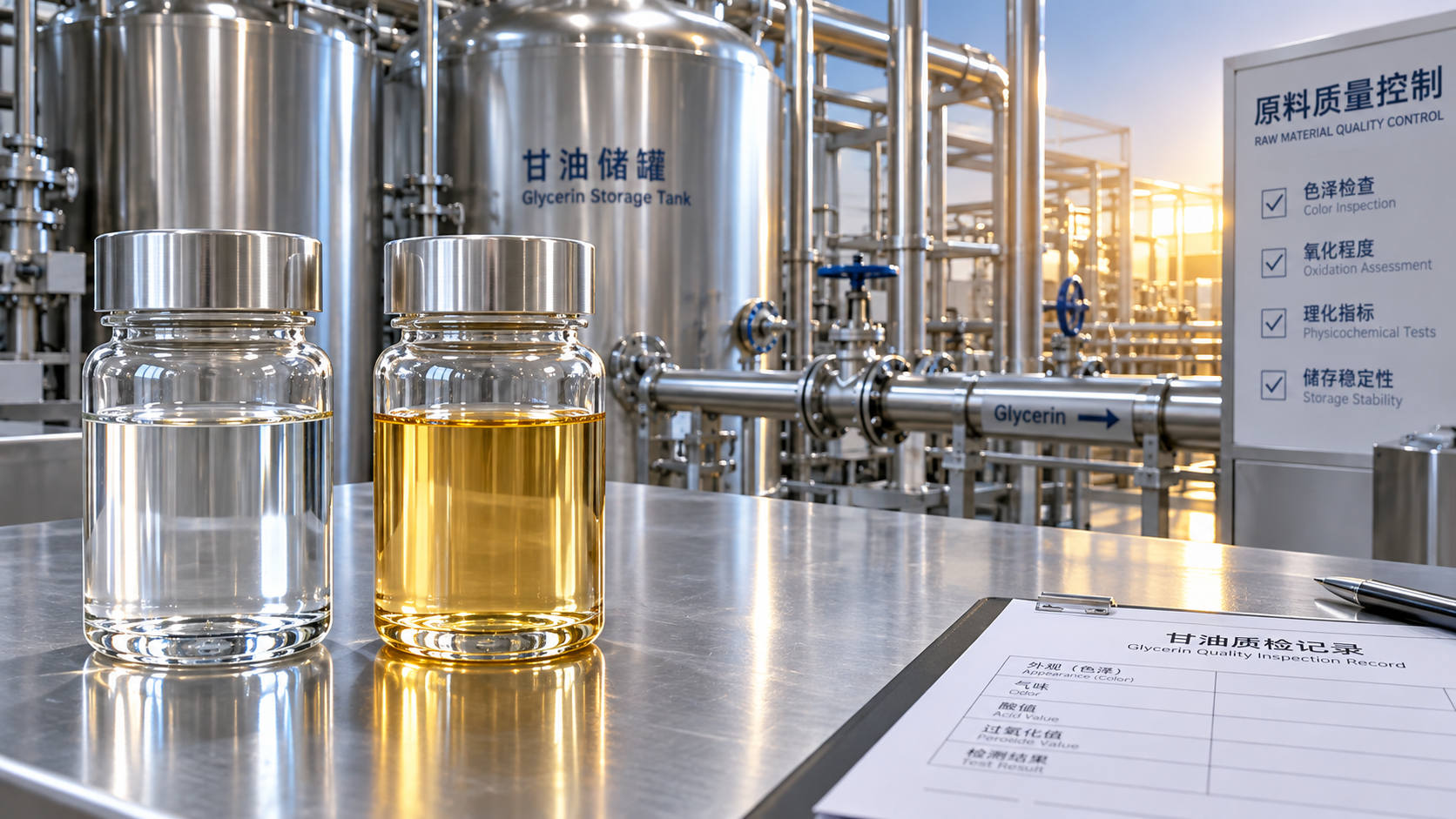
Fresh glycerol is generally expected to be clear and colorless. A yellow tint that develops during storage is therefore a quality signal, even when the material still appears homogeneous and has not formed visible sediment. The cause may be relatively limited, such as trace contamination from a closure or transfer hose, but it can also point to oxidation, prior thermal stress, or impurities that were already present when the product was packed.
The practical question is not simply whether the glycerol has changed color. Buyers and users need to establish whether the change is superficial, localized to the package, stable after mixing, or accompanied by changes in odor, acidity, water content, or downstream behavior. Color alone does not define fitness for use, but it should not be dismissed as a cosmetic issue when the application requires controlled purity, low color, or consistent formulation performance.
Glycerol itself is chemically stable under sensible storage conditions. Pronounced yellowing is more often associated with its environment, its production history, or contact with other materials than with normal aging of a high-purity product stored correctly. That distinction helps narrow an investigation quickly.
Oxidation and heat exposure can create color bodies
Oxidation is one of the first mechanisms to consider. Glycerol can undergo slow oxidative degradation when exposed to air, elevated temperature, light, or certain trace metals. The degradation products may be present at very low concentrations, yet still produce a noticeable yellow or amber cast in a normally colorless liquid.
Temperature is often the factor that turns a marginal storage condition into a visible problem. Long residence in a hot warehouse, storage near process equipment, exposure to summer heat during container transport, or repeated warming and cooling can accelerate reactions that would otherwise proceed too slowly to matter. High temperature can also amplify the effect of impurities introduced earlier in the supply chain.
Light exposure deserves similar attention, particularly where glycerol is held in translucent containers, clear intermediate bulk containers, or sight-glass-connected systems near windows or outdoor loading areas. Direct sunlight is more concerning than ordinary indoor illumination, but neither heat nor light needs to be extreme to create risk when storage time is long and product purity requirements are tight.
Oxidation-related yellowing does not always arrive with a strong odor or a dramatic analytical failure. In early stages, color may be the first visible warning. A buyer evaluating a suspect lot should compare it with a retained sample or an unopened package from the same shipment, then review whether exposure conditions differed after receipt.
Trace contamination is often more likely than bulk degradation
When only part of a delivery has yellowed, contamination is often a stronger explanation than a general stability problem. Glycerol is hygroscopic and readily handled through pumps, hoses, valves, storage tanks, drums, and dispensing equipment. Each contact point can introduce small amounts of foreign material. A few parts of colored organic residue, corrosion products, lubricants, cleaning agents, or previous cargo can be enough to affect appearance.
Common sources include:
- Iron, copper, or other metal contamination from poorly maintained transfer equipment, damaged linings, or unsuitable fittings.
- Rust particles or dissolved corrosion products from carbon-steel equipment where water ingress or inadequate internal protection has occurred.
- Residues from a prior product in a shared tank, hose, pump, or filling line.
- Migration from unsuitable packaging components, including low-quality caps, gaskets, liners, labels, adhesives, or recycled plastic containers.
- Cleaning chemicals that were not fully removed before the storage system was returned to glycerol service.
Metal contamination deserves particular scrutiny because some metals can promote oxidation as well as contribute color directly. A yellow product that becomes darker over time after transfer may reflect this combined effect. Visual inspection of the tank outlet, pump internals, filter housing, and closure materials can be as informative as testing the bulk liquid.
Packaging-related yellowing can be identified by its pattern. If the product near the cap, headspace, or container wall is darker than the bulk liquid, inspect the package before assuming the entire lot is off-specification. If multiple packages show the same uniform color, the source may be upstream, such as a production, bulk storage, or loading issue.
Production impurities may become more apparent in storage
Commercial glycerol can originate from different processes and can be supplied at different purity levels. Residual salts, organic matter, fatty-acid-related components, catalysts, soaps, esters, or process by-products may be controlled sufficiently for one application while remaining unsuitable for another. Storage may not create all of these impurities, but it can make their presence more visible through slow reaction, separation, or concentration effects.
This is especially relevant when a product was purchased to a broad grade description without a sufficiently specific quality agreement. A glycerol intended for technical use may be acceptable with a color level that would be inappropriate in a clear finished formulation, a resin system, a personal-care base, or a controlled laboratory process. The question is therefore not whether yellow glycerol is universally defective; it is whether it complies with the agreed specification and remains compatible with the intended use.
Water content can complicate the diagnosis. Because glycerol absorbs moisture from air, frequent opening of drums or poorly sealed storage can increase water content. Moisture itself does not necessarily cause a yellow color, but it can alter corrosion conditions, support contamination pathways, and change how the material performs downstream. In applications sensitive to concentration or viscosity, a color investigation should include water-content verification rather than treating appearance as an isolated parameter.
The same discipline applies in other chemical materials. A search such as “What causes PVC paste resin viscosity instability?” may lead to discussions of particle structure, plasticizer compatibility, temperature history, and contamination. Glycerol yellowing has different chemistry, but the operational lesson is similar: an outward change needs to be linked to material history, storage conditions, and the requirements of the final process before its significance can be judged.
How to investigate a yellowing complaint
Start by stopping unnecessary blending or transfer of the affected material. Mixing a questionable package into good inventory can erase useful evidence and enlarge the commercial problem. Keep the product identified by lot, container number, receipt date, and storage location.
Then compare samples in a controlled way. Draw representative samples from the top, middle, and bottom of the storage vessel where practical, as well as from an unopened package from the same lot. Observe whether color is uniform, whether haze or particles are present, and whether the appearance changes after the sample stands. A difference between levels can suggest contamination, stratification, or localized contact with equipment.
Analytical work should follow the intended use and the purchase specification. Color measurement provides an objective basis for comparison, but it should be accompanied where relevant by purity, water, acidity, ash, odor, and identity-related checks. If contamination is suspected, targeted investigation for metals or organic residues may be more useful than repeating only the standard release tests. A result can remain within one headline purity value while still being unsuitable for a color-sensitive application.
It is also important to review the certificate of analysis with care. A certificate confirms results for the tested batch at release; it does not explain a change that occurred after delivery. Compare the release value, the current result, retained samples, and storage records. This sequence separates an incoming-quality issue from a storage or handling issue and makes supplier discussions more precise.
Storage controls that reduce the risk
Glycerol should be stored in clean, compatible, closed containers with exposure to direct light and unnecessary heat minimized. The objective is not elaborate storage infrastructure for every grade, but consistent control over the factors that create avoidable variation.
- Use dedicated or thoroughly validated-clean transfer equipment, especially when the product is used in clear or purity-sensitive formulations.
- Confirm compatibility of tanks, hoses, pumps, seals, drum liners, caps, and filter media with glycerol and the required product grade.
- Keep containers tightly closed and avoid leaving partially used drums open during production interruptions.
- Protect stock from direct sunlight and prolonged high-temperature exposure during warehousing and transport.
- Use a defined first-in, first-out practice, while recognizing that age alone does not explain abnormal yellowing.
- Retain an incoming reference sample from each lot when color consistency has commercial or technical importance.
- Record storage location, transfer route, and package-opening events for material that will remain in storage for extended periods.
For bulk users, tank cleanliness and previous-cargo control often matter more than the nominal storage duration. A tank that has held a reactive, colored, or difficult-to-remove product can create recurring quality complaints even when each new glycerol shipment meets its release specification. Cleaning should be evaluated against the contamination risk, not treated as a generic maintenance step.
When yellow glycerol may still be usable
A pale color shift does not automatically mean that glycerol must be discarded. The decision depends on the agreed specification, the product grade, the severity and trend of the color change, and the sensitivity of the downstream application. Some technical processes may tolerate a minor appearance deviation if confirmatory testing shows that the properties affecting performance remain acceptable. Other uses may reject the same material because color can transfer into the finished product, obscure visual quality control, or indicate a process deviation that cannot be accepted.
Do not rely on dilution, filtration, or decolorization as an automatic remedy. Filtration may remove particulate contamination but will not correct dissolved color bodies. Blending can lower apparent color while spreading an uncertain material into compliant inventory. Chemical treatment may introduce new impurities or alter the product's status for its intended application. Any recovery approach should be evaluated against the original specification, processing controls, and regulatory obligations that apply to the finished use.
Yellowing in stored glycerol is best handled as a traceability and compatibility problem before it becomes a disposal problem. Establish whether the color came from heat and oxygen, equipment contact, package materials, or initial impurity levels. Once that source is identified, the corrective action is usually straightforward: improve storage conditions, isolate an unsuitable transfer route, tighten packaging control, or purchase against a specification that matches the actual downstream requirement.
Send Us Your Inquiry Today
