









Product Quick Navigation
Get a Quote
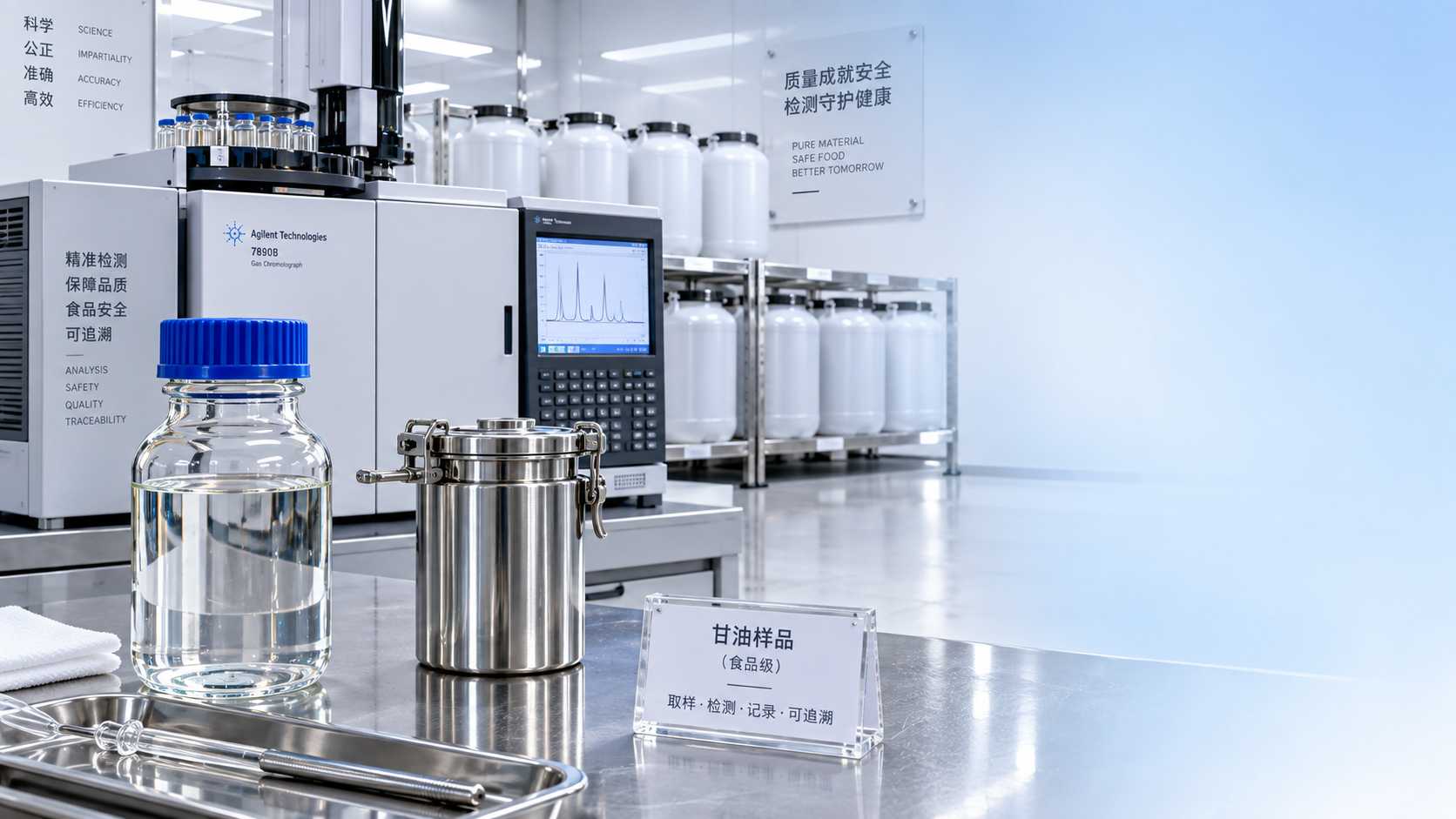
A food-grade glycerol purchase should be supported by more than a generic certificate of analysis. The report package should establish four things: the material is glycerol, its assay meets the agreed food-grade specification, relevant impurities are controlled, and the lot can be traced to the supplier’s quality system. For many buyers, the most useful documents are a batch-specific Certificate of Analysis (CoA), the underlying analytical test report when risk or audit requirements justify it, and supporting compliance documents that match the destination market and intended food use.
The practical question is not simply whether a supplier can provide a “purity certificate.” It is whether the documents describe the exact lot being shipped, use meaningful methods and limits, and cover the failure modes that matter for the application. A glycerol used as a humectant in confectionery, a solvent in flavor preparation, or a processing aid may all be food-grade, yet customers can impose different requirements for color, odor, water content, trace contaminants, packaging, and documentation.
Start with a batch-specific Certificate of Analysis
The CoA is normally the first report a buyer reviews. It should identify the product name, grade, batch or lot number, production date or retest date where applicable, quantity or packaging reference, and the analytical results for that specific lot. A template showing typical values is useful for preliminary qualification, but it does not verify the material that will actually arrive.
For food-grade glycerol, the CoA commonly includes the following core parameters:
- Glycerol assay or purity: This is usually the central result. The report should state the measured result, the specification limit, the unit, and preferably the analytical method. A high assay alone does not prove suitability for food use, but it confirms that the main component is present at the required concentration.
- Relative density or specific gravity: Density is a useful identity and concentration check. Because glycerol-water mixtures have predictable density behavior, an unexpected value may indicate dilution, incorrect concentration, or a material mix-up.
- Water content: Water may be measured directly or inferred through a related test, depending on the specification. It affects assay, viscosity, handling, formulation calculations, and microbial-control assumptions in finished foods.
- Color: A color result, often measured by a defined color scale or visual standard, helps assess appearance and possible degradation or contamination. The report must state which method or color scale was used; color values from different methods cannot be compared casually.
- Appearance and odor: These are basic release checks. Clear, colorless glycerol with no abnormal odor is generally expected for many food applications, although acceptance criteria should match the agreed grade.
- Residue, ash, or sulfated ash: This provides an indication of nonvolatile inorganic material. It can help reveal carryover from processing, salts, catalysts, or contamination.
A CoA becomes much more useful when it presents both the supplier’s specification and the actual test result side by side. A report that says only “Pass” provides less information for incoming quality review, trend analysis, and later investigation. Buyers also benefit from checking whether the lot number on the CoA matches the drum, IBC, tanker record, and shipping paperwork exactly.
Purity is an analytical package, not one assay number
Food manufacturers sometimes treat glycerol purity as a single percentage. That is understandable, because glycerol assay is easy to compare across quotations. Yet two lots with a similar assay can differ in their impurity profile, color stability, odor, and suitability for a sensitive formulation.
The analytical report should therefore show how the assay was determined and which related substances were controlled. Depending on the applicable grade specification and source route, relevant tests may include organic impurities, reducing substances, aldehydes, esters, diethylene glycol, ethylene glycol, chlorinated compounds, methanol, and other process-related substances. The exact list should follow the applicable specification, regulatory expectations, and risk assessment rather than being copied from an unrelated grade.
This distinction matters particularly when glycerol is supplied through international trading channels. Material may originate from different feedstocks or manufacturing processes, and the stated assay may not reveal whether the impurity controls are comparable. A buyer should ask which contaminants are included in the release specification, which are tested periodically rather than on every batch, and whether any result is reported as “not detected” without a stated detection limit.
For contaminants that may create a food-safety concern, “not detected” is incomplete unless the test method is capable of detecting the substance at a suitably low level. The report should ideally identify the method, reporting limit, and specification limit. This is especially important where an end user has internal limits that are tighter than a general commercial specification.
Method information gives the result context
A test result has limited value without enough method information to interpret it. Buyers do not necessarily need a full laboratory validation package for every order, but they should be able to understand the basis of the reported result. A sound analytical report or CoA normally identifies a recognized compendial method, an internal method with a controlled reference, or a suitable instrument method such as gas chromatography, high-performance liquid chromatography, titration, or Karl Fischer water determination.
Method selection depends on the parameter. Gas chromatography may be appropriate for glycerol assay and certain volatile organic impurities. Karl Fischer titration is widely used where precise water determination is required. Color may be measured instrumentally or against a defined standard. The essential point is consistency: the method, unit, and acceptance limit should remain comparable from lot to lot unless the buyer has approved a formal change.
When a supplier changes the test method, that does not automatically mean the material has changed. It can, however, disrupt historical comparison. For critical food formulations, change notification should cover the method revision, reason for the change, possible impact on reported values, and any altered specification wording.
Which supporting documents should accompany the CoA?
A batch CoA verifies released test results, but it does not answer every compliance question. The supporting document set should be proportionate to the product’s intended use and the buyer’s regulatory obligations.
Where a customer requires compliance with a pharmacopeial or food chemicals specification, the document should identify the exact standard and edition or the agreed specification revision. Broad wording such as “meets international standard” creates room for disagreement because food-grade requirements vary by market, product category, and contractual specification.
A food-contact statement may also be needed if glycerol is used in a process involving packaging or indirect food contact, but it should not be confused with a food-grade material declaration. Likewise, a safety data sheet is important for transport and workplace handling, yet it is not a purity report and usually cannot replace a CoA.
Why does glycerol color change during storage?
Glycerol is generally expected to remain clear and colorless when it is suitably produced, packaged, and stored. A developing yellow, amber, or brown tint deserves investigation, especially when the buyer’s application depends on visual clarity. The color change may be minor and remain within a stated limit, but it should not be dismissed simply because the glycerol assay is still high.
Oxidative degradation is one possible cause. Exposure to air, elevated temperature, light, or metal contamination can contribute to the formation of colored degradation products in susceptible conditions. The likelihood depends on the initial impurity profile, storage temperature, headspace conditions, package cleanliness, and storage duration. Repeated heating cycles can be more problematic than steady storage at a controlled moderate temperature.
Contamination is another common explanation. Glycerol is hygroscopic and can absorb moisture after a container is opened. Water uptake does not necessarily cause color on its own, but it can alter the material and increase the consequences of poor handling. Residue from transfer hoses, pumps, valves, tank linings, rust particles, unsuitable gaskets, or previously handled products can affect color and odor. A drum that arrives colorless but darkens after transfer points attention toward the receiving system rather than the original lot.
Storage conditions should therefore be reviewed as a system. Keep containers tightly closed, use clean and compatible transfer equipment, avoid unnecessary exposure to heat and direct sunlight, and prevent contact with incompatible residues. Bulk users should define cleaning and line-release procedures for dedicated or shared equipment. For opened packages, the retention period and resealing method should be controlled because the original unopened-package storage recommendation may no longer apply.
Color data should be trended rather than viewed as a one-time pass/fail result. If incoming glycerol is within color specification but finished product appearance drifts during storage, compare retained samples from the original package, samples after transfer, and samples held under actual warehouse conditions. This can separate supplier-related variation from handling-related contamination or formulation interactions.
How to review a supplier report before approving a shipment
A practical review can be completed without turning routine purchasing into a laboratory audit. Start by matching the CoA to the purchase specification. Confirm the grade, lot number, package identity, assay basis, and test limits. Then focus on the tests that could create the greatest consequence in the finished application: water for concentration-sensitive formulas, color for clear products, odor for flavor-sensitive products, and specific trace contaminants where required by the customer or destination market.
Next, compare the result with previous approved lots. A lot can meet every individual limit yet still represent a meaningful shift. For example, a color result near the upper acceptance limit, a density shift, or an assay trend may justify additional review before it enters a tightly controlled process. Trending does not replace specifications; it helps identify variation before it becomes an out-of-specification event in the finished product.
For a first purchase, a new source, a new production site, or a high-risk application, request more than the standard CoA. The appropriate additional evidence may include a detailed impurity report, a sample for independent verification, manufacturing-site information, confirmation of packaging materials, and a documented change-control commitment. The buyer does not need every record for every shipment, but the initial qualification should establish what will be tested routinely and what changes require notification.
Incoming testing remains valuable even when supplier documents are strong. Identity confirmation, appearance inspection, density or refractive-index screening, water determination, and color testing can provide rapid evidence that the received material matches expectations. The scope should reflect the buyer’s risk assessment, process capability, and the consequences of a failure. A high-volume user with a validated supplier may use reduced testing under an approved program; a buyer serving sensitive food applications may need more frequent confirmation.
Use the report package to make a release decision
The best report package makes a clear release decision possible. It links the shipment to a traceable batch, shows the relevant measured properties, identifies the test basis, and supports the food-grade claim with documentation that fits the intended market. A high purity number remains important, but it should be read alongside water, color, odor, residue, and targeted impurity controls.
When glycerol changes color during storage, the response should be equally evidence-based: inspect retained samples, verify storage and transfer conditions, compare color results before and after handling, and determine whether the shift is associated with oxidation, contamination, or packaging and equipment practices. That approach protects both product quality and the integrity of the supplier qualification process.
Send Us Your Inquiry Today
