









Product Quick Navigation
Get a Quote
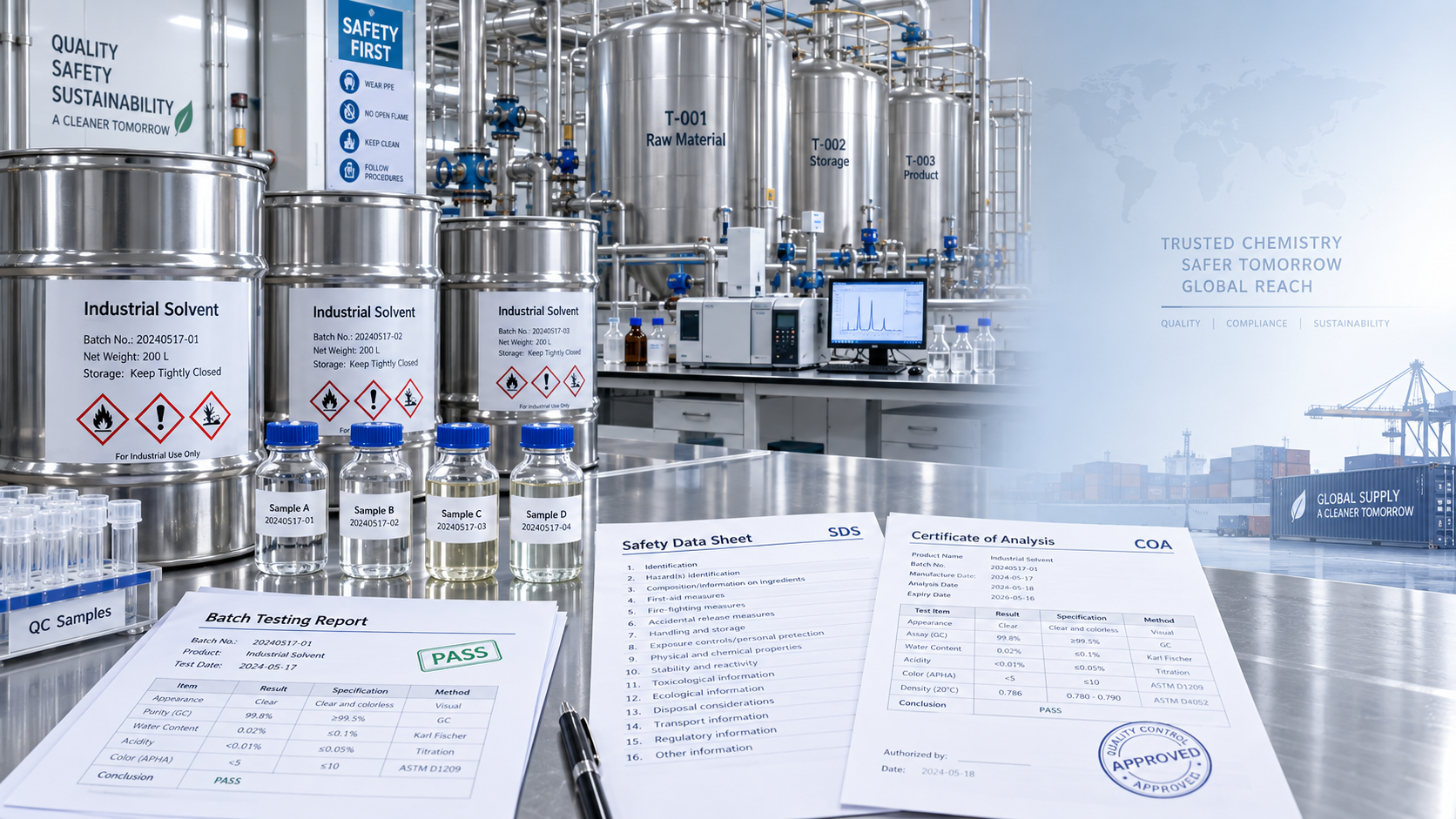
What Documentation to Request When Buying Industrial Solvents
Buying Industrial Solvents is rarely just a question of unit price, packing size, and shipment date. A solvent may look interchangeable on a quotation, yet differ in water content, purity, inhibitor level, residue, origin, or transport classification. Those differences can affect coating quality, cleaning performance, worker safety, customs clearance, storage arrangements, and the actual landed cost of a purchase.
For procurement teams, documentation is the practical evidence behind a supplier’s offer. It tells you what material is being supplied, whether the lot meets the agreed specification, how it must be handled, and whether it can legally move through the intended route and market. Requesting documents early also prevents a familiar problem: discovering after production planning has begun that the proposed solvent cannot be accepted by EHS, quality control, a freight forwarder, or the importing country.
The best approach is not to ask every supplier for a generic “certificate pack.” Instead, request documents in stages: technical information for qualification, compliance and logistics records before shipment, and lot-specific evidence before release or payment. That sequence gives purchasing, operations, and compliance teams enough information to make decisions without turning routine sourcing into paperwork for its own sake.
Start with a precise product identity
Before comparing bids, ask for a technical data sheet (TDS) or product specification sheet. This is the basic document for confirming that suppliers are quoting the same material. It should identify the chemical name, CAS number where applicable, grade, intended use, typical or guaranteed specification, physical appearance, and relevant test methods. For solvent blends, the document should make clear whether the blend is fixed by composition, performance specification, or a broader commercial description.
The distinction matters. “Acetone,” “IPA,” “MEK,” “aromatic solvent,” or “cleaning thinner” may be used loosely in commercial conversations, but a manufacturing process needs a defined standard. A printing operation may care about evaporation profile and residual moisture. A metal cleaning line may focus on non-volatile residue, acidity, and compatibility with seals. A coatings plant may need a particular solvent balance rather than a single compound. If the TDS does not state the parameters that affect your process, provide the supplier with your own purchase specification and ask whether compliance can be guaranteed lot by lot.
Also confirm the product’s commercial identity across all records. The name on the quotation, TDS, Safety Data Sheet, Certificate of Analysis, label, and shipping papers should not create ambiguity. A mismatch may be an administrative error, but it can also delay import clearance or make internal approval difficult. This check is especially important where a trade name, a mixture name, and a chemical name are all in use.
The documents that should be requested before approval
Safety Data Sheet: more than a safety form
A current Safety Data Sheet (SDS) is essential for nearly every industrial solvent purchase. It supports hazard communication, workplace risk assessment, emergency planning, warehousing decisions, and transport preparation. Review the SDS as a working document, not simply as a file to archive.
Pay particular attention to composition, hazard classification, flash point, exposure controls, personal protective equipment, first-aid guidance, firefighting measures, accidental-release procedures, storage conditions, and transport information. For flammable liquids, details such as UN number, proper shipping name, hazard class, packing group, and marine pollutant status may determine whether a carrier accepts the shipment and what surcharges apply. A solvent’s safety profile may also affect whether it can be stored with other chemicals already held at your site.
The SDS should be appropriate for the destination market and available in the language or format required by local rules. Requirements vary by jurisdiction, so buyers should not assume that a document prepared for the supplier’s domestic market is sufficient for import, workplace use, or downstream distribution. Ask who is responsible for reviewing destination-specific requirements and whether the supplier can provide a revised SDS when the local format differs.
Certificate of Analysis: the evidence for the lot you will receive
A Certificate of Analysis (COA) connects the agreed specification to the actual batch. It should include a batch or lot number, test results, applicable specification limits, test methods where relevant, date of manufacture or testing, and clear product identification. For many Industrial Solvents, the priority tests include assay or purity, water content, density, distillation range, color, acidity, non-volatile matter, and flash point. The correct list depends on the product and application.
Do not treat a typical analysis sheet as a COA. Typical values describe a product in general terms; they do not prove the quality of the planned shipment. If a supplier offers a pre-shipment COA, ask whether it represents the final packed lot or a production sample taken before filling. For critical materials, clarify the sampling point, retention sample practice, and how a quality claim will be handled if your incoming inspection differs from the certificate.
A COA is also where buyers can identify false savings. A lower-priced solvent with wider allowed water content or non-volatile residue can generate costs later through rework, filter blockage, inconsistent drying, higher consumption, or rejected finished goods. Cost comparison should therefore begin with a common quality basis, not a price per drum alone.
Regulatory status and restricted-substance information
Ask the supplier for a written regulatory-status statement relevant to the country of import and end use. Depending on the market and substance, this may include confirmation of inventory status, registration or notification responsibilities, restricted-substance declarations, or statements covering specific customer requirements. The right request depends on the solvent, its concentration in a mixture, the import route, and whether your company is importing for its own use or placing the product on the market.
Avoid accepting broad language such as “compliant with all regulations” without defining the market and scope. A useful statement identifies the product, version date, intended jurisdiction, and limitations. It should also distinguish between the supplier’s declaration and obligations that may fall on the importer, distributor, or downstream user. When the purchase involves controlled, highly hazardous, or application-sensitive materials, internal legal or regulatory review may be necessary before the order is released.
The same discipline applies beyond solvents. For example, a buyer evaluating Potassium hexafluorozirconate CAS#16923-95-8 for metal processing or catalyst-related work would need to review its own hazard and transport records rather than rely on solvent documentation. Its supplied classification information identifies UN 3288, Class 6.1, Packing Group III, which illustrates why product-specific paperwork must drive storage and logistics decisions.
Documents that protect the shipment, not just the product
International chemical sourcing introduces another layer of documentation. The commercial invoice, packing list, and transport documents must describe the goods consistently and accurately. The invoice should show the agreed product description, quantity, unit price, currency, Incoterm, and seller and buyer details. The packing list should allow receiving staff to reconcile drum, IBC, or container quantities against the purchase order. Differences between these documents are a common source of customs queries and receiving disputes.
For hazardous solvent shipments, request the dangerous goods declaration or equivalent transport documentation required for the chosen mode. The actual form varies by air, sea, road, rail, and route, but the underlying issue is the same: the carrier needs the correct classification, packaging information, emergency contact details where required, and shipper declaration. Freight can be delayed when documentation is completed from an outdated SDS or when the stated package type does not match the goods presented for loading.
A bill of lading, sea waybill, air waybill, or other transport record becomes important once goods are dispatched. Depending on the transaction, buyers may also need a certificate of origin, insurance certificate, fumigation-related records for wooden packaging, or destination-specific import documents. These should be identified during contract review, not requested after the vessel has sailed. Customs classification deserves the same early attention: the HS code proposed by a supplier can be useful, but the importer should verify the classification used for its own declaration.
Supplier records that reveal operational reliability
Product documents answer “what is it?” Supplier records help answer “can this company deliver it consistently?” Request the legal entity name, registered address, bank details through a controlled verification process, and the manufacturing or sourcing role. A trading company can be a capable partner, but it should be transparent about whether it controls manufacturing, holds inventory, manages export documentation, or sources from third parties.
For repeat purchases, ask about traceability, change-control practice, shelf-life policy, standard packaging, loading controls, and how the supplier handles nonconforming material. A concise written quality agreement or purchase-order attachment can be more valuable than a long promotional presentation. It should define the approved specification, documents required before shipment, labeling requirements, notification of manufacturing changes, acceptance criteria, and the process for claims.
Supply chain resilience is not proven by a single certificate. It is shown through clear answers about lead time, production scheduling, stock availability, alternate packaging, export readiness, and communication when conditions change. In a global market, responsiveness matters because a late document can be as disruptive as a late container.
This is one reason chemical export service providers are increasingly evaluated on coordination as well as product range. Based in Shandong Province, a major chemical-industry hub in China, Huafeng Chemical supports overseas clients through comprehensive foreign-trade services and an extensive portfolio. For buyers, the useful question is not whether a supplier claims broad capability, but whether the responsible team can align technical records, batch evidence, packaging details, and export papers for the specific material being ordered.
A practical review sequence before issuing a purchase order
A disciplined review does not need to slow down purchasing. It can be built into the approval workflow. Start by matching the TDS against the internal process specification. Review the SDS with EHS and logistics if the solvent is flammable, toxic, volatile, or otherwise regulated. Confirm that the supplier can issue a batch-specific COA containing the agreed tests. Then identify import, labeling, transport, and customs documents based on the intended delivery term and destination.
- Do the quoted product name, CAS number, grade, and specification match the purchase requirement?
- Is the SDS current, suitable for the destination, and consistent with the proposed transport classification?
- Will the COA be batch-specific and available before shipment or before final payment, as agreed?
- Are packaging, labels, palletization, and container loading compatible with carrier and site requirements?
- Who prepares each export document, and who bears responsibility when a document is incomplete or inconsistent?
Keep approved versions in one controlled location and record which documents were reviewed for each supplier and product grade. That record becomes useful when a new buyer joins the team, when a shipment is questioned at the port, or when an internal audit asks why a material was approved.
Documentation is part of total solvent cost
The lowest quotation is not necessarily the lowest procurement cost. Missing or weak documentation can lead to demurrage, storage charges, rejected cargo, additional testing, production interruption, emergency repacking, or compliance exposure. Conversely, excessive document requests can waste time if they are unrelated to the product’s hazards, application, or destination requirements.
The sensible standard is evidence proportionate to risk. For a routine, well-defined solvent bought repeatedly from an approved source, a current SDS, specification, batch COA, and standard shipping pack may be sufficient. For a new supplier, a new import market, a high-value process, or a hazardous shipment with complex routing, deeper verification is justified. Put the document list into the quotation request and purchase order, then make acceptance of those documents a normal part of release planning. That is how procurement turns paperwork into a practical control over quality, compliance, and cost.
Send Us Your Inquiry Today
