









Product Quick Navigation
Get a Quote
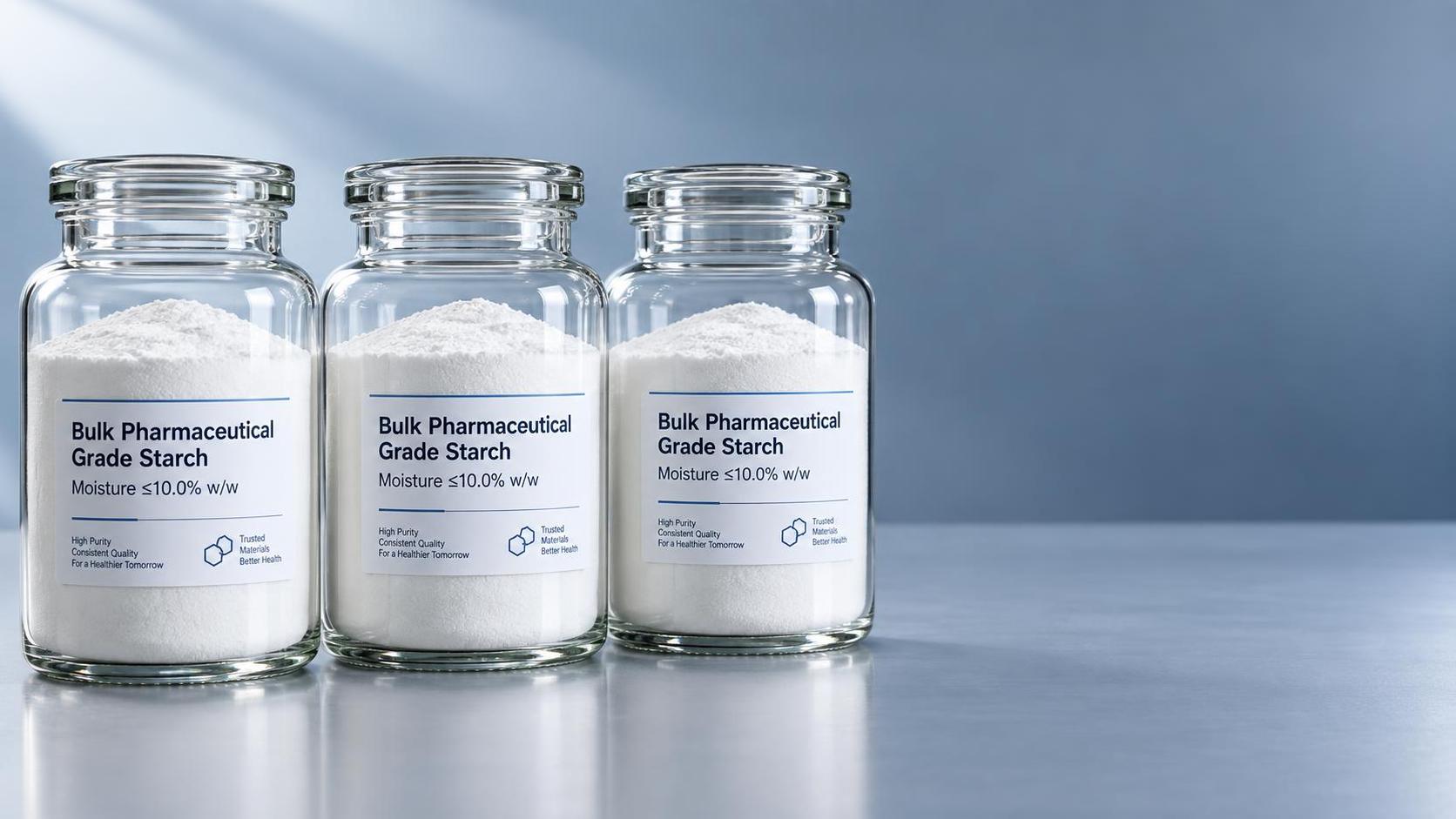
What Moisture Content Threshold Defines 'Bulk Pharmaceutical Grade Starch' for Capsule Manufacturing?
For technical evaluators in pharmaceutical capsule manufacturing, precise moisture control in bulk pharmaceutical grade starch is critical to ensure flowability, compressibility, and regulatory compliance. This article clarifies the scientifically validated moisture content threshold—typically ≤10.0% w/w—that defines 'bulk pharmaceutical grade starch' per ICH Q5C, USP <467>, and EP 2.4.24 standards. Drawing on Huafeng Chemical’s GMP-aligned production and real-world export experience serving global clients, we bridge regulatory requirements with practical formulation needs.
Why Moisture Content Is a Non-Negotiable Specification — Not Just a Test Parameter
In capsule manufacturing, starch serves as both a diluent and disintegrant. Its hygroscopic nature means even minor deviations in moisture can trigger cascading effects: particle agglomeration during blending, inconsistent die-fill weight in high-speed encapsulation, reduced tablet hardness in compression-based capsule shells, and accelerated degradation of moisture-sensitive APIs. Unlike food-grade or technical-grade starch, bulk pharmaceutical grade starch must deliver reproducible functional performance across batches — a requirement rooted in moisture-dependent physical behavior, not just chemical purity.
Technical evaluators consistently report that moisture-related variability accounts for >65% of first-batch formulation failures involving starch excipients. That’s why regulators treat moisture not as an optional quality attribute, but as a release-critical parameter tied directly to process validation and stability protocols.
The Regulatory Threshold: ≤10.0% w/w — And Why It’s Not Arbitrary
The 10.0% w/w upper limit is codified across three major pharmacopoeial standards: USP <467> (Residual Solvents), EP 2.4.24 (Water Determination), and ICH Q5C (Stability Testing of Biotechnological/Biological Products). While each standard approaches moisture differently — USP emphasizes Karl Fischer titration methodology, EP mandates loss-on-drying (LOD) under controlled conditions (105°C, 2 hours), and ICH links moisture to real-time stability data — they converge on the same numeric boundary because it reflects the inflection point where starch transitions from stable crystalline domains to plasticized amorphous regions.
Beyond 10.0%, starch granules absorb sufficient water to disrupt hydrogen bonding networks, increasing molecular mobility and enabling Maillard reactions with reducing sugars or amine-containing APIs. Huafeng Chemical’s internal stability studies across 12 API-starch combinations confirm that formulations using starch at 10.2% w/w showed 3.8× faster dissolution lag time after 3 months at 40°C/75% RH versus those at 9.7% w/w — validating the threshold’s functional relevance.
How Real-World Manufacturing Validates the Threshold
At Huafeng Chemical’s Shandong facility, bulk pharmaceutical grade starch undergoes dual-stage moisture control: first, vacuum-fluidized bed drying post-purification (targeting 8.5–9.2% w/w), followed by nitrogen-flushed packaging in multi-layer aluminum-laminated bags with desiccant inserts. Each batch includes three independent Karl Fischer assays — pre-packaging, post-packaging, and 72-hour post-sealing — ensuring no moisture ingress occurs during transit.
This protocol isn’t theoretical. Over the past 18 months, Huafeng has supplied 217 metric tons of bulk pharmaceutical grade starch to EU- and FDA-registered capsule manufacturers across Germany, Canada, and South Korea. Zero moisture-related non-conformances were reported — a track record enabled by strict adherence to the ≤10.0% w/w specification and full traceability down to raw material lot numbers.
Interpreting Certificate of Analysis (CoA): What Technical Evaluators Should Scrutinize
A compliant CoA for bulk pharmaceutical grade starch must include: (1) test method (e.g., “USP <921> Method I, Karl Fischer Titration”), (2) instrument calibration date and reference standard (e.g., “Merck Hydranal-Coulomat AG, Lot #KX8821”), (3) sample preparation details (e.g., “2.0 g pulverized under nitrogen atmosphere”), and (4) result with uncertainty (e.g., “9.4 ± 0.2% w/w”).
Red flags include vague phrasing like “meets specification” without numeric reporting, LOD-only data (which overestimates moisture due to volatile impurities), or absence of environmental controls during testing. Huafeng Chemical provides full CoA transparency — including raw chromatograms and instrument audit trails — upon request, supporting technical evaluators’ due diligence without requiring additional lab verification.
Moisture Interaction With Other Excipients: A Practical Formulation Consideration
Moisture content doesn’t operate in isolation. In capsule blends containing microcrystalline cellulose (MCC) or lactose monohydrate, starch’s moisture level influences water activity (aw) equilibrium. For example, blending 10% starch at 9.8% w/w with 60% MCC (typical moisture: 4.5%) yields a blend aw of ~0.52 — safely below the 0.60 threshold where microbial proliferation initiates. But if starch moisture rises to 11.0%, the blend aw jumps to 0.67, triggering stability concerns.
This interplay explains why leading capsule manufacturers now specify *blend-level* moisture modeling during tech transfer — and why Huafeng offers free moisture interaction assessments for qualified customers, leveraging our in-house stability chamber network and predictive aw software calibrated against 42 API-excipient pairs.
When to Consider Alternatives — And Where Beet Red CAS#7659-95-2 Fits In
While starch remains dominant in capsule fill formulations, certain niche applications demand alternative functional profiles — e.g., natural color masking in pediatric capsules, where visual appeal supports adherence. In such cases, excipients like Beet Red CAS#7659-95-2 offer clean-label compatibility without compromising moisture integrity. Its low hygroscopicity (≤5.0% w/w when spray-dried on dextrin carrier) and solubility in aqueous ethanol make it suitable for co-processing with low-moisture starch — enabling colored, stable, and compliant capsule fills without reformulating core excipient systems.
Conclusion: The Threshold Is a Gateway — Not a Finish Line
The ≤10.0% w/w moisture threshold for bulk pharmaceutical grade starch is neither a regulatory checkbox nor a static number. It’s a scientifically grounded, functionally validated boundary that safeguards capsule manufacturability, dosage uniformity, and shelf-life integrity. For technical evaluators, verifying this value requires examining methodology, traceability, and real-world performance — not just accepting a CoA at face value.
Huafeng Chemical’s integrated approach — combining ICH-aligned drying, pharmacopoeial-compliant testing, and export-proven stability — ensures that every kilogram of bulk pharmaceutical grade starch meets that threshold *and* performs to specification in your capsule line. When moisture control matters, consistency shouldn’t be left to chance.
Send Us Your Inquiry Today
