









Product Quick Navigation
Get a Quote
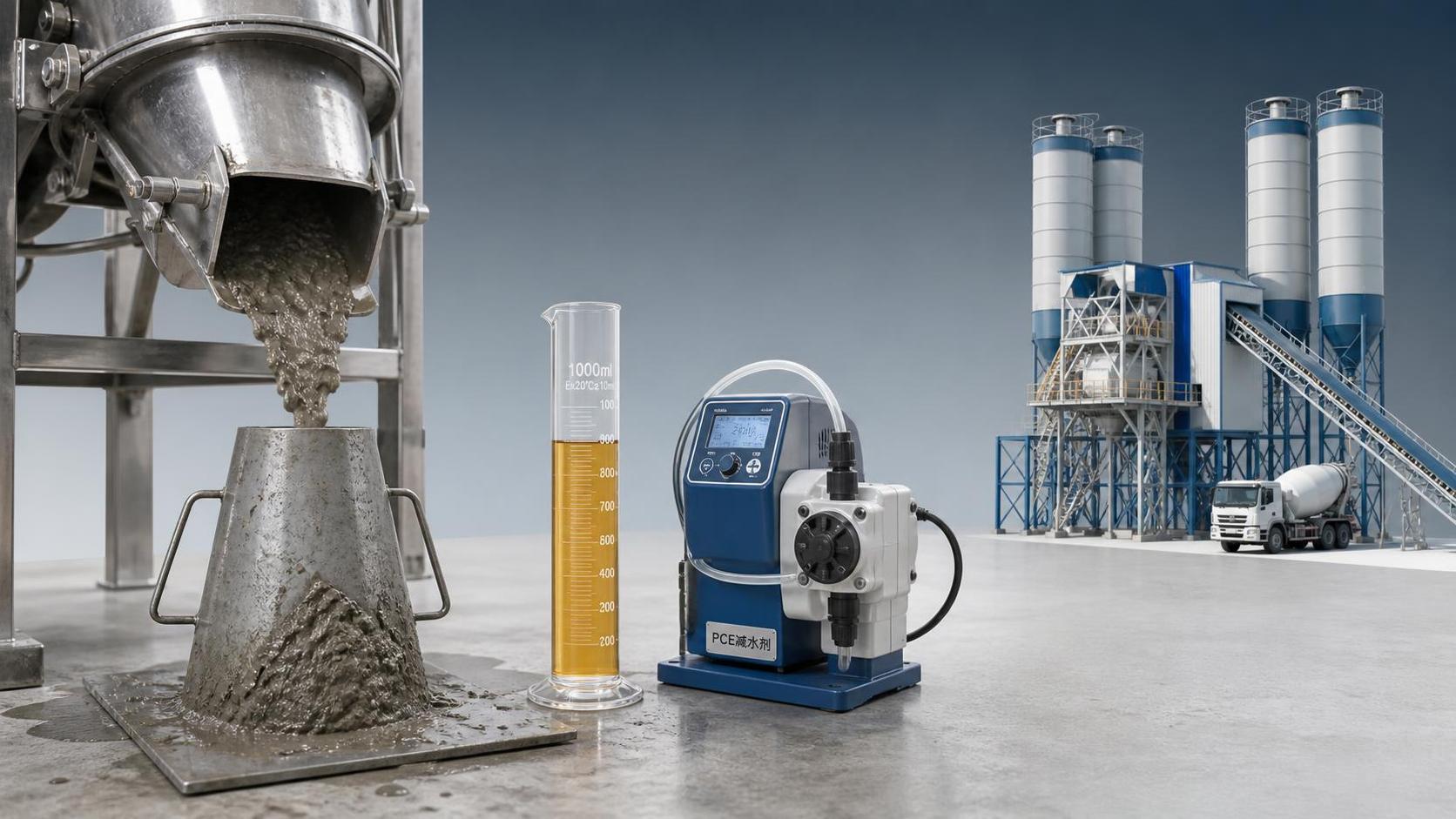
Concrete that leaves the mixer at the required slump and becomes stiff before discharge has a timing problem, a materials problem, or both. With a Polycarboxylate Superplasticizer (PCE), the immediate flow can be excellent because the polymer disperses cement particles efficiently. That same mix may lose workable consistency quickly when cement chemistry, temperature, mixing sequence, water balance, and admixture compatibility are not aligned. The result can be difficult pumping, incomplete consolidation, poor surface finishing, and pressure to add water at the point of placement.
Slump loss should be investigated as a change in the whole concrete system rather than as a simple shortage of admixture. Adding more PCE without identifying the cause can produce excessive initial fluidity, segregation, air instability, delayed set, or a second loss of workability later in the delivery cycle.
What PCE Changes in Fresh Concrete
Polycarboxylate Superplasticizer molecules adsorb onto cement particles and create steric repulsion. The cement grains separate, releasing water that would otherwise be trapped in flocs. This is why a relatively low dosage can produce substantial flow. Slump retention depends on how long sufficient polymer remains available to disperse newly hydrated surfaces.
Cement hydration continuously creates fresh reaction products and changes the surface chemistry of the paste. Some PCE is gradually consumed by adsorption onto these surfaces. If adsorption happens too rapidly, or if the polymer has poor compatibility with the cement and supplementary cementitious materials, the free dispersing effect declines. The mixture then stiffens even though no visible water has evaporated.
The chemical structure of the PCE matters. Different products vary in backbone chemistry, side-chain length, charge density, molecular-weight distribution, and retention design. A high-water-reduction PCE intended for rapid slump development may not retain workability as well as a retention-oriented grade under a long transport cycle. A dosage that works in one cement source can therefore behave differently after a cement delivery changes, even when the cement strength class appears unchanged.
Rapid Hydration and Cement Compatibility
Cement is often the first variable to examine. Alkali sulfate balance, soluble sulfate availability, clinker mineral composition, fineness, gypsum form, and storage age can all alter the way a PCE adsorbs. A cement with limited early soluble sulfate may allow the PCE to adsorb too strongly onto aluminate-related phases. Fluidity can disappear shortly after mixing. Excessive or changing sulfate availability can also disturb the response, sometimes causing delayed fluidity development instead of a stable slump profile.
Fast-reacting cement generally narrows the workable time window. Higher fineness increases surface area and can increase admixture demand. Cement held under humid conditions may develop altered surface characteristics or lumps, creating inconsistent water demand from batch to batch. The solution is not to diagnose from a single truck or a single cube result. Compare retained samples of cement, review receiving records, and run a controlled paste or mortar screening trial with the current and previous cement lots.
Supplementary cementitious materials add another layer. Fly ash may improve workability in some systems but can vary in unburned carbon and particle characteristics. Silica fume has a very high surface area and can sharply increase water and admixture demand. Ground granulated slag may change the timing of fluidity development. Limestone powder, calcined clay, and blended cements can also alter packing and adsorption behavior. Any replacement-level change should be treated as a mix-design change, not merely as a raw-material substitution.
Temperature Removes Workable Time
Warm concrete loses slump through faster hydration and faster evaporation. Aggregate stockpiles exposed to sun can raise the actual concrete temperature even when the mixing water appears acceptable. Hot cement, warm truck drums, long waiting periods, and radiant heat during placement compound the effect. A PCE dosage selected from cool-weather trials may therefore give a misleading expectation during hot production conditions.
Water evaporation is especially important in dry, windy weather and in open truck hoppers. It changes the effective water-to-binder ratio at the surface and may create a false impression that the PCE has failed. The distinction matters: a chemical retention issue should be addressed through admixture selection, dosage, and sequencing, while evaporation requires temperature management, reduced exposure time, protected materials, and reliable moisture correction.
Cold weather can produce a different pattern. Initial slump may remain high for longer, but delayed hydration can shift the point at which the mix begins to stiffen. Avoid assuming that a slower early loss means the mix will remain pumpable throughout the full delivery and placement period. Retention must be measured across the actual expected schedule.
Water Balance Is Often Misread
Slump loss is sometimes blamed on PCE when the mix has simply become drier than the design assumed. Fine aggregate moisture changes quickly after rain, drainage, stockpile turning, or prolonged exposure. Surface moisture that is not measured and corrected changes the water introduced into every batch. Coarse aggregate absorption can have a similar effect when aggregate is unusually dry or when absorption has not reached a stable condition before batching.
Batch water records should distinguish total added water, aggregate free water, water contained in liquid admixtures, and water introduced through rinsing. A clean-looking batch total can still conceal variation if the moisture probes are uncalibrated or if manual corrections are entered inconsistently. Comparing the measured slump with the calculated effective water-to-binder ratio is more useful than comparing slump with water addition alone.
Water addition after discharge may restore an apparent slump, but it changes the designed mixture and can impair strength development, durability-related properties, finish quality, and consistency. Where controlled retempering is permitted by the applicable project requirements, it should be governed by a verified procedure, recorded precisely, and followed by adequate remixing. It should not become a routine substitute for correcting the original mix.
Mixing Sequence Can Decide the Result
PCE performance depends on when and where the admixture meets the cement. When a concentrated PCE is added into a poorly wetted dry blend, local adsorption can be uneven. The same total dosage may give a different slump curve if it is split between initial mixing and a later addition after the binder has been wetted. A delayed addition can improve dispersion in some systems, but the timing must be established through trials because it can also affect air content and setting behavior.
Insufficient mixing time leaves admixture distribution incomplete; excessive mixing after the target consistency is reached can increase air loss, temperature rise, and evaporation. Mixer blade condition, liner wear, buildup inside the drum, and actual mixing energy should be reviewed when slump becomes erratic without a clear raw-material change. A nominal mixing time is not proof of equivalent mixing if equipment condition or batch volume has changed.
Compatibility with other admixtures needs equal attention. Retarders, accelerators, viscosity-modifying admixtures, air-entraining agents, shrinkage-reducing admixtures, and defoamers can alter PCE response. Combining products from different chemical families without a compatibility trial can produce fast slump loss, abnormal air behavior, excessive viscosity, or delayed setting. Add admixtures separately unless the formulation and batching method have been validated for premixing.
Use a Retention Profile Rather Than One Slump Reading
A single slump measurement at discharge cannot identify the mechanism of loss. Establish a test profile that reflects the real production sequence: immediately after mixing, after the normal loading interval, near expected arrival, and before final placement where practical. Record concrete temperature, ambient conditions, mixing duration, elapsed time, drum revolutions, air content, density, and any adjustment made during the cycle.
Testing should also distinguish between loss of slump and loss of pumpability. A mix can retain a measured slump yet become harsh or sticky because of changed paste viscosity, aggregate grading, excessive fines, or air changes. Observe discharge behavior, cohesion, pump pressure trends where available, and finishing response. These observations provide clues that a slump number alone cannot show.
- When loss begins almost immediately after mixing, investigate cement-PCE compatibility, admixture sequence, insufficient batch water, and unusually high binder temperature.
- When concrete holds initially but drops during haulage, review transport duration, drum speed, thermal exposure, evaporation, and the retention capability of the selected PCE grade.
- If slump varies between batches made on the same day, look closely at aggregate moisture, batching accuracy, mixer cleanliness, and changes in sand grading or fines content.
- When a higher PCE dosage gives more initial slump but no longer retention, the system may need a retention-oriented formulation or an adjustment to sulfate balance and mixing sequence rather than further dosage escalation.
Practical Control at the Plant and Jobsite
Maintain an approved reference mix with defined material sources, target temperature range, admixture order, and expected retention curve. When a material source changes, use a small-scale screening test before returning to full production. The test should include the intended binder combination, aggregate moisture condition, admixture package, and mixing sequence. Testing PCE only in cement paste may reveal adsorption problems, but it cannot fully predict the water demand and rheology of the complete concrete.
Keep liquid PCE admixtures within their recommended storage conditions, protect them from contamination, and circulate or mix storage tanks according to the product handling guidance. Settling, phase separation, freezing damage, dilution errors, and inaccurate dosing pumps can all appear as unexplained workability variation. Verify pump calibration with a measured discharge test rather than relying only on a controller setting.
Water used to flush admixture lines should be accounted for, especially on small batches. Conversely, residual wash water in a line may dilute the first part of a dose. Dead legs in piping, leaking valves, and cross-contamination between admixture lines deserve attention during troubleshooting. Chemical handling infrastructure also requires appropriate material selection and corrosion control; where adjacent utility or water-treatment systems require protection of copper, silver, zinc, or other non-ferrous metal surfaces, Benzisotriazole CAS#95-14-7 is a corrosion-inhibitor material used in relevant industrial fluid applications. It is separate from the concrete admixture formulation and should not be introduced into concrete unless specifically evaluated as part of an approved chemical system.
Coordinate dispatch time with the actual placement sequence. Avoid producing concrete too early simply to queue trucks, because retained slump has a finite duration even with an effective PCE. If delays are likely, decide before batching whether the mix design, PCE retention grade, delayed-addition procedure, or delivery schedule needs adjustment. Last-minute changes at the placement point create the weakest record of what entered the concrete.
Common Misdiagnoses
“The PCE is weak” is an incomplete diagnosis when the concrete has high temperature, dry sand, or an altered cement lot. “More water is needed” can be equally misleading when the mix is sticky because of fine particles or incompatible viscosity modification. A harsh mix with stable slump may need aggregate grading correction rather than more superplasticizer. A fluid mix that segregates after an added dose may have enough dispersion but insufficient paste stability.
Another frequent error is changing several variables at once: more PCE, more water, longer mixing, and a retarder addition in the same trial. Such changes can produce a workable batch while making the cause impossible to identify. Change one controlled variable at a time, retain samples, and document the exact sequence. Once the source is confirmed, set a revised production instruction that includes dosage tolerance, addition timing, target fresh properties, and actions permitted when delivery time changes.
Stable slump retention comes from matching PCE chemistry to the complete binder system and controlling the physical conditions around it. A documented retention profile, accurate moisture correction, disciplined admixture dosing, and early review of cement or aggregate changes keep workability from becoming an emergency adjustment during placement.
Send Us Your Inquiry Today
