









Product Quick Navigation
Get a Quote
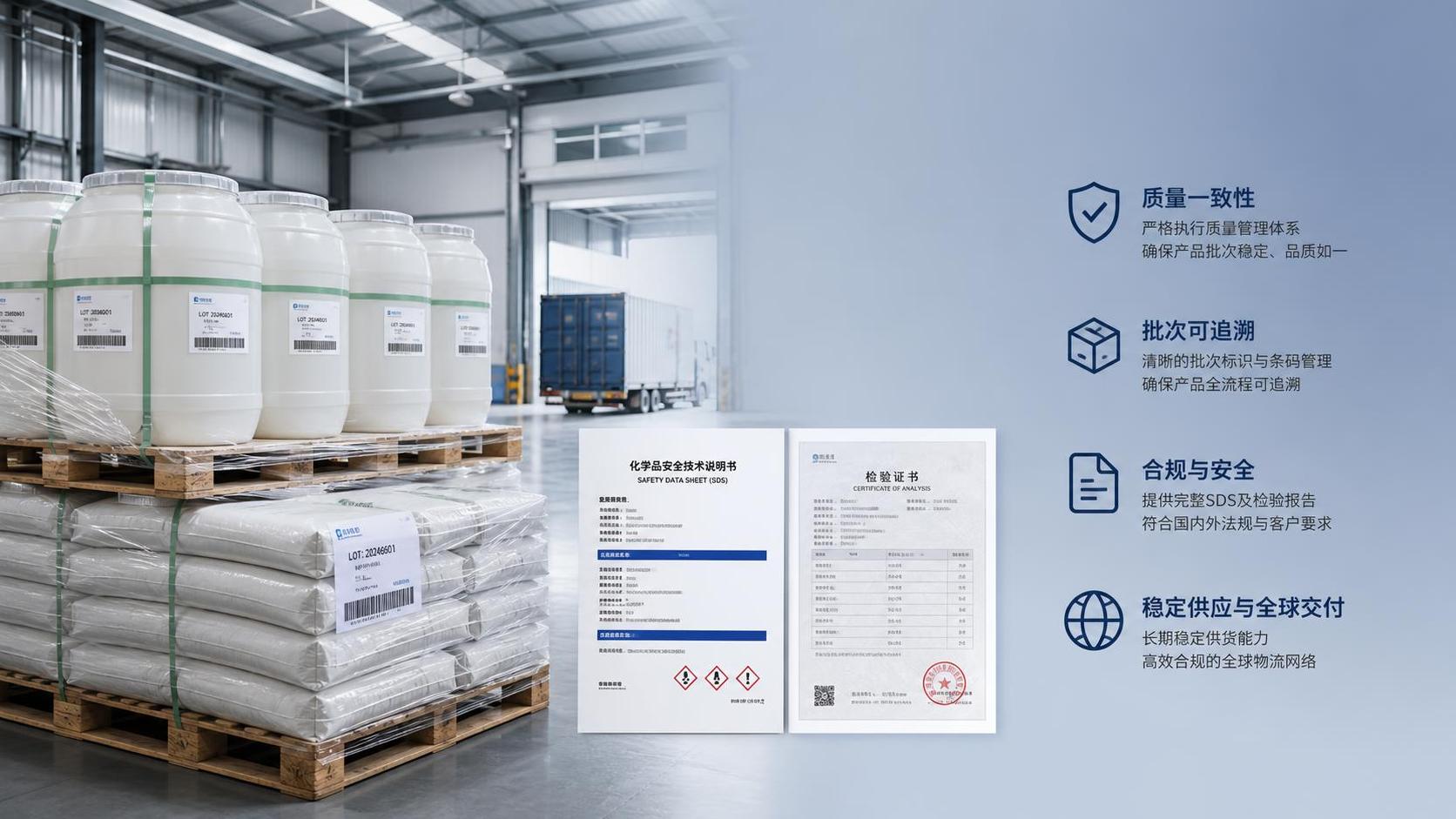
What to Evaluate When Sourcing Industrial Chemical Products for Long-Term Supply
When sourcing Industrial Chemical Products for long-term supply, business evaluators need to look beyond the quoted price and whether a supplier can ship the first order. A low offer can be attractive, especially when raw-material markets are volatile, but the real cost of a chemical purchase often emerges later: an off-specification batch, a delayed customs release, missing documents, inconsistent packaging, or a supplier that stops responding when a formulation changes.
Long-term chemical procurement is really a risk-management exercise. The buyer is not only purchasing a material; they are buying repeatability, traceability, export execution, and a working relationship that can survive changes in demand, regulations, shipping conditions, and technical requirements. This is particularly true for cross-border supply, where a product that is acceptable at origin may still create problems at destination if its paperwork, classification, labeling, or impurity profile is not properly reviewed.
The most useful supplier assessment therefore starts with a practical question: can this company deliver the same technically suitable material, with the same documentation discipline, under the same commercial terms, six or twelve months from now?
Start with the specification, not the product name
Chemical names are not enough to define what a production line needs. A name may cover different grades, particle-size distributions, assay ranges, moisture limits, stabilizer systems, color standards, or packaging formats. In many industrial applications, particularly coatings, polymers, water treatment, electronic materials, and specialty intermediates, these differences are not minor. They may affect reaction time, shelf life, conductivity, dielectric behavior, filtration performance, or downstream yield.
Before comparing suppliers, build a purchasing specification that separates “must-have” criteria from preferences. The must-have group typically includes identity, purity or assay, key impurities, moisture, physical form, particle size where relevant, storage requirements, and accepted packaging. Preferences may include preferred origin, bag design, pallet configuration, or a target lead time. Without this distinction, procurement teams can unintentionally approve a cheaper grade that looks equivalent on paper but is unsuitable in use.
A basic but important control is to reconcile the CAS number, product name, technical data sheet, safety data sheet, and certificate of analysis. These documents should tell one coherent story. If the listed chemical identity and the physical or hazard data appear to describe different substances, pause the evaluation rather than assuming it is a formatting issue. Such inconsistencies can lead to the wrong customs classification, incorrect hazard communication, unsuitable storage conditions, and avoidable quality disputes.
For functional ceramic materials, the specification discussion should go further than appearance. For example, Barium titanate CAS#12047-27-7 may be evaluated for use in multilayer ceramic capacitors, PTC thermistors, optoelectronic devices, or other dielectric components. In such applications, the relevant conversation often includes crystal phase, particle morphology, particle-size control, purity, and behavior during sintering or formulation. A white powder description alone does not establish fitness for a particular electronic-ceramics process.
Assess consistency across batches, not just the approval sample
Samples are necessary, but they are a weak predictor of long-term reliability if they are not tied to a defined grade and a normal production batch. A supplier can provide an excellent laboratory sample while routine deliveries vary more widely than the buyer’s process can tolerate. This is one of the most common blind spots in chemical sourcing.
Ask how the supplier controls incoming materials, blending, production lots, retained samples, and release testing. The goal is not to demand a generic quality presentation; it is to understand whether the controls match the risk of the product. A commodity solvent and a high-purity functional powder should not be evaluated with the same level of technical scrutiny.
For recurring purchases, buyers should request a recent certificate of analysis for more than one lot where possible. Compare the actual test values, not only whether each result says “pass.” A value that moves substantially within a broad stated range can still be operationally significant. If a critical parameter is not shown on the certificate, clarify whether it is tested routinely, tested only on request, or simply not controlled.
It is also sensible to agree on the dispute process before there is a problem. Define sample retention, notification timeframes, the method for confirming a claim, and how replacement or credit will be handled. This sounds administrative until a production line is waiting on an investigation.
Compliance is a supply condition, not paperwork after the sale
Chemical compliance has several layers: the substance itself, its intended use, the importing jurisdiction, transport classification, labeling language, and the documents required by the buyer’s internal compliance process. A supplier does not need to make legal determinations for every market, but a dependable export partner should be able to provide accurate product identity information and respond clearly to reasonable documentation requests.
At minimum, buyers commonly review the current safety data sheet, technical data sheet, certificate of analysis, country of origin information, packing details, and transport status. Depending on the product and destination, further review may be needed for inventory status, restricted-substance obligations, local registration requirements, or end-use declarations. These are not universal checkboxes. The correct requirement depends on the chemical and the market, so the importing party should confirm local obligations with its compliance team or qualified adviser.
There is a practical distinction between a supplier that sends documents and one that manages documents well. The second supplier maintains version control, can explain which document applies to which batch or grade, and does not issue vague or contradictory transport information. For hazardous goods, errors in UN information, packing group, labels, or emergency details can affect carrier acceptance and port handling. Even for non-dangerous goods, poor documentation can delay clearance.
Calculate landed cost rather than comparing an FOB number
Price remains important, but the unit price on a quotation is only one part of procurement cost. The comparison should include packaging, palletization, inland transfer, export handling, freight assumptions, insurance, duties and taxes where applicable, port charges, customs brokerage, local delivery, and the financial effect of payment terms. For some materials, the cost of special packaging, temperature protection, or hazardous-goods handling can materially change the economics.
There is another cost that rarely appears in a sourcing spreadsheet: variability. A less expensive supplier may require more incoming inspection, more inventory buffer, more technical troubleshooting, or more frequent urgent shipments. Those burdens are real, even when they sit outside the purchase-order price. A supplier with a slightly higher quotation may be the lower-cost option if it reduces disruptions and allows lower safety stock.
Test the supplier’s export and logistics competence
A capable manufacturer is not automatically a capable exporter. International supply requires coordination among production planning, packaging, documentation, freight forwarding, customs declaration, and communication with the buyer. This becomes more demanding when shipments involve multiple SKUs, controlled delivery windows, special handling, or destination-specific paperwork.
Useful questions are concrete: Which port is normally used? Who prepares commercial and shipping documents? Can the supplier provide packing photographs before dispatch if required? How are batch numbers linked to shipping documents? What happens if vessel schedules change? Is there a clear contact person who can resolve document corrections quickly?
Shandong has a substantial chemical manufacturing base, and suppliers in the region may offer broad product access and established export routines. For overseas buyers, the value lies less in geography alone than in execution. Companies such as Huafeng Chemical position their service around a broad chemical portfolio and comprehensive foreign-trade support. That can be useful when a buyer wants fewer interfaces across products, but it should still be verified product by product: technical suitability, document accuracy, packing capability, and delivery communication remain the decision points.
Look for capacity transparency and a realistic continuity plan
Long-term supply does not require a supplier to promise that shortages will never happen. In chemicals, feedstock availability, plant maintenance, freight interruptions, energy costs, and regulatory changes can all affect supply. What matters is whether the supplier is candid about constraints and has a credible way to manage them.
Ask whether the quoted quantity comes from regular production, trading inventory, or a special sourcing arrangement. Understand typical production lead time, minimum order quantity, normal inventory policy, and whether the material has an alternative source or substitute grade. For critical inputs, a buyer may choose dual sourcing even when a primary supplier performs well. The purpose is not to divide volume evenly; it is to maintain a tested fallback route before an emergency develops.
Forecast sharing can improve responsiveness, but it should be handled carefully. A rolling forecast gives the supplier visibility; it is not the same as a binding purchase commitment unless the parties expressly agree. Where demand is seasonal or project-driven, discuss how much flexibility is available on call-off volumes and delivery dates.
Use the first orders to validate the operating relationship
The best evaluation combines document review with a controlled commercial trial. Start with an order size that is meaningful enough to test normal packaging, documentation, production release, and logistics, rather than a small sample shipment that bypasses ordinary processes. Measure what actually happens: response time to technical questions, consistency between documents and cargo, delivery communication, condition on arrival, and the supplier’s behavior when clarification is needed.
A supplier relationship becomes more valuable when both sides can discuss a problem plainly. If a parameter is uncertain, if a delivery date is at risk, or if an import document needs correction, early and precise communication is far better than reassurance without detail. That is usually the difference between a manageable exception and a costly disruption.
For Industrial Chemical Products, the strongest long-term decision is rarely based on the lowest quote or the most polished brochure. It is based on a supplier’s demonstrated ability to match the required grade, maintain traceable quality, support compliant exports, and explain limitations before they become the buyer’s problem. Those are the conditions that make cost planning credible and supply genuinely dependable.
Send Us Your Inquiry Today
