









Product Quick Navigation
Get a Quote
Can Integrated Pest Control Cut Crop Chemical Use by Half?
Can integrated pest control for crops reduce chemical usage by half? In many farming systems, it can, but only when decisions become more precise.
For growers, distributors, and agricultural supply chains, the practical question is not whether pesticides disappear entirely, but how unnecessary applications can be removed.
Integrated pest control combines field monitoring, crop management, biological tools, physical controls, and carefully targeted pesticide treatments when economic thresholds are reached.
The strongest programs reduce chemical inputs without accepting uncontrolled pest losses, residue problems, or unreliable crop quality for buyers and downstream processors.
A fifty percent reduction is achievable in certain crops, regions, and pest situations, especially where routine calendar spraying is still common.
However, the percentage is not a universal target. Results depend on pest pressure, weather, crop value, local regulations, available biological products, and technical capability.
For commercial decision makers, integrated pest control should be treated as a risk-management system rather than a simple pesticide-reduction campaign.
It can lower input costs, support residue compliance, improve market access, and reduce resistance risks when implementation remains disciplined and data-based.
The key requirement is replacing broad, preventive chemical use with regular observation and interventions selected for a specific pest, crop stage, and field condition.
This article explains where chemical reductions are realistic, how to evaluate the economics, and what agricultural supply chains need before adopting integrated pest control.
Why Growers Ask Whether Chemical Use Can Be Cut by Half
The core search intent behind this question is practical: growers want lower chemical dependence without sacrificing yield, quality, export eligibility, or operational predictability.
Many farms apply pesticides according to fixed schedules because scouting is inconsistent, labor is limited, and a missed outbreak can be financially costly.
That approach may feel reliable, yet it often treats fields that do not need treatment or uses broad-spectrum products against poorly identified problems.
Integrated pest control changes the sequence. First, the farm identifies the pest, measures population levels, and evaluates crop damage before choosing an action.
This process does not mean waiting until pests become severe. It means acting at the correct threshold instead of applying chemicals automatically.
Economic thresholds connect pest density with likely financial damage. They help managers decide when intervention costs less than the expected crop loss.
For example, a low aphid count may require monitoring, while increasing populations during a sensitive crop stage may justify a selective insecticide application.
The potential reduction becomes significant when repeated preventive applications are replaced by scouting, localized treatment, beneficial insects, sanitation, and resistant crop varieties.
Buyers and exporters also have a separate concern: pesticide residues can create rejected shipments, delayed clearance, damaged customer relationships, and expensive corrective action.
Integrated pest control supports compliance by improving spray records, product selection, pre-harvest interval management, and traceability across the agricultural supply chain.
When a Fifty Percent Reduction Is Realistic
A fifty percent reduction is most realistic when a farm begins with high spray frequency, limited monitoring, duplicated active ingredients, or calendar-based pesticide programs.
Protected cultivation, orchards, vegetables, and high-value crops often offer strong opportunities because pest populations can be monitored frequently and interventions adjusted quickly.
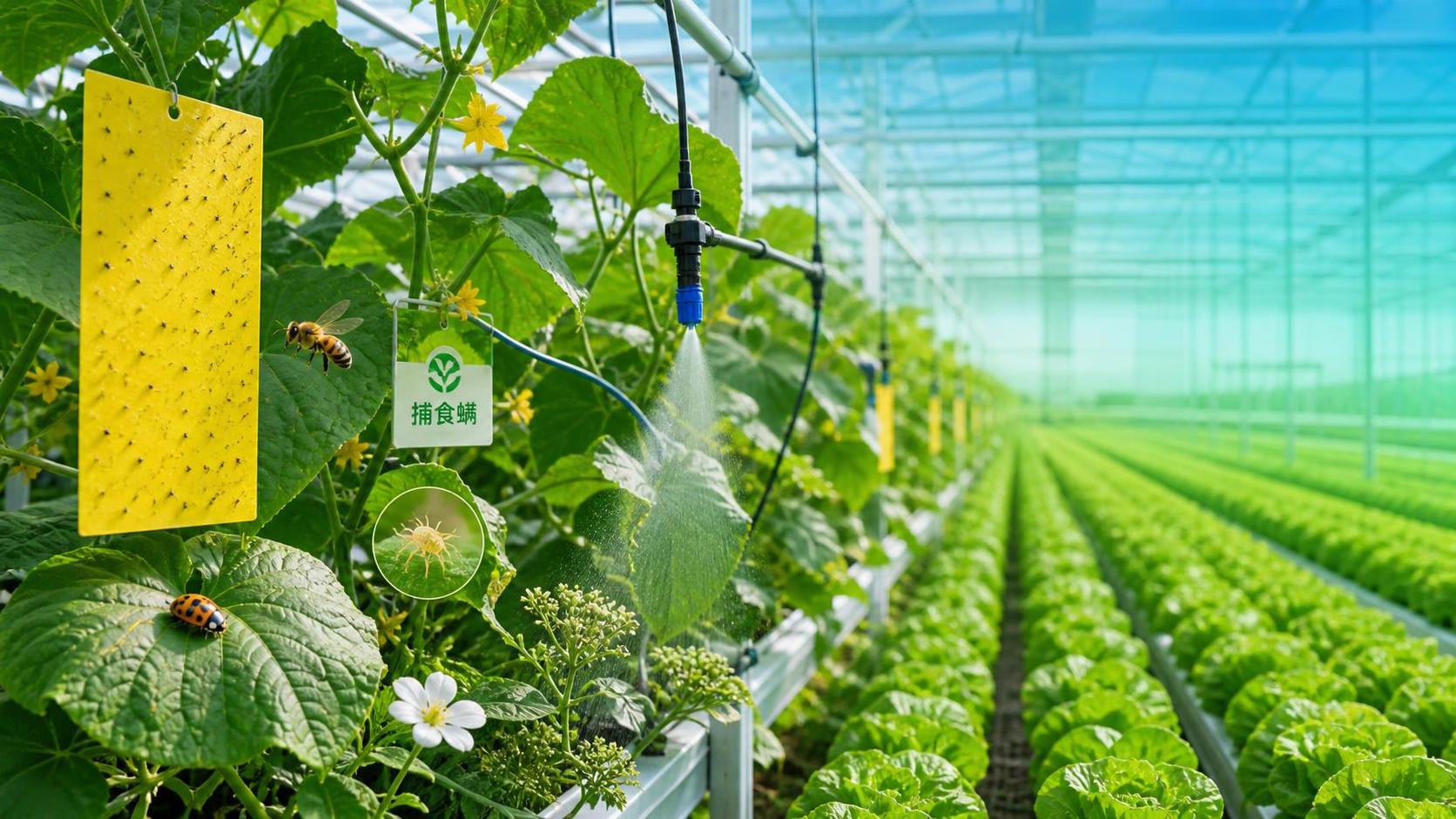
Greenhouses can be particularly suitable because exclusion screens, sticky traps, climate management, beneficial insects, and localized applications work together effectively.
Open-field production can also achieve major reductions, although weather variability, neighboring fields, migration pressure, and large farm areas make execution more complex.
Crops with established biological-control programs may reduce insecticide use substantially, especially where predators, parasitoids, microbial products, or pheromone-based tools are available.
Reduction may be harder when invasive pests arrive suddenly, disease pressure is extreme, crop value is very high, or regional advisory systems are weak.
Farms should therefore avoid promising a fixed percentage before establishing a baseline. The starting point determines whether a fifty percent reduction is meaningful.
A farm using ten insecticide treatments may have considerable room for optimization, while a farm already using three targeted applications may not.
Managers should measure reductions by application number, active ingredient volume, toxicity profile, treatment area, residue risk, and total crop-protection cost.
Reducing liters alone can be misleading. A smaller volume of a highly potent product may create different worker, environmental, resistance, or market-access considerations.
What Integrated Pest Control Actually Includes
Integrated pest control is often described broadly, but effective programs rely on a connected set of practices rather than a single biological product.
Monitoring is the operational foundation. Scouts inspect representative field zones, record pest levels, identify beneficial organisms, and note crop growth stages.
Reliable identification matters because visible damage may come from insects, mites, diseases, nutrient stress, irrigation problems, or environmental injury.
Cultural controls reduce pest suitability before chemical decisions are needed. These include crop rotation, planting dates, sanitation, irrigation management, and balanced fertilization.
Removing crop residues, volunteer plants, and weed hosts can interrupt pest life cycles and reduce the source population entering the next crop.
Physical measures include insect netting, traps, mulches, barriers, hand removal, and protected cultivation practices that prevent pest establishment or movement.
Biological controls may involve beneficial insects, predatory mites, parasitoids, microbial insecticides, fungal agents, nematodes, or naturally derived pest-management products.
Chemical products remain part of the system, especially when monitoring confirms that pest populations exceed action thresholds or crop risk becomes unacceptable.
The difference is that chemical treatments are selected for efficacy, selectivity, timing, resistance-management value, residue requirements, and compatibility with biological controls.
In practice, integrated pest control does not reject crop chemicals. It uses them as precise tools within a broader strategy designed to preserve their effectiveness.
How to Build a Program That Reduces Chemical Dependence
The first step is creating a baseline for each crop and production area. Record historical pests, products used, application dates, rates, costs, and outcomes.
This baseline reveals where applications are routine rather than evidence-based. It also identifies repeated active ingredients that may accelerate resistance development.
Next, define the major pests that create economic loss. Focus resources on the pests affecting yield, marketable appearance, storage quality, or export compliance.
Each priority pest needs a monitoring method, action threshold, preferred nonchemical controls, selective chemical options, and resistance-management rotation plan.
Scouting schedules should match pest biology and crop sensitivity. Fast-reproducing pests require more frequent checks than slow-moving or seasonal pests.
Field records should capture location, pest counts, life stage, crop stage, weather observations, natural enemies, and the action taken after inspection.
Digital farm platforms can simplify this work, but spreadsheets and standardized paper forms can also succeed when teams record information consistently.
Decision rules should be simple enough for supervisors and farm workers to use. Complex protocols that nobody follows do not reduce chemical use.
When treatment becomes necessary, target the affected zone whenever possible. Spot spraying can reduce product use and protect beneficial organisms elsewhere.
After every intervention, review results. The farm should confirm control performance, note crop recovery, and adjust future thresholds or product choices accordingly.
Economics: Savings, Investments, and Return on Effort
Lower pesticide volume can reduce direct purchasing costs, but that is only one part of the financial case for integrated pest control.
Programs require investment in scouting labor, training, monitoring tools, biological agents, recordkeeping, and technical advice during the implementation period.
For some farms, labor becomes the largest new expense. Managers should compare that cost with avoided sprays, fewer crop failures, and lower residue-related losses.
The economic return is usually strongest where pesticide programs are expensive, residue requirements are strict, and crop quality commands premium prices.
Export-oriented growers may gain additional value when stronger traceability and residue control support access to retailers, processors, or regulated international markets.
Distributors also benefit from demand for selective products, biological controls, monitoring tools, and advisory services rather than only high-volume conventional pesticides.
A useful financial review compares total crop-protection cost per hectare, marketable yield, rejected produce, labor hours, and net revenue across seasons.
Do not judge the program solely after one season. Weather and pest outbreaks vary, so at least two or three production cycles provide stronger evidence.
Managers should also calculate the value of avoided risk. One rejected export container or failed residue test can outweigh apparent savings from cheaper spraying.
Integrated pest control becomes commercially credible when it protects gross margin, maintains quality, and gives buyers confidence in production controls and documentation.
Residue Compliance and Supply Chain Requirements
For agricultural supply chains, residue compliance is often the strongest reason to improve pest-control decisions, particularly for fresh produce and export crops.
Different markets may apply different maximum residue limits, approved active ingredients, pre-harvest intervals, and documentation expectations for the same commodity.
A product legally registered in one producing country may still create commercial problems if it is not accepted by the destination market.
Integrated pest control helps teams plan backward from buyer specifications. They can prioritize permitted products, avoid late unnecessary sprays, and manage pre-harvest timing.
However, integrated approaches do not replace regulatory diligence. Farms and suppliers must confirm local registrations, label requirements, import tolerances, and customer restrictions.
Traceability should connect field records with product batches, spray operators, application equipment, water sources, harvest dates, and laboratory testing where required.
Chemical suppliers have an important role by providing accurate technical documents, safety data, regulatory information, storage guidance, and responsible-use support.
For export service providers, reliable supply chain coordination also matters. Product availability, packaging integrity, transport conditions, and documentation affect compliance outcomes.
Huafeng Chemical can support overseas customers through a broad product portfolio and foreign-trade capabilities, while buyers should still validate crop-specific local requirements.
The most reliable partnerships combine compliant sourcing with grower training, transparent records, and realistic guidance about how each product fits an integrated program.
Risks That Can Prevent Expected Chemical Reductions
The largest implementation risk is inadequate monitoring. Without accurate scouting, farms may detect problems too late and return to emergency broad-spectrum spraying.
Another risk is introducing biological controls without managing pesticide compatibility. Residual insecticides can harm beneficial organisms and undermine the entire system.
Thresholds must be adapted to local conditions. Imported recommendations may not fit local varieties, climates, pest complexes, labor costs, or buyer quality standards.
Resistance management also remains essential. Repeated use of one pesticide group can reduce performance, forcing higher rates or more frequent applications later.
Managers should rotate modes of action, follow label guidance, avoid unnecessary repeat treatments, and include nonchemical measures that reduce selection pressure.
Training cannot be treated as a one-time event. Scouts, applicators, supervisors, and procurement teams need aligned procedures and clear accountability.
Procurement decisions can create hidden problems when low-cost products are purchased without considering residue limits, selectivity, formulation quality, or technical support.
Weather disruptions also require contingency planning. Heavy rainfall, heat, wind, and unusual seasonal conditions can reduce control performance or accelerate pest development.
Farms should establish escalation rules for unusual outbreaks. Integrated pest control needs flexibility when crop health, food safety, or commercial contracts are threatened.
The goal is not rigidly avoiding chemical treatment. The goal is making each treatment justified, effective, compliant, and as limited as practical.
How to Decide Whether Integrated Pest Control Fits Your Operation
Start by asking whether current pesticide use is driven by verified pest pressure or by habit, uncertainty, sales advice, and fixed seasonal routines.
Then assess operational readiness. Successful programs need someone responsible for scouting, decision records, training coordination, and communication with crop-protection suppliers.
Review the crop portfolio carefully. High-value crops with demanding residue requirements usually provide a clearer business case than low-margin commodities.
Evaluate local access to technical expertise, beneficial organisms, monitoring supplies, registered selective products, and laboratories capable of residue testing.
Choose one crop, greenhouse block, orchard section, or production region for an initial pilot instead of changing every field simultaneously.
Set measurable objectives before the pilot begins. These may include fewer applications, lower active ingredient use, improved residue performance, or stable marketable yield.
Compare pilot results with a suitable baseline or control area. Include crop quality, labor, product cost, pest incidents, and customer acceptance.
Use the findings to improve protocols before scaling. A pilot should reveal practical weaknesses in timing, records, worker skills, supplier reliability, or thresholds.
For distributors and chemical exporters, the same approach can guide portfolio development toward products supporting safer, more targeted, and compliance-ready pest management.
Integrated pest control succeeds when commercial expectations, agronomic evidence, regulatory requirements, and supply availability are managed as one coordinated system.
Conclusion: Half Is a Possible Outcome, Not a Universal Promise
Can integrated pest control for crops reduce chemical usage by half? Yes, particularly where farms replace routine spraying with monitoring and targeted interventions.
But the right target is not an arbitrary percentage. It is the lowest effective chemical use that protects yield, quality, worker safety, compliance, and profitability.
Growers should begin with baseline records, priority pests, clear thresholds, trained scouts, selective products, and a practical review of economics after each season.
Supply chain partners should support the transition with reliable products, regulatory documentation, technical guidance, traceability tools, and realistic residue-management planning.
When implemented carefully, integrated pest control can make agricultural production more resilient while reducing unnecessary chemical exposure and preserving valuable crop-protection options.
Send Us Your Inquiry Today
