









Product Quick Navigation
Get a Quote
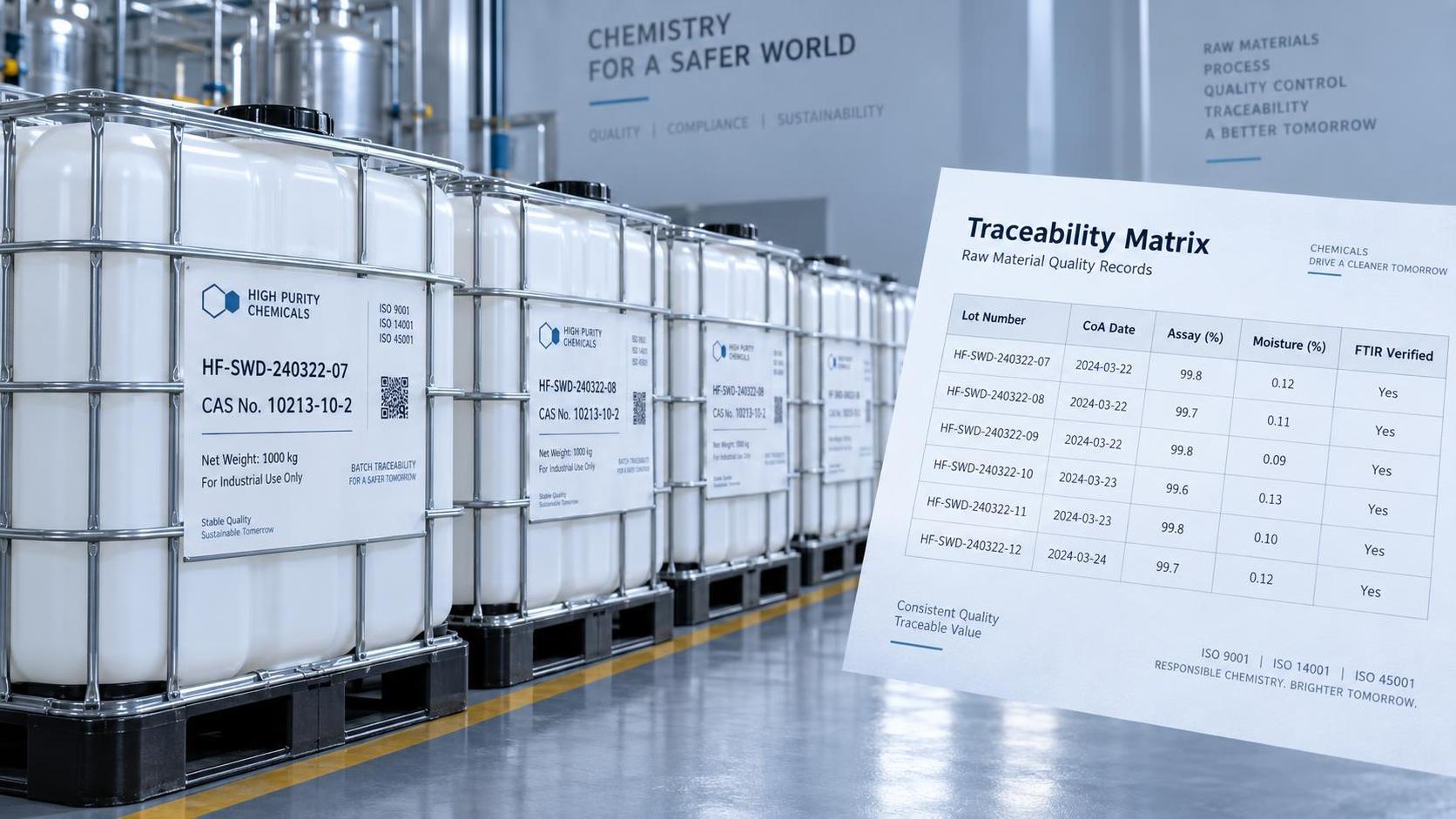
For quality control and safety professionals conducting ISO 9001 audits of chemical raw materials wholesale suppliers, the absence of verifiable, batch-specific lot numbers is not a minor documentation gap—it directly undermines Clause 8.5.2 (Identification and traceability) and exposes your organization to nonconformities that can halt production, delay certifications, or trigger supplier requalification. When auditors request evidence linking a delivered batch of sodium tungstate dihydrate to its manufacturing record, analytical certificate, and storage history, generic lot labels or handwritten entries won’t suffice. Traceability must be systematic, unbroken, and auditable—not assumed.
Why Lot Number Traceability Is Non-Negotiable in ISO 9001 Audits
ISO 9001:2015 requires organizations to “identify the output as appropriate throughout its realization” and “retain documented information necessary for traceability.” For chemical raw materials wholesale, this means each consignment must carry a unique, permanent lot identifier tied to specific parameters: production date, reactor batch ID, analytical test results (e.g., purity ≥ 99.0%, water content ≤ 12.5%), packaging conditions, and storage log. Without this, you cannot demonstrate control over critical process variables—especially for substances like Sodium Tungstate Dihydrate CAS#10213-10-2, where slight deviations in hydration state or impurity profile affect electroplating efficiency or catalyst performance. A missing or inconsistent lot number isn’t just an administrative oversight; it signals potential gaps in supplier change control, calibration records, or nonconforming product handling—all high-risk areas for major NCs.
What Constitutes Audit-Ready Lot Documentation
Auditors don’t accept “traceable in theory.” They verify traceability in practice. Valid documentation includes:
- A legible, permanent lot label physically affixed to primary packaging—laser-etched or heat-transfer printed, not inkjet-stamped or adhesive stickers prone to fading;
- A Certificate of Analysis (CoA) issued at time of release, listing the exact lot number, test methods (e.g., ASTM E290 for moisture), and results against specification limits;
- Batch production records showing raw material inputs, mixing times, drying temperatures, and QC hold points—linked via the same lot number;
- Shipping documents (commercial invoice, packing list, bill of lading) referencing the identical lot number, with no discrepancies across documents.
If your chemical raw materials wholesale supplier issues CoAs dated after shipment, omits test method references, or uses alphanumeric codes without a documented coding scheme (e.g., “HF-SWD-240322-07” where “240322” = 2024-03-22 and “07” = seventh batch), treat this as a red flag. ISO 9001 requires documented information to be “controlled”—not retrofitted.
How Sodium Tungstate Dihydrate Exemplifies High-Stakes Traceability Needs
Consider Sodium Tungstate Dihydrate CAS#10213-10-2 used in steel electroplating baths. Its solubility (730 g/L at 20°C) and weak alkalinity (pH 9.5–11.5 in 1M solution) are critical for uniform deposition. But if a batch loses crystal water during transit due to improper storage (>25°C), its effective concentration drops—and plating adhesion fails. An auditor will ask: How do you prove the delivered material retained its dihydrate structure? The answer lies in the lot number’s linkage to FTIR spectra, Karl Fischer moisture data, and thermal gravimetric analysis (TGA) curves from the release batch record. Without that chain, you’re relying on supplier assurances—not objective evidence.
Supplier Evaluation: Three Practical Checks Before Committing
Don’t wait until audit prep to validate traceability capability. Conduct these checks during initial supplier assessment:
- Request a sample CoA for a recent lot—verify that the lot number appears identically on the CoA header, test result table, and signature block. Cross-check the reported assay (e.g., Na₂WO₄·2H₂O ≥ 99.0%) against your specification. If values are rounded (e.g., “99%” instead of “99.2%”), question their measurement uncertainty reporting.
- Ask for their lot numbering policy document—it should define format, uniqueness rules (e.g., no reuse within 5 years), and assignment timing (at completion of final QC, not at packaging). Suppliers who cite “internal systems only” without written policy fail Clause 7.5.2.
- Review one archived batch record—confirm it includes operator signatures at critical steps (e.g., dissolution, filtration, drying), equipment IDs, environmental logs (humidity/temperature during crystallization), and deviation reports—if any. Gaps here indicate systemic weakness, not isolated errors.
When Traceability Breaks Down: Common Root Causes
Recurring lot number issues rarely stem from malice—they reflect process fragility. Most frequent causes include:
- Multipoint handoffs without reconciliation: Raw material received under Lot A, repackaged into smaller containers labeled Lot B, then shipped with Lot C on the invoice. Each step severs the chain unless all three are cross-referenced in the master record.
- Legacy ERP limitations: Systems that auto-generate lot numbers per order rather than per physical batch, making it impossible to link analytical data from the same reactor run.
- Uncalibrated weighing or labeling equipment: A scale drift of ±0.5% may not affect bulk shipment weight but invalidates mass-balance calculations needed for traceability verification.
If your current chemical raw materials wholesale supplier exhibits any of these, prioritize remediation—not workarounds. ISO 9001 requires corrective action, not justification.
Integrating Traceability Into Your Internal Audit Protocol
Your internal audit checklist should go beyond “lot number present?” Ask:
- Does the lot number on the CoA match the physical container label and the shipping manifest?
- Can you retrieve the full batch record—including raw material certificates of conformance for all inputs—using only that lot number?
- Are there documented procedures for handling lot number discrepancies (e.g., mismatched labels)? What evidence shows they’ve been applied?
Without answers to all three, your audit readiness is incomplete—even if the supplier provides lot numbers.
Final Verification: The One Document That Closes the Loop
The definitive proof isn’t a single CoA or label. It’s the traceability matrix: a one-page summary linking the lot number to every supporting record—production log, QC report, stability data (if applicable), and shipping documents—with timestamps and responsible personnel. When presented during an ISO 9001 audit, this matrix demonstrates intentional, controlled traceability—not fragmented data. Suppliers capable of generating this consistently have embedded traceability into their QMS—not layered it on top.
Send Us Your Inquiry Today
