









Product Quick Navigation
Get a Quote
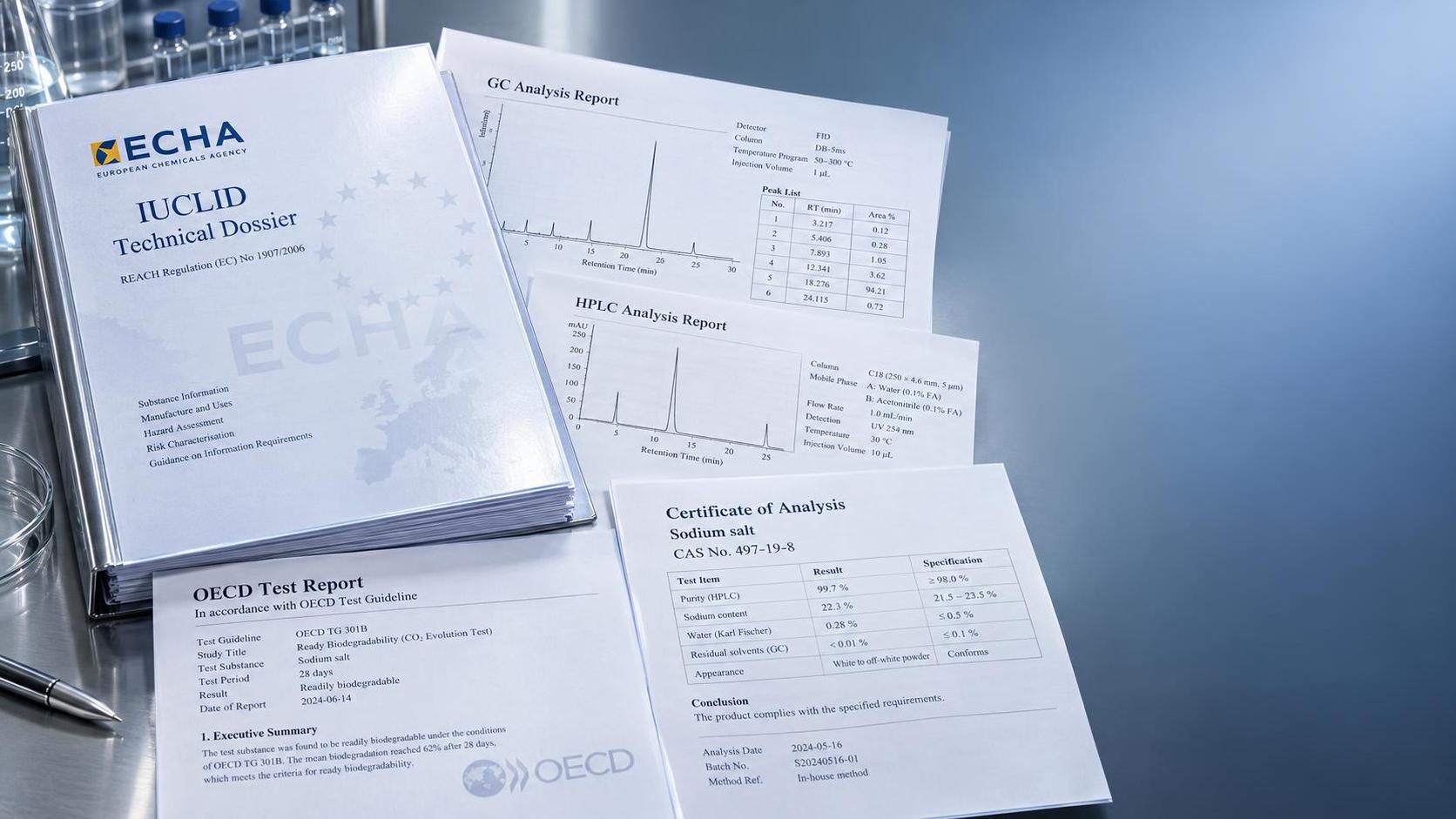
For any agricultural chemical export company targeting the EU market, REACH registration is not optional—it’s a legal prerequisite for placing substances or mixtures on the European Economic Area (EEA) market. Failure to submit complete, technically valid documentation triggers immediate non-compliance: customs holds, product recalls, enforcement actions by ECHA, and potential liability for downstream users. Unlike general chemical exports, agricultural chemicals face additional scrutiny due to their intentional release into the environment and direct exposure pathways—making dossier completeness, substance identity verification, and exposure scenario justification especially critical.
The core compliance documentation required falls into three interdependent layers: substance identification and characterisation, hazard and risk assessment data, and administrative and legal coordination records. These are not standalone forms but integrated components of a technical dossier submitted via IUCLID and registered through REACH-IT. What distinguishes an effective submission from one that triggers ECHA queries—or worse, rejection—is not just data presence, but data coherence: analytical consistency across certificates, alignment between declared uses and exposure scenarios, and traceability from batch-level test reports back to the registered tonnage band.
Substance Identity & Technical Characterisation
EU authorities require unambiguous identification—not just a CAS number, but full structural and impurity profiling. For an agricultural chemical export company, this means providing:
- Full molecular structure with stereochemistry, tautomeric forms, and salt dissociation behaviour;
- Batch-specific analytical data (e.g., GC/HPLC chromatograms, NMR spectra, mass spectra) confirming ≥95% purity and identifying all impurities above 0.1% w/w;
- Physicochemical properties measured according to OECD Test Guidelines (e.g., melting point, vapour pressure, water solubility, log Kow), not literature values unless validated for the exact grade being registered;
- Manufacturing process description, including synthesis route, starting materials, catalysts, solvents, and purification steps—critical for assessing genotoxic impurities in active ingredients.
For example, sodium carbonate (CAS#497-19-8), commonly used as a pH adjuster or processing aid in pesticide formulation, must be characterised not only by its stoichiometric formula but also by its crystalline form (anhydrous vs. decahydrate), residual chloride/sulfate content, and particle size distribution—each influencing dissolution rate and environmental fate. A dossier relying solely on generic supplier COA without batch-specific assay data will fail technical completeness checks.
Hazard & Risk Assessment Data Package
This layer determines whether the substance can be placed on the market at all—and under what conditions. The required studies depend on annual tonnage band, but even low-tonnage registrations (1–10 t/y) demand specific endpoints:
- Acute oral toxicity (OECD 423) and skin/eye irritation (OECD 404/405);
- Genotoxicity battery (Ames test + in vitro micronucleus + in vitro chromosome aberration);
- Environmental fate data: hydrolysis half-life (OECD 111), adsorption/desorption (OECD 106), and ready biodegradability (OECD 301);
- Ecotoxicity testing for aquatic species (algae, daphnia, fish) per OECD 201/202/203—especially relevant for agrochemicals due to runoff exposure;
- Endocrine disruption screening (if applicable) using validated in vitro assays (e.g., ER/AR binding).
Data waivers are possible—but only with scientifically robust justification documented in the Chemical Safety Report (CSR). Simply stating “not applicable” or citing structural similarity without read-across justification is routinely rejected. For substances like Sodium carbonate CAS#497-19-8, which exhibits high water solubility and low bioaccumulation potential, certain ecotoxicity endpoints may be waived—but only if the CSR explicitly links physicochemical properties (e.g., log Kow < 0.5, rapid hydrolysis) to reduced environmental hazard, supported by peer-reviewed literature.
Administrative & Legal Documentation
Technical validity alone doesn’t guarantee registration. Legal enforceability hinges on correct administrative setup:
- Only Representative (OR) appointment letter, signed by both non-EEA manufacturer and OR, specifying scope, responsibilities, and duration—must be uploaded to REACH-IT before dossier submission;
- Proof of OR’s EEA establishment (e.g., commercial register extract, VAT number confirmation);
- Letter of access to existing studies (e.g., from SIEF members), clearly stating permitted use scope and referencing study titles/numbers;
- Use-Descriptor system mapping: linking each registered use (e.g., “formulation of herbicides”) to corresponding exposure scenarios (e.g., “industrial mixing with closed system”), ensuring exposure assessments cover actual operational conditions.
Errors here are among the most frequent causes of delayed registration. An OR letter missing the phrase “legally binding mandate to act on behalf of the manufacturer” or omitting explicit reference to REACH Article 8(2) will be flagged during administrative check—even if all technical data is flawless.
Practical Validation Steps Before Submission
Before uploading to REACH-IT, verify these five checkpoints:
- Confirm IUCLID version matches ECHA’s current requirement (IUCLID 6.6+ for submissions after 2023);
- Validate all analytical reports include accredited lab logos, test method references, and raw data appendices—not just summary tables;
- Cross-check CSR exposure scenarios against the declared uses in Section 3 of the dossier; discrepancies trigger automatic rejection;
- Ensure all supporting documents (OR letter, LoA, manufacturing flowchart) are PDF/A-1b compliant and text-searchable;
- Run ECHA’s CheckApp tool on the final dossier—this catches formatting errors, missing mandatory fields, and inconsistent substance identifiers before submission.
Post-submission, ECHA typically issues a completeness check within 10 working days. If deficiencies are identified, the clock starts on the 12-week deadline to respond—no extensions granted. This makes pre-submission validation non-negotiable for time-sensitive agrochemical launches.
When Third-Party Support Becomes Necessary
Self-managing REACH registration is feasible for single-substance, low-tonnage, well-characterised products. But for agricultural chemical export companies handling multiple active ingredients, co-formulants, or complex mixtures, technical dependencies multiply: impurity profiles affect classification, degradation products require separate assessment, and joint submissions demand SIEF coordination. In such cases, support isn’t about outsourcing—it’s about accessing verified IUCLID templates, validated exposure scenarios for crop protection applications, and real-time regulatory interpretation for evolving guidance (e.g., ECHA’s 2024 updates on nanoforms or endocrine disruptor criteria). The value lies in avoiding iterative corrections that delay market entry by months—not in replacing internal expertise, but in closing technical gaps where regulatory precedent is thin or contested.
Send Us Your Inquiry Today
