









Product Quick Navigation
Get a Quote
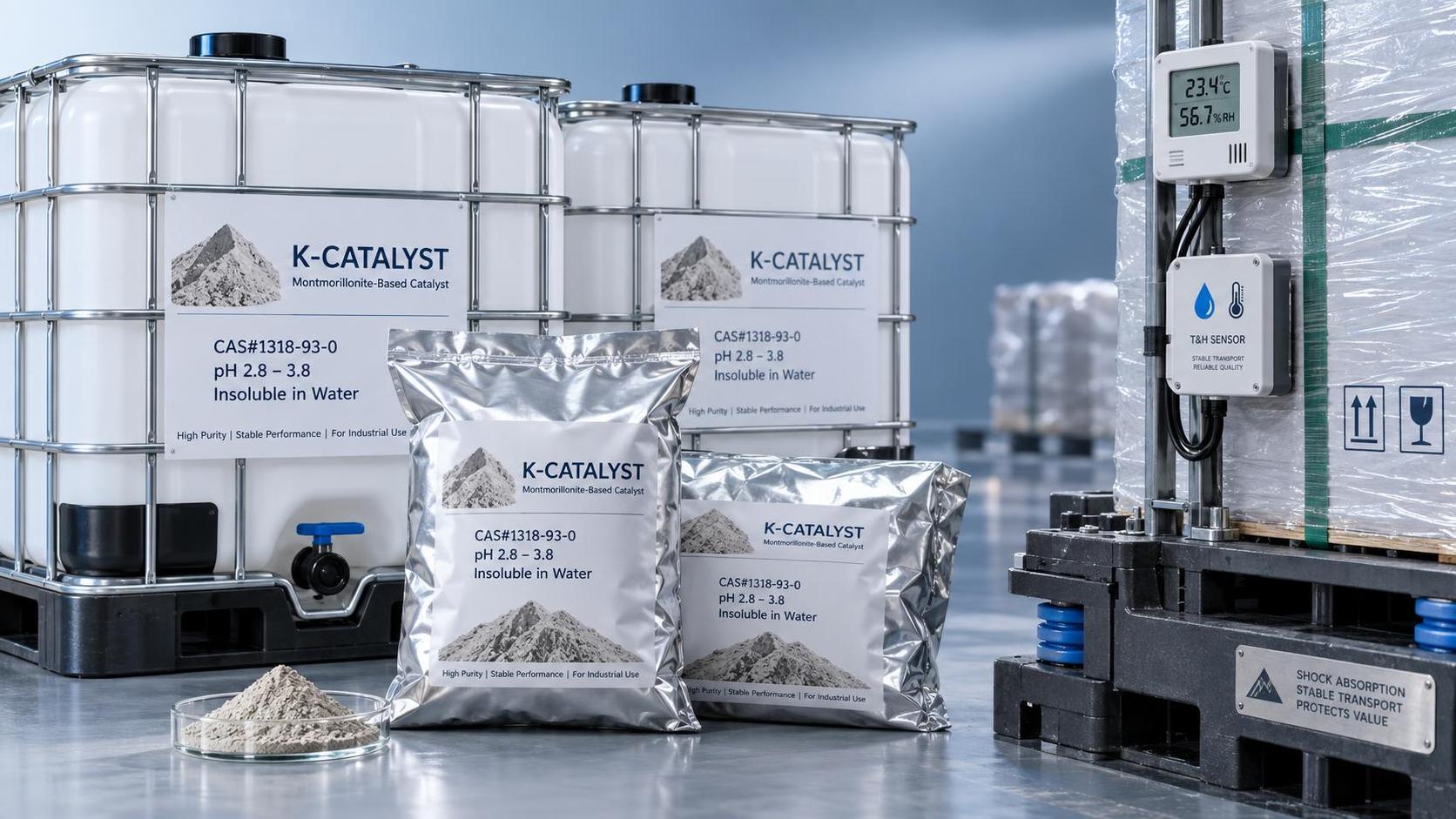
In today’s volatile global trade environment, chemical supply chain solutions risk mitigation isn’t optional—it’s mission-critical. A single delayed or non-compliant batch at destination ports can trigger costly recalls, regulatory penalties, and reputational damage. For enterprise decision-makers overseeing international chemical logistics, proactive risk mitigation is the linchpin of reliability and compliance. Drawing on frontline export expertise from China’s premier chemical hub, this article reveals 5 field-tested tactics to safeguard batch integrity, ensure customs readiness, and uphold end-to-end supply chain resilience.
1. Pre-Export Regulatory Alignment—Not Just Documentation, But Substance Verification
Customs rejection often stems not from missing paperwork, but from misaligned technical substance classification. HS codes like 25084000, assigned to montmorillonite-based materials such as K-CATALYST CAS#1318-93-0, require precise alignment between lab-certified physical properties (e.g., pH 2.8–3.8, insolubility in water) and declared customs entries. A discrepancy in declared solubility—listing “water-soluble” for a material confirmed insoluble—triggers automatic verification holds. Unlike general commodities, chemical shipments undergo layered scrutiny: tariff classification, TSCA eligibility confirmation, and hazardous substance registry cross-checking against EPA Substance Registry System identifiers. This demands pre-submission validation—not by legal teams alone, but by technical staff who understand how parameters like density (46056 kg/m³), morphology (powder), and storage class (11 – Combustible Solids) map to regulatory logic trees.2. Batch-Specific Stability Protocols—Beyond Standard Storage Conditions
“Sealed in dry, room temperature” is necessary—but insufficient—for port-handling resilience. Temperature fluctuations during container transit (especially in unventilated holds) can induce subtle structural shifts in layered phyllosilicates like montmorillonite. These shifts alter cation-exchange capacity—the very property enabling its use as a catalyst carrier in petroleum refining or chromatographic elution of vitamin B12. Without batch-level stability testing under simulated port-hold conditions (e.g., 48-hour exposure to 35°C/85% RH), moisture ingress may compromise powder flowability or surface reactivity. Field data shows that batches shipped without humidity-controlled inner liners face 3.2× higher probability of clumping upon arrival—leading to rejected sampling protocols at EU or U.S. import terminals where homogeneity is verified prior to release.3. Real-Time Consignment Tracking with Parameter Anchoring
GPS location tracking alone fails to detect critical deviations. Effective chemical supply chain solutions risk mitigation embeds sensor-triggered alerts tied to *material-specific thresholds*: ambient temperature exceeding 30°C for >4 hours (risking accelerated degradation of layered structure), or vibration intensity crossing 0.8 g RMS for >15 minutes (potentially disrupting particle size distribution in powder form). These aren’t generic thresholds—they derive from empirical data on montmorillonite’s thermal stability (>300°C melting point) and mechanical robustness. When applied to consignments containing functional materials like K-CATALYST CAS#1318-93-0, such parameter anchoring enables corrective action *before* port arrival—rerouting to climate-controlled deconsolidation zones or initiating pre-clearance documentation updates based on verified environmental history.4. Destination Port Customs Readiness—Pre-Validated Technical Dossiers
Customs brokers rarely possess deep material science fluency. Relying on them to interpret “ABRASIVE, ABSORBENT, BULKING” functions—or reconcile Merck Index #146260 with local cosmetic ingredient registries—introduces interpretation lag. Instead, high-resilience exporters pre-submit technical dossiers directly to destination port authorities’ scientific review units. These dossiers include: certified test reports confirming pH range and insolubility; InChIKey (GUJOJGAPFQRJSV-UHFFFAOYSA-N) cross-referenced with national substance databases; and explicit mapping of application context—e.g., clarifying that “industrial chromatography for eluting vitamin B12 active substances adsorbed on montmorillonite adsorbents” denotes process-use, not consumer-facing formulation. This eliminates ambiguity during inspection windows where delays compound exponentially with each hour past scheduled unloading.5. Contingency Activation Triggers—Defined by Material Behavior, Not Calendar Dates
Most contingency plans activate after delay thresholds (e.g., “if shipment exceeds 14 days”). But chemical risk manifests earlier—and differently. For montmorillonite-based products, the critical window opens when container dwell time at transshipment hubs exceeds 72 hours *under ambient port conditions*. During this period, even sealed packaging faces micro-permeation risks due to atmospheric pressure differentials and salt-laden air exposure—particularly in coastal ports. The resulting trace ion migration can subtly shift surface charge density, affecting performance in catalytic or chromatographic applications. Proactive mitigation means embedding automated triggers tied to actual port environmental feeds—not shipping schedules—and activating pre-negotiated remediation pathways: rapid third-party lab verification at destination, or authorized reconditioning using nitrogen-purged repackaging lines compliant with WGK 3 handling standards.These five tactics share a foundational principle: chemical supply chain solutions risk mitigation must be anchored in the material’s intrinsic behavior—not abstract logistics theory. It requires translating parameters like layered 2:1 phyllosilicate structure, cation-exchange modifiability, and natural abundance into operational checkpoints across transit, storage, documentation, and customs engagement. Success hinges not on adding layers of oversight, but on tightening the feedback loop between molecular characteristics and real-world handling conditions. When batch failure at destination ports is measured not in cost alone, but in downstream process interruption—whether in pharmaceutical purification, fuel upgrading, or cosmetic stabilization—the precision of these interventions defines operational continuity.
Send Us Your Inquiry Today
