









Product Quick Navigation
Get a Quote
Crop Fertilizers vs. Soil Health: When to Prioritize Nutrient Delivery Over Microbial Support
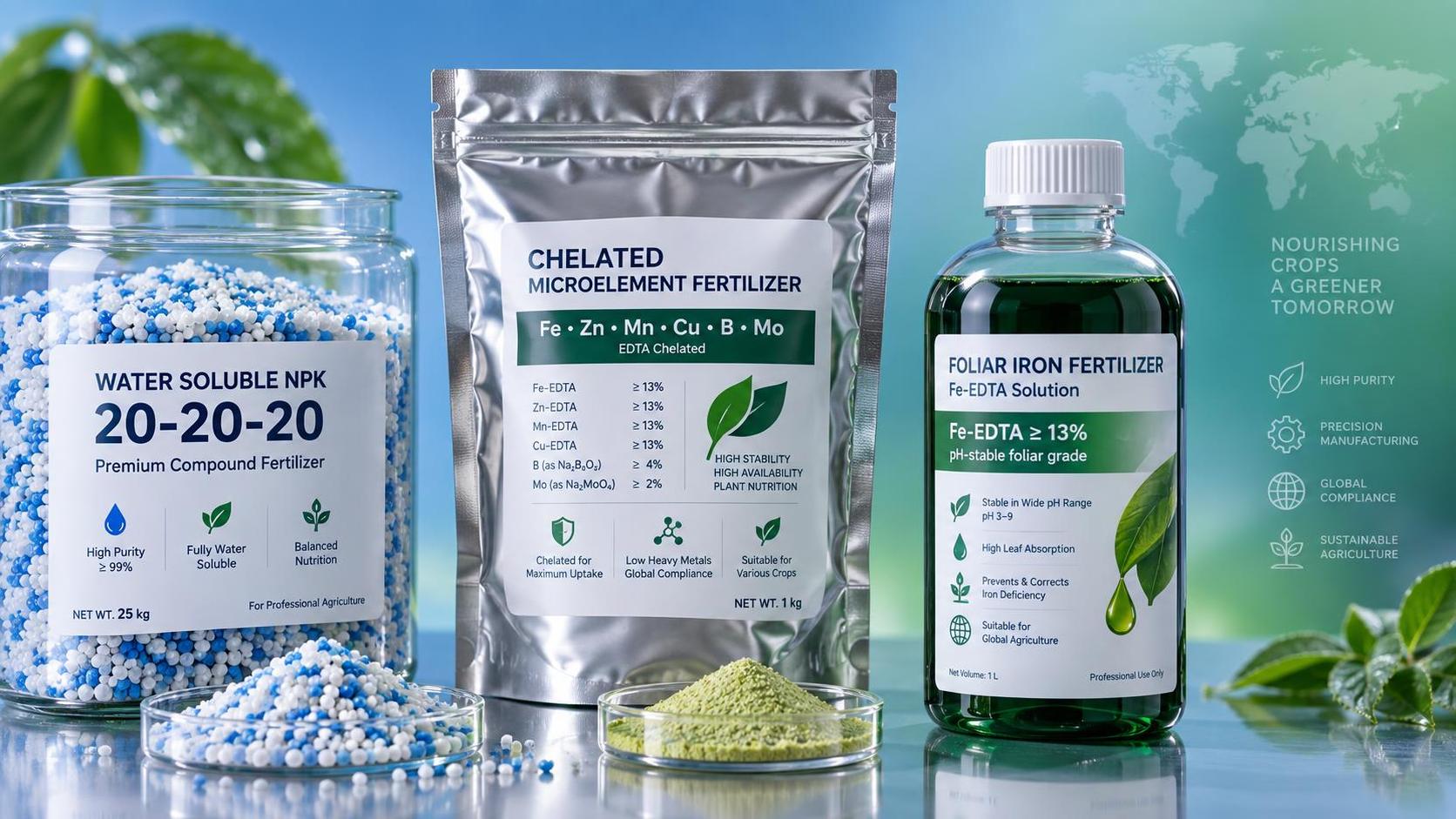
For project managers overseeing large-scale agricultural infrastructure or fertilizer distribution systems, balancing immediate crop nutrition with long-term soil vitality is a constant strategic challenge. When yield timelines are tight and field conditions demand rapid nutrient correction, prioritizing high-efficiency Crop Fertilizers—backed by reliable supply chain execution and regulatory-compliant formulations—becomes essential. At Huafeng Chemical, we support global project leaders with precision-engineered fertilizers that deliver targeted macro- and micronutrients without compromising on traceability, stability, or cross-border compliance.
Why This Decision Matters More Than Ever for Infrastructure & Distribution Projects
Project managers don’t operate in theoretical agronomy—they manage budgets, deadlines, logistics networks, and contractual delivery KPIs. A delayed harvest due to nutrient deficiency isn’t just an agronomic setback; it triggers cascading delays in warehousing, transport scheduling, export documentation, and downstream processing contracts. In such contexts, “soil health” is a multi-year investment metric—not an operational lever. The critical question isn’t whether microbial support matters (it does), but whether it’s the *right priority* when your project timeline hinges on achieving 95% nitrogen uptake within 14 days of application.
Three Clear Indicators That Crop Fertilizers Should Take Priority
1. Acute Deficiency Confirmed by Rapid Field Testing
When leaf tissue analysis or portable soil nitrate meters show N–P–K deficits below 60% of sufficiency thresholds—and planting windows have closed—microbial inoculants won’t restore yield potential in time. Fast-release, water-soluble Crop Fertilizers with calibrated salt index and low phytotoxicity are operationally non-negotiable. Their value lies not in biological synergy, but in predictable, quantifiable, and auditable nutrient release kinetics.
2. Supply Chain Constraints Demand Single-Point Reliability
Importing compost-based amendments or bio-stimulants often requires cold-chain logistics, extended customs clearance for live cultures, and batch-specific viability certification. By contrast, industrial-grade synthetic and chelated Crop Fertilizers from suppliers like Huafeng Chemical ship as stable solids or concentrated solutions—with full SDS, TSCA, REACH, and APAC regulatory dossiers pre-validated. For projects spanning multiple jurisdictions, this reduces lead-time variance by up to 40%.
3. Regulatory or Certification Deadlines Are Imminent
When preparing fields for GlobalG.A.P., USDA Organic (transition phase), or EU Fertilising Products Regulation (EU) 2019/1009 compliance, you need formulation transparency—not just organic origin. Many microbial products lack full CAS-level chemical disclosure, complicating dossier submissions. In contrast, chemically defined inputs—including specialty reagents like Stannous chloride dihydrate CAS#10025-69-1, used in analytical quality control of heavy metals in fertilizer batches—enable precise contaminant profiling and third-party verification.
Where Soil Microbial Support Adds Real Value—And Where It Doesn’t
Microbial interventions shine in long-horizon scenarios: multi-year soil remediation after saline intrusion, rebuilding organic matter in degraded monoculture zones, or supporting perennial cropping systems. But they fail under three common project conditions: (1) soil pH < 5.2 or > 8.0 (outside most bacterial strain viability ranges), (2) residual herbicide carryover (e.g., imidazolinones), and (3) irrigation water with > 200 ppm chloride. Project managers must audit these variables *before* budgeting for microbial inputs—not after.
In contrast, engineered Crop Fertilizers perform consistently across pH 4.5–9.0, tolerate moderate salinity, and require no viability testing upon arrival. Their ROI is measured in bushels per hectare per week—not colony-forming units per gram.
The Hidden Cost of Misaligned Prioritization
One overlooked risk is “fertilizer stacking”—applying both high-dose soluble nutrients *and* microbial boosters simultaneously. This can trigger unintended redox reactions, especially in iron- or manganese-rich soils, leading to localized precipitation and nutrient lock-up. Worse, some microbial carriers (e.g., lignosulfonates) interact unpredictably with chelated micronutrients like EDTA-Zn, reducing bioavailability by up to 70% in field trials. Huafeng Chemical’s technical team routinely advises clients to sequence applications: nutrient correction first, microbial establishment second—separated by ≥10 days and verified via post-application soil respiration assays.
How Huafeng Chemical Enables Confident, Compliant Decisions
As a Shandong-based exporter serving over 38 countries, Huafeng Chemical doesn’t just supply Crop Fertilizers—we embed them in project execution frameworks. Our portfolio includes ISO 9001-certified urea-ammonium nitrate (UAN) solutions with corrosion-inhibited packaging for tropical ports, granular MAP with dust-suppressant coating for pneumatic distribution systems, and foliar-grade chelated iron with guaranteed photostability for aerial application programs. Every batch carries full traceability—from raw material assay certificates to container-level humidity logs—ensuring your project meets both agronomic and audit requirements.
For analytical rigor in quality assurance labs, our Stannous chloride dihydrate CAS#10025-69-1 supports precise colorimetric detection of arsenic and lead at sub-ppm levels—critical for meeting FAO/WHO fertilizer contaminant limits and avoiding port rejections.
Practical Decision Framework: A 4-Step Checklist for Project Managers
Step 1: Confirm deficiency type and severity using lab-validated rapid tests—not visual symptoms alone.
Step 2: Map your logistical constraints: port dwell time, inland transport temperature range, storage facility humidity control.
Step 3: Cross-check all inputs against destination-country registration status (e.g., EPA FIFRA, India FCO, Brazil MAPA).
Step 4: Calculate time-to-impact: If yield response is needed in ≤21 days, prioritize soluble, regulated Crop Fertilizers. If horizon > 12 months, allocate budget to microbial and organic matter strategies.
Conclusion: Prioritization Is Not Compromise—It’s Precision Execution
Choosing between nutrient delivery and microbial support isn’t about ideology—it’s about matching intervention speed, reliability, and compliance depth to your project’s operational reality. For infrastructure upgrades, seasonal distribution rollouts, or emergency field rehabilitation, high-performance Crop Fertilizers are the only tools that guarantee measurable, auditable, and schedule-adherent outcomes. Soil health remains vital—but it belongs in your 3-year sustainability roadmap, not your Q3 delivery schedule. With Huafeng Chemical, you gain more than product: you gain formulation confidence, supply chain resilience, and regulatory foresight—engineered for the project manager’s bottom line.
Send Us Your Inquiry Today
