









Product Quick Navigation
Get a Quote
What Global Procurement Teams Actually Need from a Modified Starch Supplier
It’s not just about specs on a datasheet. When you’re sourcing modified starch for food texture systems, pharmaceutical excipients, or industrial binders, your real constraints are cost predictability, shipment consistency, and the quiet confidence that your supplier won’t trigger a compliance audit—or delay your next production run.
That’s why procurement professionals increasingly look beyond price-per-kilogram. They’re evaluating how well a supplier integrates into their own risk management workflow: Can they document traceability down to batch-level testing? Do they hold certifications recognized in your target markets—not just ISO 9001, but also ISO 22000 for food-grade materials or ICH Q7 for pharma intermediates? And critically—can they adapt formulations without requiring full requalification?
Shandong Huafeng Chemical: Where Geography Meets Execution
Based in Shandong Province—the geographic and industrial core of China’s chemical manufacturing ecosystem—Huafeng Chemical isn’t positioned as a “low-cost alternative.” It operates as a technical export partner, built around three operational anchors: certified manufacturing infrastructure, documented process control, and end-to-end trade execution capability.
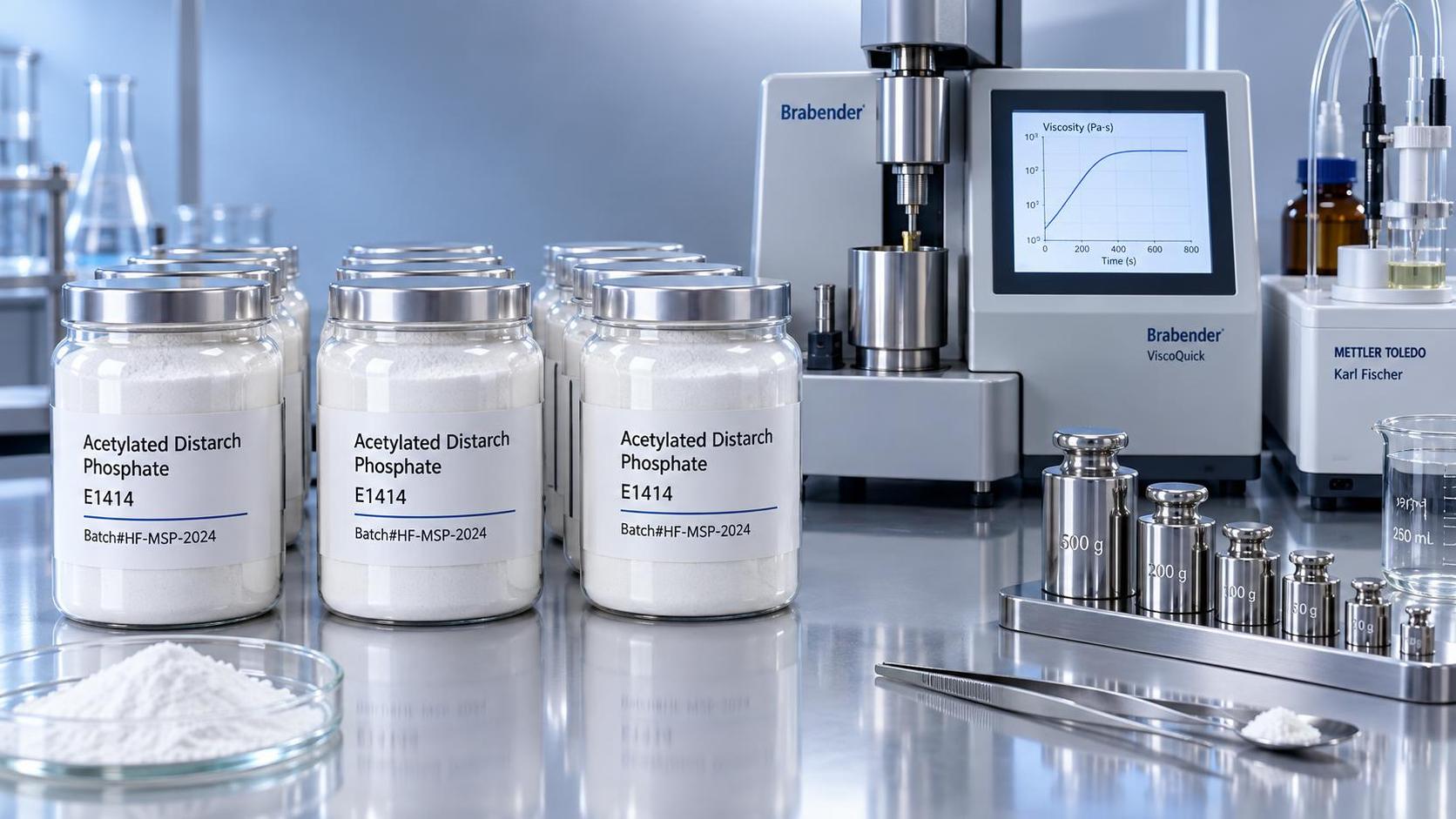
Its modified starch portfolio reflects that focus. Rather than offering dozens of generic variants, Huafeng structures its range around application-specific performance profiles: cold-water swelling types for instant beverage powders, high-shear stable variants for dairy analogs, and cross-linked grades with precise gelatinization onset for controlled-release pharmaceutical matrices. Each grade carries full technical documentation—not just pH or viscosity ranges, but actual test methods (e.g., Brabender viscoamylograph profiles at 3°C/min ramp), moisture limits validated by Karl Fischer titration, and residual solvent data per ICH Q3C guidelines where applicable.
Compliance Isn’t a Checkbox—It’s a Chain
For buyers in regulated sectors, “certified” means little without context. Huafeng’s ISO 9001 and ISO 22000 certifications are verified annually—but more importantly, their internal quality records include raw material COAs from pre-qualified starch suppliers (typically non-GMO maize or tapioca sourced under contractual traceability protocols), in-process testing logs for substitution degree (DS) consistency, and finished product heavy metal screening against EU Commission Regulation (EC) No 1881/2006 limits.
That level of documentation matters when your internal QA team reviews vendor files—or when customs authorities in Brazil, South Africa, or Vietnam request proof of origin alongside health certificates. Huafeng handles those requirements natively: HS code classification support, bilingual commercial invoices, and pre-shipment inspection coordination—not as add-ons, but as part of standard order fulfillment.
Technical Specifications That Hold Up Under Scrutiny
A typical Huafeng modified starch datasheet includes parameters most competitors omit: granule size distribution (laser diffraction, D50 ±0.5 µm tolerance), freeze-thaw stability data after five cycles, and clarity index (Hazen units) for transparent gels. These aren’t marketing flourishes—they’re the metrics that determine whether your salad dressing stays emulsified through summer warehouse storage, or whether your tablet disintegrates within 30 seconds in simulated gastric fluid.
For example, their acetylated distarch phosphate (E1414 equivalent) lists not only viscosity at 6% w/w but also shear recovery percentage measured via rotational rheometry—a critical factor for pumpable sauces that must regain structure after pipeline transit. This kind of detail reduces qualification time because it aligns directly with formulation engineers’ test protocols.
Cost Optimization Starts Before the PO
True cost efficiency rarely comes from negotiating unit price alone. It emerges from reducing hidden friction: fewer retests due to inconsistent DS values, lower logistics risk from consolidated container loads with predictable lead times, and less engineering time spent adapting to new suppliers’ documentation formats.
Huafeng’s export model supports this by offering fixed-quantity pallet configurations (e.g., 25 kg multi-wall paper bags with PE liner, stacked 40 per pallet), standardized shipping terms (FOB Qingdao or CIF destination port), and quarterly technical bulletins that flag any minor process adjustments—well before they affect specifications. That transparency lets procurement teams forecast supply continuity without building excessive safety stock.
When Chemistry Meets Real-World Use Cases
The same rigor applies across Huafeng’s broader specialty chemical offerings. Take Arbutin CAS#497-76-7: a compound used in cosmetic brightening formulations, urinary antiseptics, and photographic stabilizers. Its technical profile—melting point 195–198 °C, specific optical rotation [α]/D -64.0±2.0°, hygroscopic nature requiring dry nitrogen storage—isn’t theoretical. It directly informs packaging decisions (aluminum-laminated foil pouches), handling SOPs (glovebox transfer for high-purity batches), and stability testing windows (accelerated studies at 40°C/75% RH).
This isn’t about listing every parameter. It’s about knowing which ones impact your process—and having them verified, documented, and communicated without translation layers or follow-up emails.
What to Confirm Before Engaging
If you’re evaluating Huafeng’s modified starch range, start here:
- Request batch-specific COAs for your intended grade—not generic templates.
- Ask whether their current production lot matches the exact DS and viscosity profile cited in your last successful trial.
- Verify if their export documentation includes country-specific regulatory language (e.g., Arabic for Saudi Arabia, Portuguese for Angola).
- Clarify minimum order quantities for custom formulations versus standard grades.
None of these questions require sales pitches. They’re operational checkpoints—ones that separate suppliers who treat procurement as transactional from those who treat it as partnership infrastructure.
Global trade isn’t getting simpler. But sourcing doesn’t have to get harder. The right supplier makes complexity manageable—not by promising perfection, but by delivering consistency you can verify, document, and build upon.
Send Us Your Inquiry Today
