









Product Quick Navigation
Get a Quote
Crop Protection Chemicals to Southeast Asia Compliance: Mapping ASEAN Country-Specific MRLs, Labeling Rules & Import Licensing
Time : Sep 13, 2026
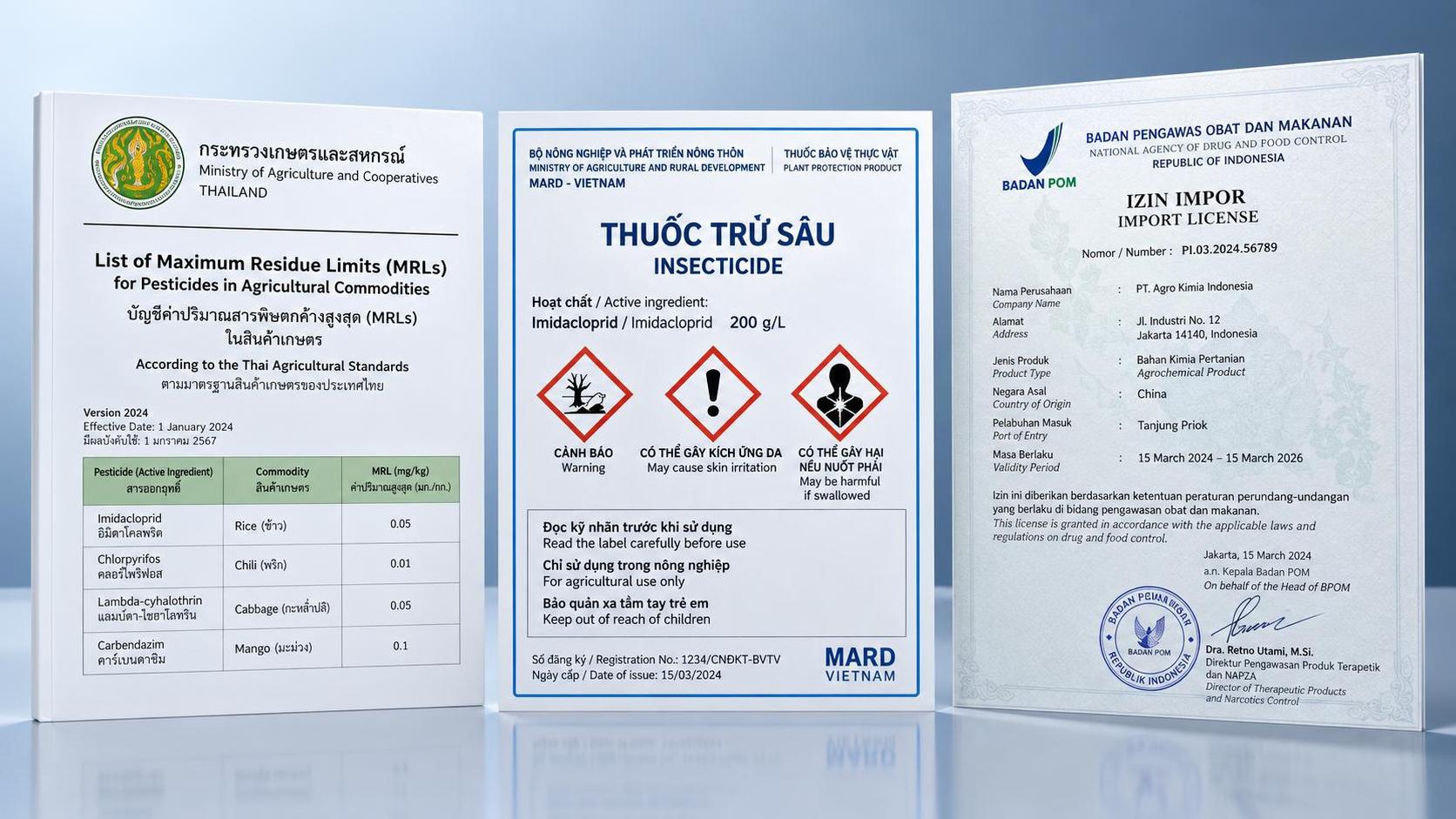
Compliance for crop protection chemicals entering Southeast Asia is not a uniform process—it’s a jurisdiction-specific operational checkpoint. For business evaluators assessing market entry feasibility, the critical question isn’t whether a product meets *a* standard, but whether it satisfies *the specific regulatory triad* of each ASEAN country: Maximum Residue Limits (MRLs), labeling rules, and import licensing requirements. These three elements operate independently across Thailand, Vietnam, Indonesia, Malaysia, and the Philippines—not as harmonized benchmarks, but as distinct legal filters that determine whether a shipment clears customs or triggers rejection, retesting, or forced destruction.
MRLs are the most technically volatile component. While Codex Alimentarius provides reference values, ASEAN members apply them selectively—and often revise them without synchronized notification. Thailand’s Department of Agriculture updates its MRL list quarterly via the Pesticide Registration Portal, with revisions frequently referencing newer EFSA or EPA assessments rather than Codex. Vietnam’s Ministry of Agriculture and Rural Development (MARD) maintains two parallel lists: one aligned with Codex for imported food commodities, another—more restrictive—for domestically registered active ingredients. Crucially, Vietnam does not recognize MRLs established solely for export-only registrations; residues must be validated under local residue trials or accepted foreign data meeting MARD’s 2021 Data Requirements Guideline. Indonesia’s BPOM applies MRLs based on its own risk assessment framework, which prioritizes local dietary exposure models and frequently sets limits lower than Codex for high-consumption crops like rice and chili peppers. There is no regional MRL database with real-time cross-referencing capability. Evaluators must verify each compound-crop combination against the latest national gazette—not against third-party summaries or outdated trade portals.
Labeling compliance is less about chemistry and more about administrative precision. ASEAN countries do not accept bilingual English-local language labels as default. In Thailand, all labels must be in Thai—including full chemical names, hazard pictograms per GHS Rev.7, and first-aid instructions—without abbreviations or transliterations. The label must also include the Thai registration number issued by the Department of Agriculture, not the exporter’s Chinese registration number. Vietnam requires labels to carry the Vietnamese name of the active ingredient *as registered in its national pesticide directory*, which may differ from IUPAC nomenclature due to historical translation conventions. Indonesia mandates that labels display the BPOM registration number *and* the manufacturing site address *as verified during facility inspection*, meaning a label approved for one production line cannot be reused for another—even within the same factory. None of these jurisdictions accept digital or QR-based supplementary labeling in lieu of physical label content. A single typographical error in the local-language hazard statement—such as misplacing a diacritical mark in Vietnamese—has triggered consignment rejection at Ho Chi Minh City port.
Import licensing introduces procedural asymmetry that cannot be mitigated by technical documentation alone. Thailand requires pre-shipment registration of both the product *and* the importer’s license—meaning a new buyer must complete a 45-day registration cycle before any shipment can be cleared. Vietnam operates a dual-track system: “temporary import permits” for trial shipments (valid 90 days, non-renewable) versus full import licenses (valid 3 years, requiring local representative appointment and annual reporting). Indonesia’s BPOM import license is tied to the product’s domestic registration status—if registration lapses, the import license becomes void, even if the license itself hasn’t expired. Crucially, none of these licenses permit “blanket” coverage across formulations: a suspension concentrate (SC) and its emulsifiable concentrate (EC) counterpart require separate licenses, even if sharing identical active ingredients and concentrations. This means evaluators must map not just active ingredients, but formulation types, to each country’s licensing structure—before estimating lead time or cost.
The absence of mutual recognition compounds execution risk. A product registered in Malaysia carries no weight in Singapore’s Agri-Food & Veterinary Authority (AVA) evaluation. A residue study accepted by Thailand’s DOA is routinely rejected by Vietnam’s MARD unless conducted in GLP-certified labs recognized under Vietnam’s 2020 Lab Accreditation Directive. Even analytical methods matter: Indonesia requires HPLC-MS/MS validation per BPOM Regulation No. 22 of 2022, while Thailand accepts GC-ECD for certain organophosphates—despite identical detection thresholds. These divergences mean that a single dossier cannot serve multiple markets. Evaluators must treat each ASEAN jurisdiction as a standalone regulatory entity—not as part of a regional bloc.
This fragmentation has concrete implications for supply chain design. A common misconception is that “ASEAN alignment” reduces compliance overhead. In practice, it increases coordination complexity: a single manufacturing batch destined for four countries may require four distinct labels, four MRL validations against different crop-residue pairings, and four import license applications with differing validity periods and renewal triggers. Lead times vary from 30 days (Malaysia’s straightforward online portal) to 180 days (Indonesia’s BPOM facility inspection + product review cycle). Storage and logistics planning must account for potential quarantine delays—not as exceptions, but as routine contingencies built into working capital calculations.
Technical substance selection further narrows viable pathways. Compounds with limited metabolic data in tropical cropping systems—such as newer biopesticides or plant extracts—face longer review timelines and higher likelihood of conditional approval. Conversely, legacy chemistries with extensive residue history in ASEAN-relevant crops (e.g., rice, cassava, rubber) move faster through registration—but may face stricter MRL tightening as countries adopt newer toxicological endpoints. Evaluators should prioritize compounds with existing ASEAN registration precedents in target crops over those with strong EU or US approvals but no regional footprint.
Operational resilience depends on anticipating—not reacting to—regulatory shifts. Thailand’s 2023 amendment to its Pesticide Act introduced mandatory post-market surveillance reports for all newly registered products after 12 months. Vietnam’s MARD now requires annual submission of sales volume data by importers—a requirement enforced through customs linkage. Indonesia’s BPOM has begun cross-checking import license usage rates against declared volumes, flagging discrepancies for audit. These are not theoretical compliance layers; they are active enforcement mechanisms affecting cash flow, inventory turnover, and contractual liability.
For business evaluators, the core decision point lies in determining whether regulatory execution capacity resides internally or must be sourced externally. Internal management demands dedicated staff fluent in local languages, trained in national electronic filing systems, and authorized to represent the company before regulatory agencies—a resource-intensive model rarely justified for initial market testing. External support requires verifying not just “regulatory consulting” capability, but documented success in securing *specific* MRL acceptances, label approvals, and import licenses for *identical product categories* in the target country. Generic chemical compliance experience does not transfer across ASEAN jurisdictions.
One illustrative case: a Chinese manufacturer exporting a fungicide containing tebuconazole faced divergent outcomes across three markets. Thailand approved it within 60 days using existing Codex MRLs and simplified label review. Vietnam required additional residue trials on dragon fruit—a crop not covered in the original EU dossier—delaying clearance by 11 months. Indonesia rejected the initial application due to mismatched manufacturing site details between the BPOM registration and import license forms, despite identical addresses in English; the discrepancy arose from inconsistent translation of “No. 123 Industrial Park Road” into Bahasa Indonesia across two government forms. Each outcome stemmed from jurisdiction-specific procedural logic—not technical deficiency.
In this context, Huafeng Chemical functions as an execution layer—not a strategic advisor. Its value lies in maintaining up-to-date access to national regulatory portals, managing document version control across evolving requirements, and executing submissions with jurisdiction-specific formatting discipline. That capability matters most when evaluating whether to proceed with registration in a given country: the question isn’t whether the chemistry works, but whether the compliance pathway is predictable, repeatable, and anchored in verifiable precedent—not generic claims.
Where technical specifications intersect with regulatory execution, consistency becomes non-negotiable. For instance, Xylitol CAS#87-99-0 demonstrates how molecular stability translates into regulatory predictability: its thermal stability and hygroscopic sensitivity dictate packaging specifications that directly affect shelf-life declarations on ASEAN labels—requirements enforced during BPOM or MARD inspections. Such linkages show why compliance cannot be outsourced as a checklist; it must be embedded in technical documentation from synthesis through packaging.
Ultimately, ASEAN crop protection chemical compliance is a series of discrete, non-interchangeable judgments—not a single threshold to cross. Business evaluators must assess each country on its own terms, using current, source-level regulatory texts—not aggregated summaries—and align internal capabilities or external partnerships accordingly. The cost of assuming convergence is higher than the cost of structured divergence.
Send Us Your Inquiry Today
