









Product Quick Navigation
Get a Quote
Food Modified Starch with COA: What Each Parameter on the Certificate of Analysis Means for Your Production Line
Time : Sep 13, 2026
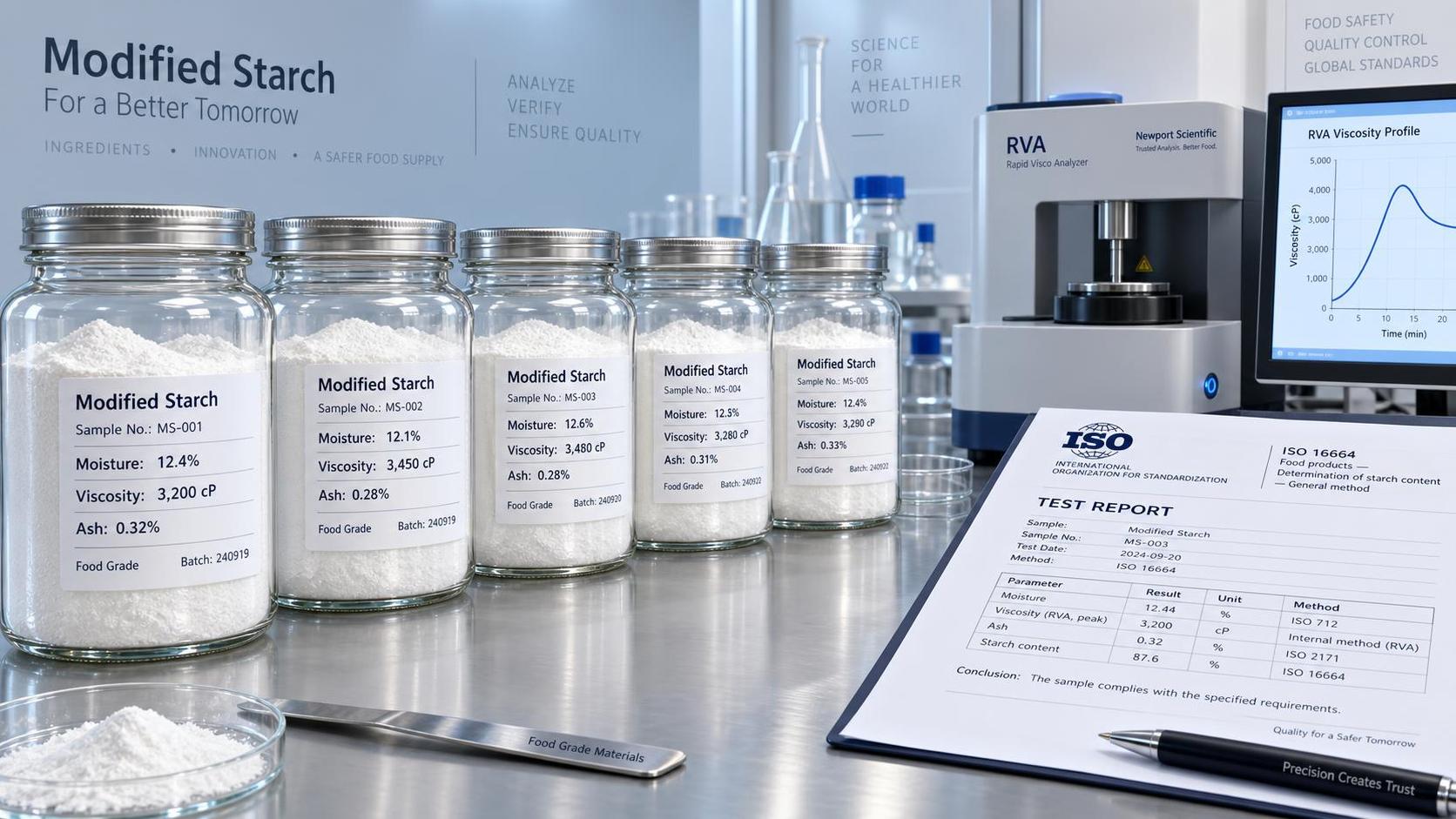
Ensuring consistent quality and regulatory compliance starts with understanding your food modified starch with COA—especially when it directly impacts production line performance, shelf life, and food safety. For quality control and safety managers in the chemical and food manufacturing sectors, every parameter on the Certificate of Analysis (e.g., moisture, viscosity, ash content, heavy metals) carries operational weight. At Shandong Huafeng Chemical Co., Ltd., we empower global clients with transparent, lab-verified COAs backed by ISO-compliant testing—helping you mitigate risk, accelerate batch release, and maintain supply chain integrity.
But here’s what many overlook: a COA isn’t just a checklist—it’s a functional blueprint for how your material behaves *in practice*. A value like “viscosity: 3,200 cP at 5% suspension, 50°C” doesn’t live in isolation. It interacts with your shear rate, hydration time, thermal profile, and even ambient humidity during mixing. Misreading or misapplying one parameter can cascade—delaying gelation, triggering phase separation, or compromising texture stability downstream.
Let’s walk through the most consequential parameters—not as abstract numbers, but as real-time signals your production line sends back to you.
**Moisture Content (% w/w)**
Often listed first, moisture is rarely just about water weight. In modified starches, it governs flowability, microbial stability, and reactivity during thermal processing. A reading of 12.4% vs. 13.8% may seem trivial—until your dry blending station experiences bridging, or your extrusion feed rate fluctuates unpredictably. Too low? Starch becomes electrostatically charged and clumps. Too high? Microbial growth accelerates—even within sealed intermediate packaging. Huafeng’s COAs specify moisture via AOAC Method 950.46 (vacuum oven), ensuring comparability across labs and shifts.
**Viscosity (Brookfield, RVA, or Brabender Profile)**
This is where theory meets torque. Viscosity data without context—like shear rate, temperature ramp, or hydration protocol—is misleading. Our COAs always state test conditions explicitly: e.g., “RVA profile: 10% slurry, 30–95–50°C, 7.5 rpm”. Why does that matter? Because if your line hydrates starch at 65°C but the COA was measured at 75°C, your actual peak viscosity could be 20–30% lower—potentially undermining thickening efficacy in sauces or dressings. We include both peak and setback values, which tell you whether your starch holds structure during cooling—a critical factor in chilled ready meals.
**Ash Content (%)**
Ash reflects inorganic residue after combustion—mostly sodium, potassium, calcium, and trace metals from processing aids or native grain minerals. While <0.5% is typical for food-grade starches, a shift from 0.32% to 0.48% across batches might indicate subtle changes in source corn origin or purification efficiency. For low-sodium formulations—or products targeting markets with strict mineral limits (e.g., infant nutrition)—this parameter anchors formulation recalculations. Huafeng cross-references ash data with ICP-OES results to identify elemental contributors—not just totals.
**Heavy Metals (Pb, Cd, As, Hg, Cr)**
Compliance isn’t binary; it’s layered. A COA stating “Pb <0.1 ppm” meets FDA and EU limits—but what if your customer requires <0.05 ppm for organic certification? Or your internal spec demands confirmation of speciation (e.g., inorganic vs. methylated arsenic)? Our reports detail detection methods (ICP-MS, not just AAS), LOD/LOQ, and whether testing followed ISO 17025-accredited protocols. No assumptions. No extrapolation.
**Sulfur Dioxide (SO₂) Residue**
Not all modified starches use SO₂-based bleaching—but when they do, residual levels affect flavor release, Maillard browning, and even allergen labeling (SO₂ is a declared allergen in EU and UK). A value of 28 ppm may pass JECFA guidelines but trigger reformulation if your clean-label initiative caps sulfites at 10 ppm. Huafeng discloses SO₂ methodology (Monier-Williams) and notes whether samples were tested pre- or post-packaging—since migration from liners can occur.
**Microbiological Parameters (TPC, Yeast/Mold, Pathogens)**
A COA listing “TPC <100 CFU/g” means little without knowing incubation time, media, and temperature. We report using ISO 4833-1:2013 (aerobic plate count at 30°C, 72h), plus separate tests for *Salmonella* (absent/25g) and *E. coli* (absent/1g), aligned with BRCGS and FSSC 22000 requirements. Crucially, we flag any borderline results—not just pass/fail—so you can assess trend data before approving a batch.
**pH and Solubility Profile**
Modified starches aren’t inert fillers—they’re pH-sensitive hydrocolloids. A pH of 5.8 vs. 6.3 alters ionization of phosphate groups, shifting hydration kinetics and cold-water swelling. Our COAs include pH measured in 1% aqueous slurry (ISO 750), alongside solubility at defined temperatures—because “soluble” means different things at 20°C versus 80°C. This informs whether your dispersion tank needs pre-heating, or if cold-start mixing will yield incomplete hydration.
And then there are the less obvious—but equally decisive—parameters:
**Residual Reactants (e.g., Epichlorohydrin, Sodium Trimetaphosphate)**
For cross-linked starches, unreacted monomers must be tracked. Huafeng validates residual levels against EFSA thresholds—not just regulatory minimums—and includes method validation summaries so you can assess uncertainty margins.
**Particle Size Distribution (D50, Span)**
A narrow distribution ensures uniform hydration. But if your high-shear mixer relies on rapid wetting, a D50 of 18 µm may behave very differently than 25 µm—even with identical chemistry. We report laser diffraction data per ISO 13320, with refractive index settings documented.
None of this replaces in-house verification—but it *sharpens* your validation focus. When you know exactly what each number represents—and how it maps to your process variables—you stop treating COAs as paperwork. You start treating them as predictive tools.
That same rigor extends beyond starches. For instance, when sourcing solvents like 4-Methyl-2-pentanone CAS#108-10-1, used in pharmaceutical synthesis or polymer dissolution, we apply parallel discipline: precise flash point verification (56°F, ASTM D93), APHA color tracking (≤15), and volatility profiling—because solvent carryover affects final product purity just as starch hydration affects texture.
Global supply chains don’t reward speed alone. They reward *clarity*: clarity in specifications, clarity in testing, clarity in interpretation. At Huafeng, every COA is signed by a qualified analyst, traceable to NIST standards, and reviewed against both regional regulations and your stated application intent—not just generic food-grade criteria.
So next time you receive a COA for food modified starch with COA, don’t just check boxes. Ask:
• Was moisture measured under conditions matching my storage environment?
• Does viscosity reflect my actual shear profile—or an idealized lab curve?
• Are heavy metal results reported with speciation and uncertainty?
• Is the microbiological method aligned with my audit standard?
Because consistency isn’t delivered in a drum. It’s built—one parameter, one decision, one production run—at a time.
Send Us Your Inquiry Today
