









Product Quick Navigation
Get a Quote
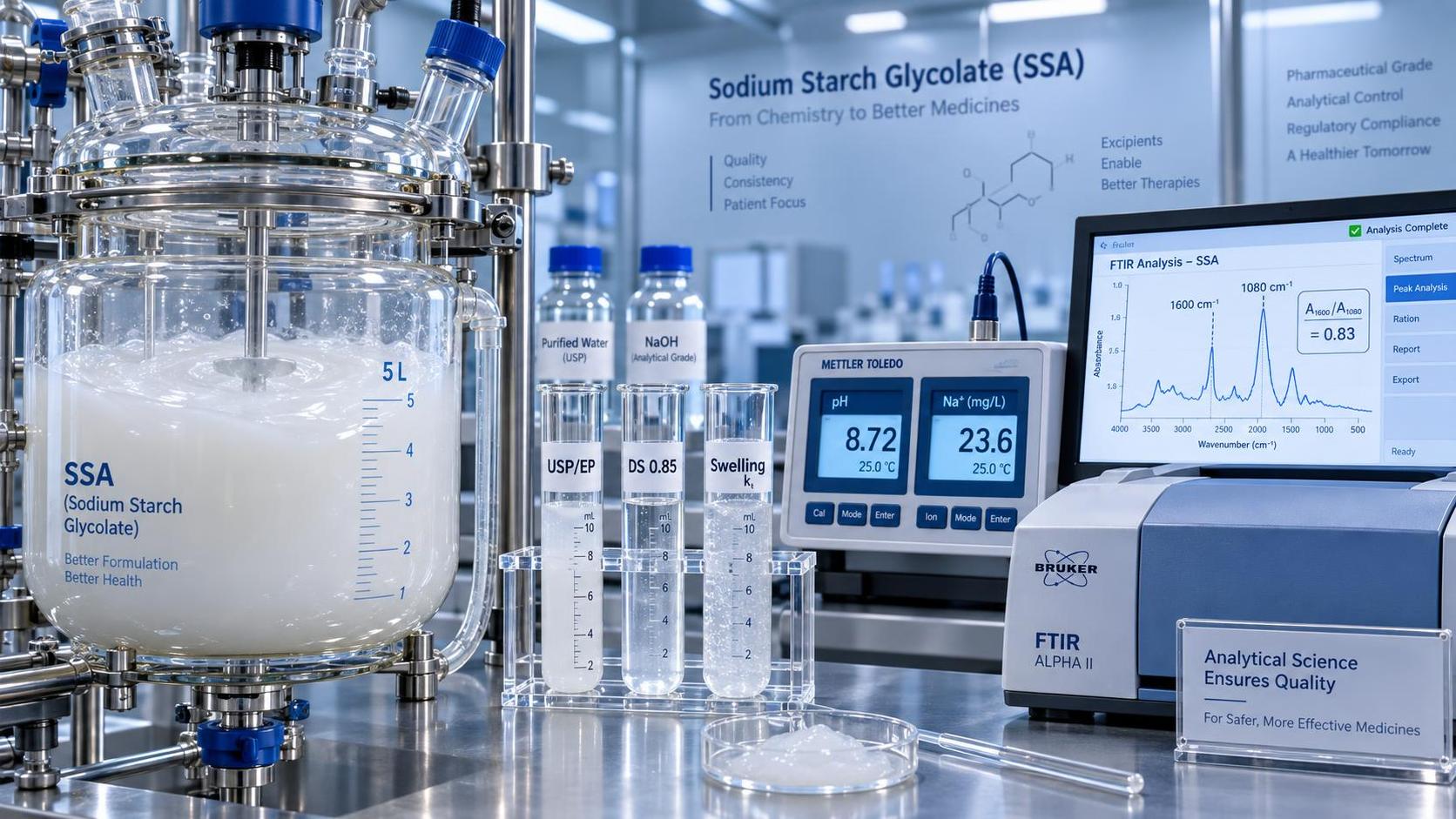
Selecting the right sodium starch glycolate supplier is critical for pharmaceutical manufacturers prioritizing tablet disintegration performance, regulatory adherence, and batch-to-batch consistency. With rising demand for USP/EP-compliant Sodium Starch Glycolate (SSA), buyers must rigorously evaluate substitution ratio, swelling capacity, and GMP-aligned production—factors directly impacting formulation efficacy and regulatory approval.
Why Substitution Ratio Matters Beyond Specification Sheets
The degree of substitution (DS) defines how many hydroxyl groups per glucose unit are carboxymethylated. While USP-NF and Ph. Eur. specify a DS range of 0.5–1.2, this number alone is insufficient for predicting functional behavior. A DS of 0.85 achieved via alkaline pre-treatment followed by controlled chloroacetate addition yields more uniform substitution across amylose and amylopectin chains than the same nominal DS obtained through rapid, high-pH reaction—where surface substitution dominates and internal chain modification remains incomplete. This heterogeneity affects hydration kinetics: low-DS regions swell slowly, delaying initial water ingress; over-substituted zones may form localized gels that impede radial water penetration into tablet cores. As a result, two SSA batches with identical DS values can exhibit up to 35% difference in t50 (time to 50% disintegration) under standardized USP Apparatus 2 testing at 50 rpm. Buyers should request not only DS but also substitution distribution profiles—ideally supported by FTIR peak ratio analysis (e.g., C=O stretch at 1600 cm−1 vs. C–O at 1080 cm−1) or enzymatic digestibility data showing amyloglucosidase resistance patterns.
Swelling Capacity: Not Just Volume, But Kinetics and Structural Integrity
Swelling capacity is commonly reported as mL/g after 30 minutes in distilled water—but this static value masks critical dynamics. Pharmaceutical-grade SSA must swell rapidly (within seconds) upon contact with dissolution media, yet maintain structural coherence long enough to generate mechanical stress on the tablet matrix. Over-swollen, fragile gels collapse before exerting sufficient force; under-swollen material fails to disrupt binder networks. The key lies in cross-link density and granule morphology. High-shear wet granulation during SSA manufacturing introduces micro-fissures that accelerate water wicking, while excessive drying (>60 °C) collapses pore architecture and reduces effective surface area. A supplier claiming “12 mL/g swelling” without specifying time point, temperature (25 °C vs. 37 °C), or medium composition (0.1 N HCl vs. pH 6.8 phosphate buffer) provides functionally irrelevant data. Real-world relevance requires testing under pharmacopoeial conditions: USP Disintegration Test using tablets containing 5% SSA, lactose monohydrate, and microcrystalline cellulose, compressed to 10 kN. Swelling rate constants (kswell) derived from gravimetric uptake curves between 10–120 seconds correlate more strongly with t90 than equilibrium volume alone.
USP/EP Compliance Is a Process, Not a Certificate
A certificate stating “conforms to USP-NF Sodium Starch Glycolate” does not guarantee suitability. USP monograph requirements include identity (FTIR, TLC), assay (carboxymethyl content), residue on ignition (<5.0%), heavy metals (<20 ppm), microbial limits (not more than 100 cfu/g aerobic bacteria, absence of E. coli and S. aureus), and disintegration performance (≤15 min for immediate-release tablets). However, compliance hinges on process control—not just end-product testing. For example, residual chloroacetic acid (a Class 2 solvent per ICH Q3C) must be monitored throughout synthesis and purified to <50 ppm; its presence above threshold degrades tablet stability and triggers genotoxicity concerns. Similarly, starch source matters: USP permits maize, potato, or wheat origin, but wheat-derived SSA carries gluten risk requiring dedicated milling lines and ELISA verification—not just supplier declarations. EP 10.0 adds tighter limits on sulfated ash (≤0.5%) and stricter microbial enumeration methods. Buyers must audit whether the supplier performs lot-specific testing for all monograph parameters—or relies on periodic validation with historical data interpolation.
GMP Alignment Extends Beyond the Facility Walls
GMP compliance for excipients demands traceability from raw starch sourcing to final packaging. This includes documented starch origin (farm-level where feasible), pesticide residue screening (e.g., glyphosate <0.1 ppm), and mycotoxin controls (aflatoxin B1 <2 ppb). Packaging integrity is equally critical: SSA is hygroscopic. Exposure to ambient humidity >60% RH during transfer or storage causes premature hydration, reducing swelling efficiency and promoting microbial growth. Suppliers must use triple-layer moisture-barrier packaging (e.g., aluminum-laminated polyethylene) with desiccant packs and sealed inner liners—not generic HDPE bags. Furthermore, shipping documentation must include environmental monitoring logs (temperature/humidity) for the entire transit chain, especially for air freight where cargo holds experience rapid pressure and humidity shifts. A deviation report for a single unmonitored 4-hour leg invalidates the entire GMP claim—even if the facility itself holds EU GMP certification.
Functional Consistency Requires More Than Analytical Equivalence
Two SSA batches may pass all USP tests yet behave differently in high-speed tableting. Differences in particle size distribution (PSD) affect flowability and blend uniformity: D90 > 120 µm increases segregation risk in low-dose formulations; D10 < 15 µm elevates dust generation and electrostatic charging. Suppliers rarely disclose PSD unless specifically requested—and even then, laser diffraction data assumes spherical particles, whereas SSA granules are irregular and porous. BET surface area measurements (m²/g) provide better correlation with hydration onset than sieve analysis. Additionally, residual moisture content must be tightly controlled: 6–8% ensures optimal compressibility without compromising stability. Values below 4% increase friability; above 9%, caking occurs during storage. These parameters interact—e.g., higher DS generally lowers optimal residual moisture—and cannot be optimized in isolation.
For applications requiring co-processing or multi-functional excipients, compatibility with other formulation components becomes decisive. In acidic environments (e.g., enteric-coated tablets), low-DS SSA exhibits reduced swelling due to protonation of carboxyl groups; high-DS material maintains ionization but may interact with basic APIs like ranitidine, forming insoluble salts. Such interactions are detectable only through forced degradation studies—not standard compatibility testing. One widely overlooked factor is thermal history: SSA exposed to >40 °C during storage undergoes partial retrogradation, diminishing its ability to disrupt hydrogen bonding in HPMC-based matrices. Stability-indicating assays tracking viscosity loss in 1% aqueous dispersions at 25 °C over 6 months reveal this degradation more reliably than visual inspection.
Where formulation flexibility is required, certain auxiliary materials serve complementary roles—for instance, Glycerol CAS#56-81-5 functions as both a plasticizer in film coatings and a humectant in chewable tablets, helping maintain tablet integrity during disintegration without interfering with SSA’s swelling action. Its low volatility and high boiling point (290 °C) ensure retention during fluid-bed drying, unlike volatile solvents that may alter SSA surface properties.
Supplier Evaluation: Actionable Due Diligence Steps
- Request full batch records—not just CoA—for three consecutive commercial lots, including raw starch certificates of analysis, in-process DS measurements, and final swelling kinetic curves (not just endpoint values).
- Verify microbial testing methodology: USP Microbiological Examination of Nonsterile Products requires membrane filtration for SSA due to its insolubility; turbidimetric or plate-count-only reports are noncompliant.
- Require evidence of change control: any process adjustment (e.g., dryer temperature shift, new starch vendor) must trigger comparative functional testing against reference batches—not just analytical retesting.
- Assess supply chain transparency: ask for proof of starch origin certification, not just supplier statements; verify whether the same production line handles non-pharma starch grades (risk of carryover).
Ultimately, sodium starch glycolate is not a commodity excipient. Its performance is intrinsically tied to molecular architecture, processing history, and handling conditions. The lowest-cost supplier often incurs highest total cost when disintegration failures delay clinical trials or trigger field alerts. Rigorous evaluation of substitution homogeneity, swelling dynamics, and verifiable GMP execution—not just monograph compliance—is the only path to robust, scalable tablet development.
Send Us Your Inquiry Today
