









Product Quick Navigation
Get a Quote
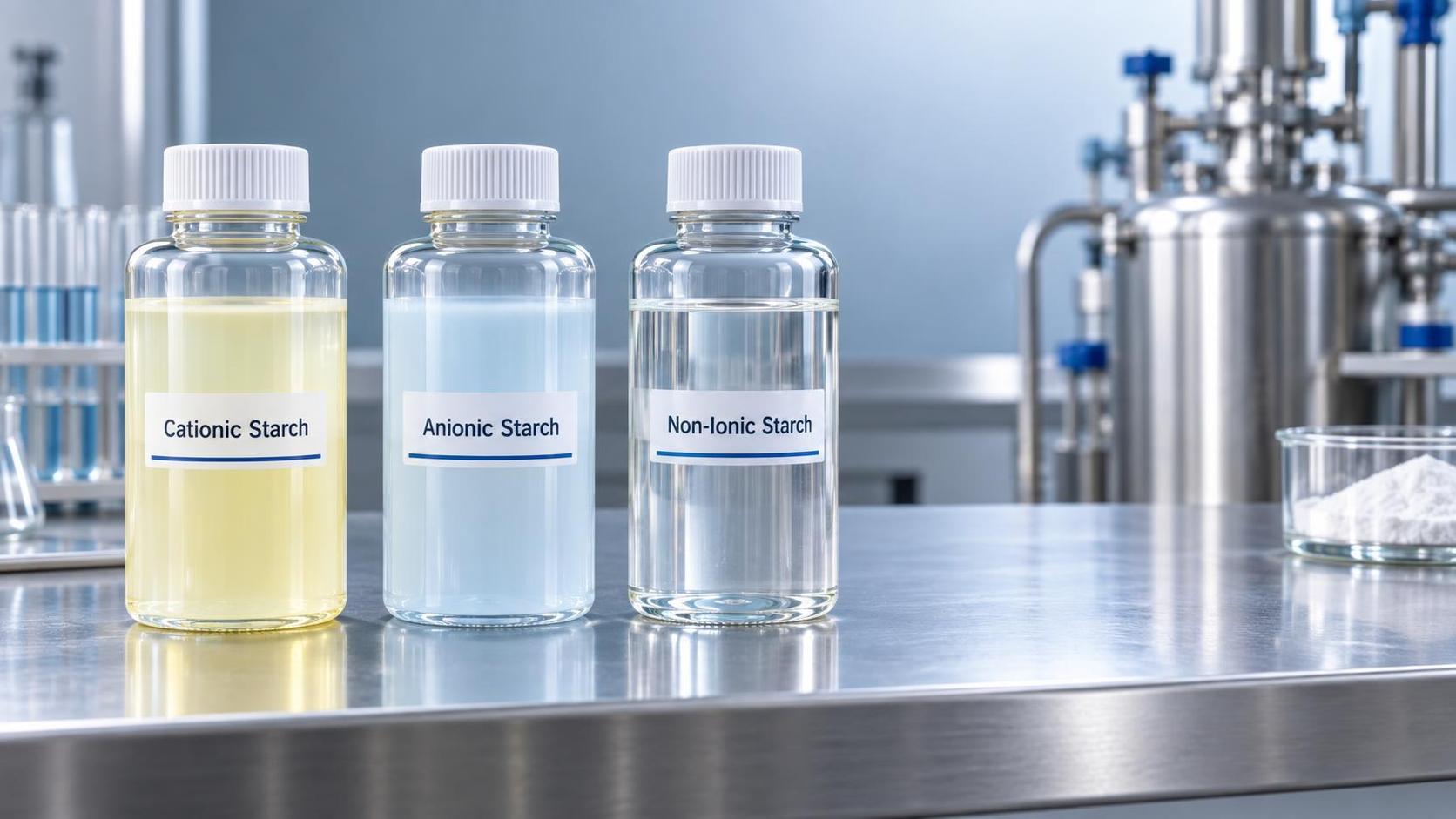
Cationic, Anionic, or Non-Ionic? Choosing the Right Modified Starch for Paper Sizing — A Practical Operator’s Guide
If you’re running a paper machine—especially at speeds above 800 m/min—or adjusting formulations for recycled fiber blends, filler-loaded sheets, or lightweight coated grades—you’ve likely hit this bottleneck: sizing performance drops just as demand for surface strength, ink holdout, and dry-end runnability rises. Modified starch remains the workhorse sizing agent in most wet-end systems, but selecting the wrong ionic type isn’t just a matter of suboptimal results—it can trigger deposit buildup, interfere with retention aids, or even destabilize the entire furnish. This isn’t theoretical. It’s what happens when cationic starch meets anionic fillers without dosage calibration, or when non-ionic starch fails to anchor to highly anionic eucalyptus pulp.
Why Ionic Character Matters More Than “Starchiness”
Modified starch for paper industry sizing agent functions not just as a film former, but as a molecular bridge. Its effectiveness hinges on electrostatic affinity—not just viscosity or gel temperature. The pulp fiber surface is predominantly anionic (due to carboxyl groups from hemicellulose and lignin), especially in mechanical or recycled pulps. Fillers like GCC and PCC carry strong negative surface charges. Retention systems often rely on cationic polymers. So the starch’s charge determines whether it adsorbs strongly, competes destructively, or simply washes through.
Cationic starches (typically etherified with quaternary ammonium groups) deliver rapid, high-affinity binding to fibers and fines. That means excellent initial sheet strength and improved pick resistance—but only if the system isn’t oversaturated with other cationics. Overdosing can cause colloidal instability, leading to deposits in size presses or dryer sections. Anionic starches (often phosphate- or sulfate-esterified) resist precipitation in high-cationic environments and offer better compatibility with calcium-based fillers—but their fiber affinity is weaker, requiring higher dosages and often sacrificing dry tensile. Non-ionic starches (e.g., hydroxyethyl or acetylated types) provide neutral, predictable rheology and minimal interference with retention chemistry—but they rely almost entirely on hydrogen bonding and mechanical entanglement, making them vulnerable to shear degradation and less effective on low-freeness, high-filler stocks.
Real-World Trade-Offs: Strength vs. Stability vs. Runnability
There’s no universal “best.” What works on a 100% bleached kraft liner machine may fail catastrophically on a 70% deinked pulp newsprint line—even with identical dosage rates. Here’s how operators actually weigh the options:
- Cationic grades excel where fiber bonding dominates the priority: packaging boards, kraft sack papers, and tissue base sheets. They boost Mullen burst and Scott bond significantly—even at 0.3–0.5% on pulp—but require tight control of pH (optimal 4.5–6.2) and conductivity. In mills using high-ash broke or municipal sludge-blended furnish, unexpected anion demand spikes can neutralize cationic starch before it reaches fibers.
- Anionic grades are the pragmatic choice for high-filler, alkaline papers—especially where precipitated calcium carbonate (PCC) exceeds 20%. Their negative charge prevents coagulation with Ca²⁺ ions and avoids competing with cationic retention aids. However, don’t expect them to replace cationic starch in surface sizing applications; their film integrity under calendering is lower, and they show reduced efficacy below pH 7.5.
- Non-ionic grades shine in specialty applications demanding consistency over raw strength: carbonless base stock, thermal paper substrates, or when blending with synthetic latex. Their neutrality makes them ideal for closed-loop whitewater systems prone to high dissolved solids. But their lack of electrostatic drive means they perform poorly on low-pH sulfite pulps or in machines with aggressive pre-press nips that shear starch granules before full hydration.
When “Natural Origin” Isn’t Enough—Look at Functional Consistency
Some buyers assume plant-derived starches automatically mean broader compatibility or regulatory safety. That’s misleading. Natural origin matters for certain pharmaceutical excipients—like Tussilagone CAS#104012-37-5, which is isolated from Tussilago farfara flower buds for research into inflammatory pathways—but papermaking demands reproducible rheology, narrow particle distribution, and batch-to-batch charge density stability. A starch labeled “non-GMO” or “plant-based” tells you nothing about its substitution pattern, degree of crosslinking, or residual monomer content. What matters is whether the manufacturer controls the oxidation, cationization, or enzymatic cleavage steps tightly enough to hold charge density within ±5% across shipments—and whether they validate performance under your specific furnish conditions, not just lab beaker tests.
Three Checks Before You Specify or Sample
Before committing to trials—or worse, scaling up—verify these three points with your supplier:
- Furnish-specific charge titration data. Ask for zeta potential shift curves measured *in your actual whitewater*, not distilled water. A cationic starch showing +12 mV adsorption in pure water may drop to +2 mV in your high-anionic-demand broke system.
- Shear stability profile. Request viscosity retention data after 5 minutes at 10,000 s⁻¹ (simulating size press nip shear). Many modified starches lose >40% apparent viscosity under that stress—degrading film formation.
- Residual formaldehyde or acetaldehyde levels. Not just for odor control: aldehydes react with amine-based biocides used in size press systems, reducing preservative efficacy and accelerating microbial growth in starch tanks.
Suppliers who provide only generic spec sheets—or insist their starch “works for everyone”—aren’t equipped for real-world troubleshooting. Reliable partners run pilot trials on representative furnish, track sizing efficiency via Cobb60 and Hercules test, and correlate lab results with actual machine runnability metrics: sheet breaks per shift, size press cleaning frequency, and post-calender gloss variation.
Final Note: Don’t Optimize One Parameter in Isolation
Improving sizing efficiency by switching to a higher-substitution cationic starch might gain 5% in dry tensile—but if it pushes your anionic trash level past critical flocculation thresholds, you’ll pay for it in increased ash spots, wire marks, and downtime. The right modified starch for paper industry sizing agent isn’t the one with the highest charge or lowest price. It’s the one whose ionic behavior aligns with your furnish’s net charge, your retention strategy’s chemical architecture, and your machine’s shear and dwell-time constraints. Start there—and treat every new grade as a system variable, not just a drop-in replacement.
Send Us Your Inquiry Today
