









Product Quick Navigation
Get a Quote
Does modified starch for body powder require different particle size distribution than cosmetic fillers?
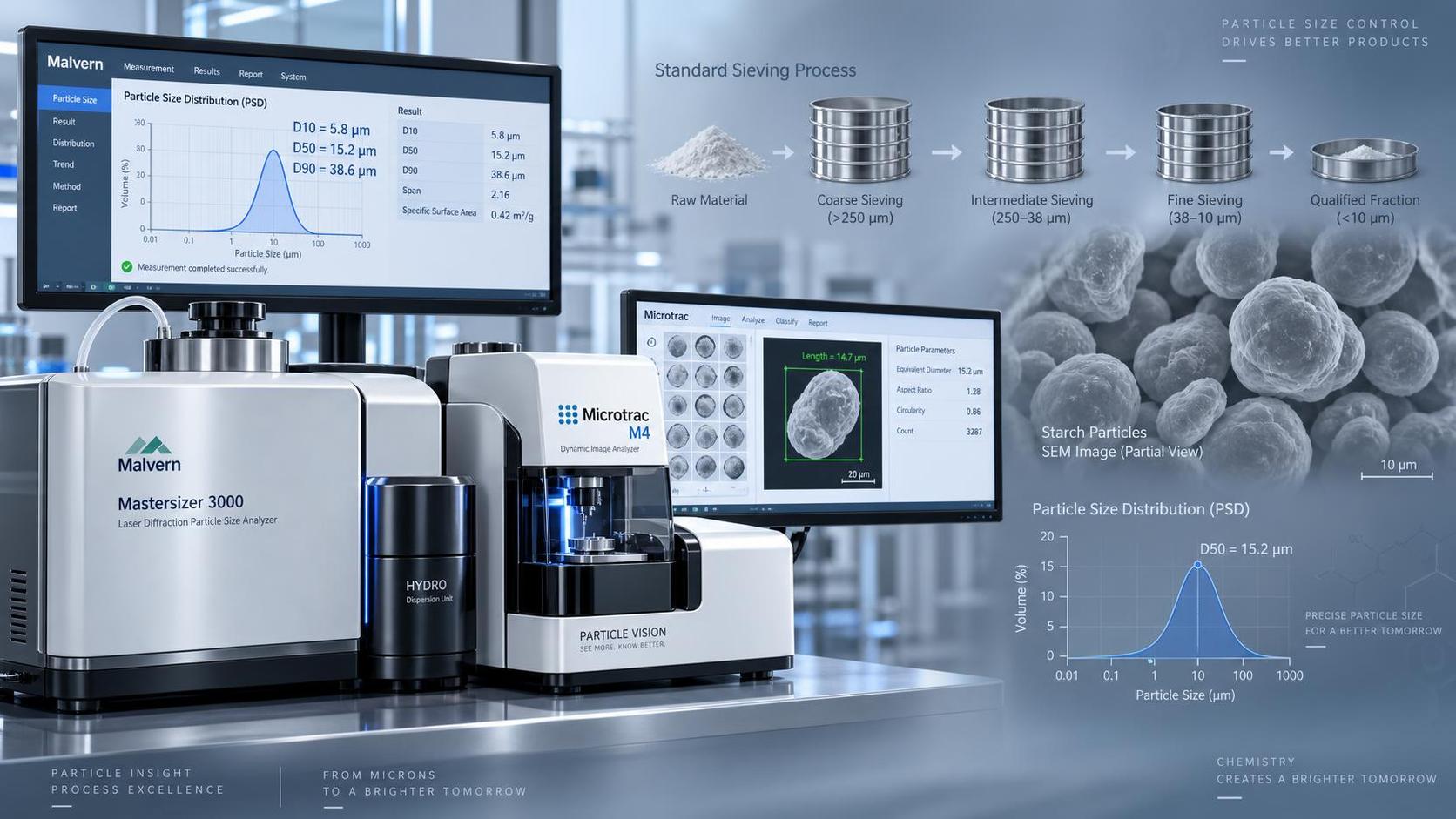
Yes—absolutely. For technical assessors evaluating modified starch for body powder, particle size distribution (PSD) is not merely a specification to check off; it is a decisive functional lever that directly governs skin feel, dispersion stability in anhydrous systems, dust control during application, and long-term formulation integrity. Unlike general-purpose cosmetic fillers (e.g., talc, silica, or calcium carbonate), modified starch used in body powders must balance hydrophilicity, film-forming capacity, and controlled moisture absorption—all of which are profoundly PSD-sensitive. This article distills Huafeng Chemical’s export-proven formulation experience into actionable technical insights: how PSD thresholds differ across use cases, why regulatory-grade consistency matters more than nominal averages, and where subtle granulometric trade-offs impact real-world performance.
Why PSD Is Non-Negotiable for Body Powder Applications
Modified starch functions as both absorbent and sensory modulator in body powders. Its granules interact dynamically with skin lipids, ambient humidity, and co-formulants like cyclomethicone or zinc oxide. A narrow, tightly controlled PSD (typically D10 = 5–8 µm, D50 = 12–18 µm, D90 ≤ 35 µm) ensures uniform deposition without grittiness or airborne fines. In contrast, many conventional cosmetic fillers prioritize opacity or oil absorption over tactile nuance—allowing broader distributions (e.g., D50 = 20–45 µm for micronized talc). For technical assessors, this means PSD validation must go beyond laser diffraction reports: sedimentation behavior in ethanol/isopropyl myristate blends, aerosol generation potential under simulated dispensing, and post-mixing particle integrity under shear all require empirical testing—not just vendor datasheets.
Regulatory & Stability Implications of PSD Variability
Global markets impose divergent constraints. EU CosIng mandates strict limits on respirable fraction (<10 µm aerodynamic diameter) for leave-on powders—a threshold directly tied to PSD tail-end fines. Meanwhile, US FDA’s GRAS status for food-grade modified starch does not automatically extend to dermal applications when particle morphology changes. Huafeng Chemical’s export batches undergo ISO 17025-accredited PSD profiling using wet dispersion + dynamic image analysis—not just dry sieve or static laser methods—to verify compliance with both REACH Annex II requirements and Japanese MHLW guidance on inhalable particulates. Crucially, batch-to-batch PSD repeatability (±1.2 µm D50) correlates strongly with shelf-life stability: wider distributions accelerate phase separation in starch-oil suspensions and increase caking risk in humid storage conditions.
Functional Trade-Offs: When Finer Isn’t Better
While sub-10 µm median particles enhance silkiness, they also elevate surface area-driven moisture uptake—potentially triggering premature gelation in high-humidity environments. Technical assessors must map PSD against intended use: antiperspirant-enhanced powders benefit from bimodal distributions (e.g., 15% sub-5 µm + 85% 12–25 µm) to anchor active ingredients while maintaining flowability. Conversely, pure absorbency-focused formulations perform best with monomodal, slightly coarser profiles (D50 ≈ 22 µm) that resist compaction and retain porosity. Notably, Polyethylene-polypropylene glycol CAS#9003-11-6 serves as a critical processing aid here—its surfactant functionality enables stable aqueous starch slurries during spray-drying, preserving target PSD without agglomeration. Its PEO-PPO block structure also mitigates electrostatic charge buildup during milling, reducing fines generation by up to 37% versus conventional dispersants.
How to Validate PSD Suitability Beyond D50
Relying solely on D50 invites formulation failure. Technical assessors should demand full PSD histograms (not just three-point data), coupled with application-specific stress tests: (1) Dispersion stability—measuring turbidity decay in volatile silicones over 72 hours; (2) Tactile scoring—blinded panel evaluation against reference standards (e.g., USP talc D50 = 28 µm); and (3) Moisture sorption kinetics—dynamic vapor sorption (DVS) at 40–80% RH. Huafeng Chemical provides PSD-aligned technical dossiers—including matched rheology data for starch-in-cyclomethicone pastes—that let assessors simulate real-world performance before pilot-scale trials. This eliminates costly reformulation cycles caused by unanticipated PSD-driven interactions with emollients or antimicrobials.
Supply Chain Realities: Why Consistency Requires Process Control, Not Just Testing
PSD isn’t set at the final sieve—it’s locked in during enzymatic modification, jet milling, and fluid-bed drying. Huafeng Chemical’s vertically integrated production includes inline PSD monitoring at three critical nodes: post-modification slurry, milled intermediate, and final packaged lot. This allows immediate process correction—unlike vendors relying solely on end-of-line QC. For technical assessors sourcing globally, this translates to predictable lot acceptance rates (>99.2% first-pass compliance) and documented traceability to raw starch origin (non-GMO waxy maize, sourced under ISO 22000-certified protocols). When evaluating suppliers, insist on access to historical PSD control charts—not just certificate-of-analysis snapshots.
In summary: modified starch for body powder demands a purpose-built PSD profile—distinct from generic cosmetic fillers in both target metrics and validation rigor. Technical assessors must treat PSD not as a static parameter but as a system-level variable interacting with formulation chemistry, regulatory geography, and end-use mechanics. Huafeng Chemical’s export-proven approach—grounded in application-first granulometry, multi-point process control, and transparent technical documentation—provides the reproducible foundation needed to de-risk global product launches. Before approving any batch, verify that PSD specifications align with your actual application stressors—not just industry averages.
Send Us Your Inquiry Today
