









Product Quick Navigation
Get a Quote
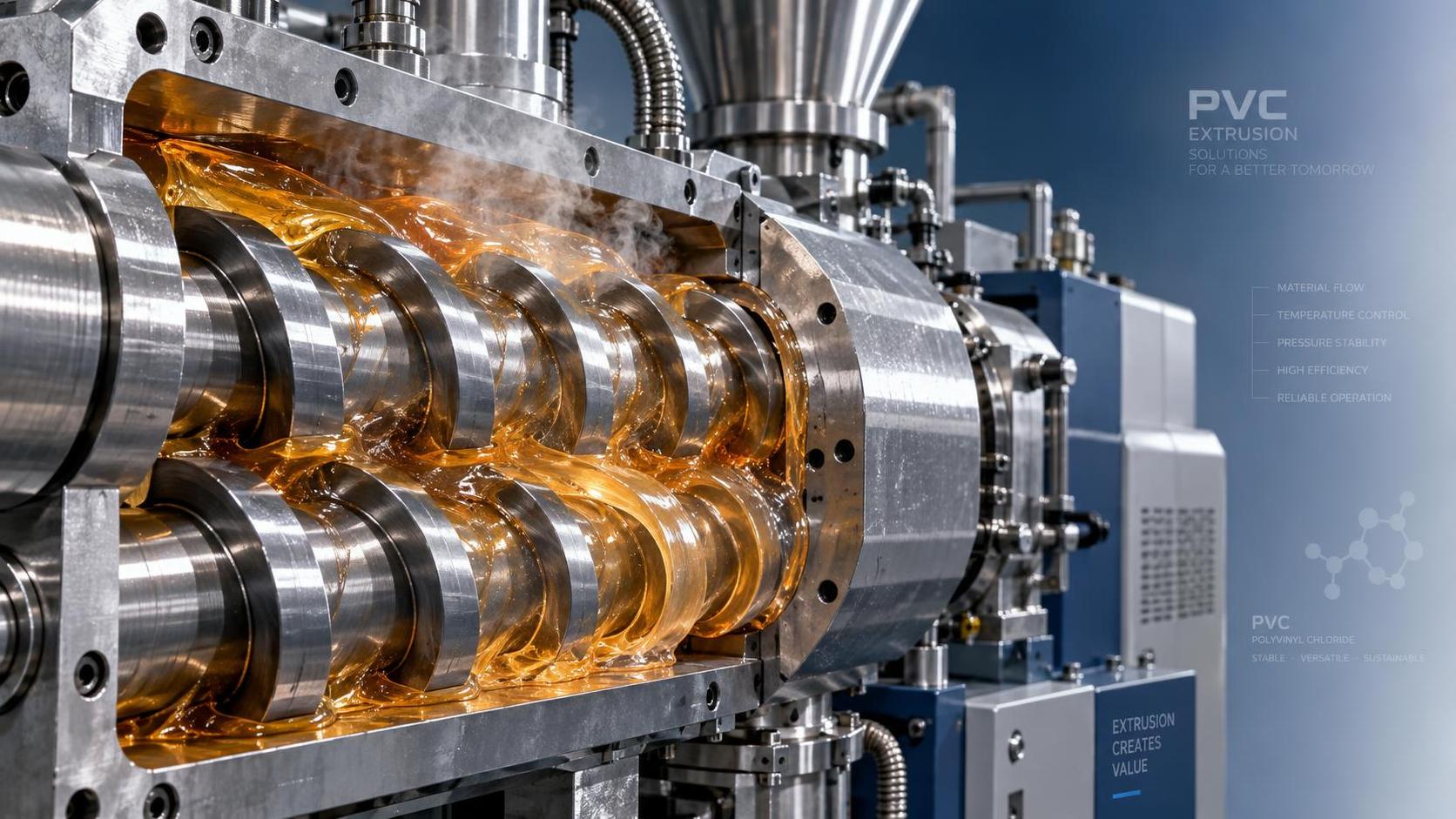
For PVC compounders, plastic resin selection isn’t a background specification—it’s a throughput lever. When project managers are tasked with scaling extrusion output without destabilizing quality, batch repeatability, or regulatory compliance, the choice of Plastic Resin directly determines whether the line runs at 85% capacity or consistently hits 98%—and whether unplanned downtime eats into weekly targets.
It’s Not Just About “PVC”—It’s About How That PVC Behaves Under Shear and Heat
Many assume all suspension-grade PVC resins behave similarly in extrusion. They don’t. Key differences—particle morphology, porosity, bulk density, and thermal history—dictate how readily the resin absorbs plasticizer, how uniformly it melts in the barrel, and how smoothly it transitions from solid to melt phase under screw shear. A resin with low porosity and high crystallinity may require longer residence time to fully plasticize, forcing operators to reduce screw speed to avoid melt fracture—cutting throughput by 12–18% compared to a more open, porous grade designed for rapid uptake and dispersion. This isn’t theoretical: compounders routinely report that switching between two seemingly comparable SG-5 resins—both meeting ISO 1043 specifications—shifts stable extrusion speed by ±7 rpm on the same twin-screw line, with no other process change.The Real Bottleneck Is Often Upstream—Not the Extruder Itself
Project managers sometimes focus optimization efforts solely on screw design or barrel temperature profiles—while overlooking how resin choice governs feed consistency. A resin with poor flowability (e.g., high fines content or irregular particle shape) causes bridging in the hopper or erratic feeding through the gravimetric feeder. Even brief fluctuations in feed rate translate directly into melt temperature spikes, surging backpressure, and downstream gauge variation—triggering scrap, rework, or manual intervention. In practice, this means throughput isn’t limited by motor amperage or die design; it’s capped by how predictably the material feeds. Resins engineered for consistent particle size distribution and low electrostatic charge—often achieved via surface treatment or controlled polymerization conditions—deliver tighter feed control and allow operators to run closer to mechanical limits with confidence.Stabilizer Compatibility Isn’t Optional—It’s Throughput Insurance
PVC degrades rapidly above 160°C. Stabilizers delay decomposition—but their effectiveness depends heavily on how well they disperse *within the resin matrix* during initial mixing. A resin with high internal surface area and uniform pore structure allows stabilizers (especially organotin or Ca/Zn systems) to anchor more effectively during dry blending. Poor dispersion leads to localized hot spots, premature degradation, and carbon buildup in screen packs or die lips—requiring more frequent changeovers and reducing effective production hours per shift. This is especially critical when running high-output lines where residence time is compressed: there’s less margin for incomplete stabilization. Resins pre-tested for compatibility with common heat stabilizer packages—and validated under accelerated shear conditions—reduce this risk significantly.Why “Generic” Resin Sourcing Creates Hidden Throughput Risk
Global supply chain volatility has pushed some compounders toward opportunistic sourcing—accepting off-spec lots or unverified regional grades to meet delivery timelines. But small deviations matter: a 0.3 g/cm³ difference in bulk density alters volumetric feed calibration; a 2°C shift in thermal decomposition onset changes optimal barrel zone settings; even subtle variations in residual VCM or moisture content affect melt homogeneity. These aren’t quality-only concerns—they force conservative operating parameters: lower screw speeds, wider temperature safety margins, increased screen pack frequency. The result? A 10–15% throughput penalty masked as “process caution.” Reliable throughput requires resin consistency—not just batch-to-batch, but across supplier shifts, production sites, and calendar years.Where Functional Additives Fit In—And Where They Don’t
Some compounders look to additives to “fix” throughput issues caused by suboptimal resin choice. While lubricants or processing aids can improve melt flow, they rarely compensate for fundamental mismatches—like using a rigid, low-porosity resin intended for rigid pipe in a flexible cable compound requiring rapid plasticizer absorption. Over-reliance on external additives also introduces new variables: dosage sensitivity, interaction with stabilizers, and potential plate-out in high-speed dies. A better approach is selecting a Plastic Resin whose inherent structure aligns with the application’s rheological demands—then fine-tuning with minimal, targeted additives.In certain niche applications—particularly where montmorillonite-based carriers are used to support catalytic activity or enhance dispersion—functional mineral additives like K-CATALYST CAS#1318-93-0 may play a supporting role in formulation stability. Its layered structure and cation-exchange capacity allow tailored surface modification, making it suitable as a carrier in multi-step chemical processes where consistent interfacial behavior matters. However, it is not a PVC resin substitute, nor does it function as a primary processing aid in standard extrusion compounding.
What Project Managers Should Verify Before Finalizing Resin Selection
- Shear stability data—not just TGA curves. Request actual torque vs. time profiles from lab-scale extrusion trials under conditions mimicking your line’s L/D ratio and shear rate.
- Feed consistency metrics. Ask for Hausner ratio, compressibility index, and sieve analysis—not just “free-flowing” claims.
- Batch traceability and QC documentation. Confirm if each lot includes full FTIR, K-value, and volatile residue reports—not just pass/fail summaries.
- Supply chain validation. For global projects, verify if the supplier maintains dedicated production lines, dual-source raw materials, and documented contingency plans—not just export certifications.
At Shandong Huafeng Chemical Co., Ltd., we work with PVC compounders who treat resin selection as a system-level decision—not a procurement checkbox. Our PVC resins undergo rigorous extrusion validation across multiple screw geometries and thermal profiles, with real-time monitoring of melt pressure, temperature gradients, and power consumption. More importantly, every shipment carries full analytical traceability and is backed by responsive technical support—not just documentation. Because in today’s environment, throughput isn’t just about speed. It’s about predictability you can schedule, scale, and stake operational decisions on.
Send Us Your Inquiry Today
