









Product Quick Navigation
Get a Quote
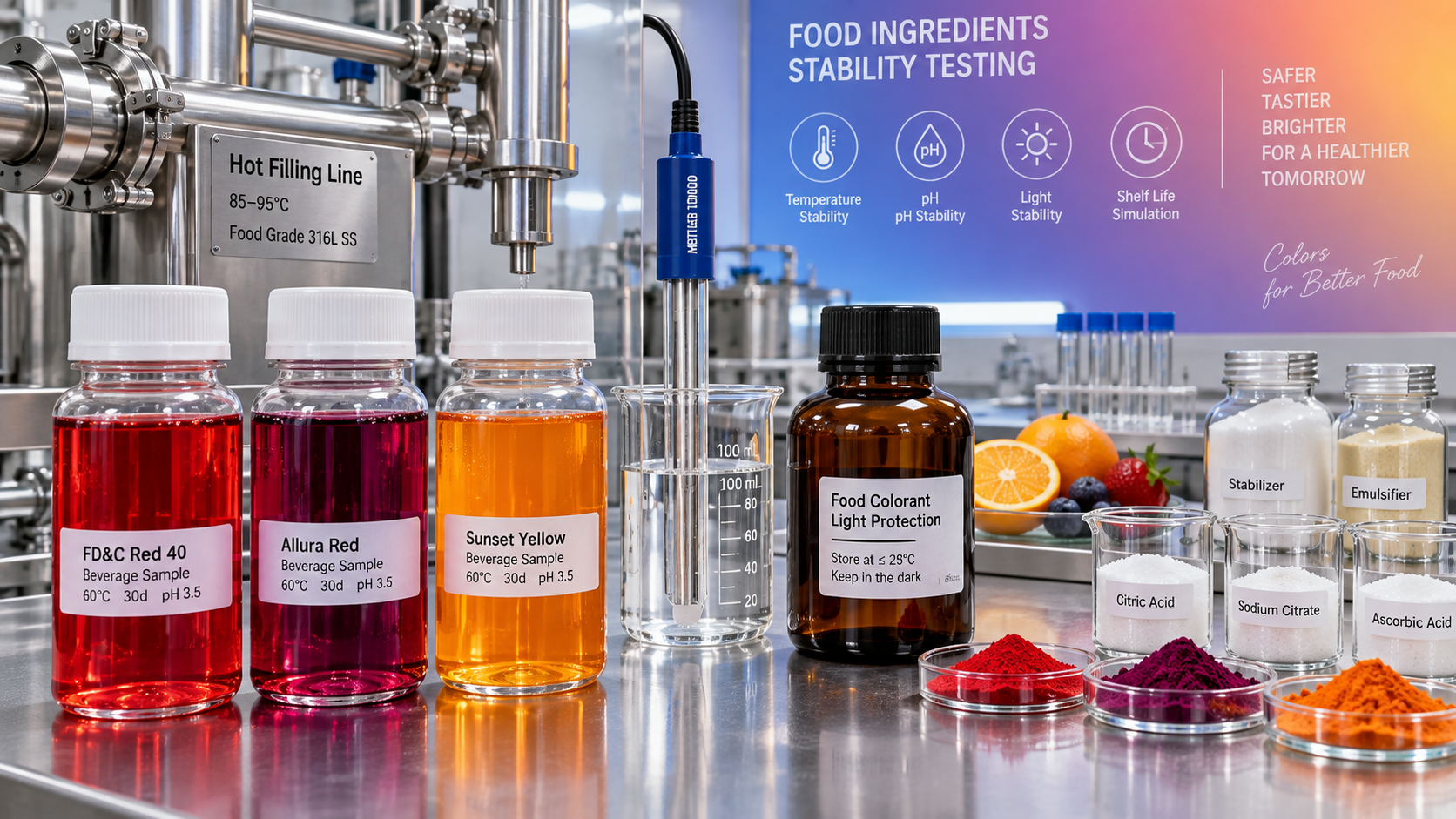
A red beverage that looks correct in the pilot room can turn dull brown after hot filling. A purple fruit preparation may shift toward gray after a few weeks in a chilled display case. In bakery fillings, a color that survives mixing may fade during baking, while a naturally derived alternative may create an unexpected shade change when the finished product reaches its final pH. These are not isolated colorant failures; they are usually selection failures caused by evaluating shade, stability, labeling, and processing as separate questions.
The practical answer is to choose Food Colorants from the conditions of the finished food outward: define the target shade at the point of consumption, identify the full pH and thermal history, assess oxygen and light exposure, then compare permitted labeling and regulatory status in the intended market. A visually attractive sample is not enough. The preferred colorant is the one that produces an acceptable shade after the actual process, packaging, distribution, and shelf-life conditions have acted on it.
Start with the product environment, not the color chart
Supplier shade cards are useful for initial screening, but they generally cannot reproduce a specific food matrix. Proteins, fats, sugars, minerals, emulsifiers, preservatives, flavor extracts, and suspended solids can all alter perceived color or pigment behavior. A colorant that is stable in water may behave differently in a dairy beverage, an oil-based coating, a high-solids confectionery system, or an acidic sauce.
Before selecting candidates, establish a concise application profile. The most useful information is often operational rather than descriptive:
- Target shade, acceptable hue range, and required visual intensity.
- Finished-product pH and the likely pH range during batching, fermentation, or acidification.
- Peak temperature, heating duration, and whether the color is added before or after the heat step.
- Exposure to oxygen, dissolved air, ultraviolet or retail lighting, and metal ions.
- Water activity, fat content, alcohol content, salt level, and presence of reactive ingredients.
- Package type, headspace conditions, intended storage temperature, and expected display conditions.
- Markets of sale and the label statement required for the selected source and format.
This profile prevents a recurring mistake: choosing a color because it looks correct in a neutral laboratory solution, then trying to correct instability through higher dosage. Increasing dosage can deepen the starting shade, but it does not stop a pigment from changing form, degrading, precipitating, or interacting with the food matrix.
Shade stability is more than resistance to heat
Heat is highly visible in development discussions because it is easy to identify as a processing event. Yet temperature is only one stressor. The relevant question is whether the colorant remains visually acceptable after the combined stress history of the product. A brief high-temperature process can be less damaging than a moderate heating step followed by oxygen-rich filling and prolonged light exposure.
pH can change both shade and solubility
Many natural pigment systems are particularly sensitive to acidity or alkalinity. Some shift from red toward purple or blue as pH rises; others lose intensity or become less stable outside a narrow range. A formulation may also experience temporary pH zones during ingredient addition. Adding an acidulant directly into a concentrated color premix, for example, can create a local pH low enough to change the color before the batch is fully mixed.
When acidity must be adjusted in a food formula, sequence and dilution deserve as much attention as the final pH reading. Acetic acid is used as a food acidifier, but its strong vinegar-like odor and flavor character mean that it should be considered in relation to the finished product’s sensory profile as well as its pH target. Where it is appropriate for the formulation, Acetic acid CAS#64-19-7 may be relevant to acidification planning; the color trial should still use the intended dosage, addition order, and mixing conditions rather than an adjusted laboratory substitute.
pH control also matters because it can influence microbial preservation systems, protein stability, and flavor balance. A colorant decision should not drive pH into a range that compromises other product requirements. Instead, identify colorants compatible with the pH that the food genuinely requires.
Light and oxygen often reveal weaknesses after launch
Color fading in transparent bottles, clear confectionery packs, or open display environments frequently results from photo-oxidation rather than a formulation error at manufacture. Light sensitivity varies by pigment chemistry and by package protection. Oxygen dissolved in the product, headspace oxygen, and repeated opening after purchase can intensify loss of color, especially in products stored under retail lighting.
Testing should therefore include the actual package whenever possible. A sample held in an amber laboratory bottle does not answer whether a product in a clear container will retain its intended appearance. If light stability is limited, practical options may include a more stable colorant family, opaque or light-barrier packaging, reduced oxygen exposure, or a revised target shade that remains acceptable as it ages. The decision depends on the product’s commercial presentation, not on a single laboratory measurement.
Processing order changes the outcome
The same ingredients can produce different results when color is introduced before homogenization, before thermal treatment, after cooling, or in a separate syrup phase. Water-soluble and oil-dispersible formats need compatible addition points. In high-fat systems, inadequate dispersion can create uneven shade. In beverages with insoluble components, color may bind to particles or settle with them, creating a lighter supernatant and darker sediment.
Record not only the final formula but also the addition sequence, shear conditions, hold times, and temperatures. This turns an apparently subjective color observation into a repeatable processing parameter.
Natural, nature-identical, and synthetic options require different trade-offs
“Natural” is not a technical performance category. It may describe source, processing route, or labeling position depending on the market and product context. A naturally sourced color can be appropriate for a label objective but may have narrower stability limits than another permitted option. Conversely, a highly stable colorant may introduce label language that does not match the product’s positioning. Neither choice is automatically superior.
A disciplined evaluation separates three questions that are often merged: Can the color produce the desired initial shade? Can it retain an acceptable shade through the product life cycle? Can it be used and declared appropriately in the intended market? A candidate should pass all three. A technically stable material that does not support the necessary label approach is not a viable final choice, while a label-friendly choice that cannot survive processing is likely to create avoidable reformulation work.
Use application-specific trial conditions
Screening trials should imitate the most demanding realistic conditions rather than ideal conditions. For a fruit beverage, this may mean the final acidity, thermal process, package, and light exposure. For a baked product, it may mean testing after the full bake rather than evaluating raw batter. For a coated confectionery item, consider the temperature of the coating mass, fat phase compatibility, cooling profile, and display lighting.
Color measurement instruments can help compare batches and quantify drift, but visual inspection remains important. Instrumental values may identify a change that is not commercially meaningful, while a small numerical change in hue may be immediately visible to consumers depending on the product and surrounding package colors. Establish an internal visual acceptance reference using retained samples or approved targets, then use instrumental readings to support consistency.
A practical staged approach is more efficient than trying every candidate at full scale:
- Eliminate unsuitable options based on product pH, matrix type, intended market, and major process stress.
- Prepare small-scale samples using final formulation ingredients and realistic addition order.
- Run the critical process step, including heat, shear, or fermentation where applicable.
- Assess color immediately after processing and after a short stabilization period, since some systems change as temperature equilibrates or components hydrate.
- Place selected samples in representative packaging and evaluate under expected storage and light conditions.
- Confirm that the selected concentration does not create flavor, odor, sedimentation, or texture concerns.
Keep control samples. Without an uncolored control and a reference-colored sample, it can be difficult to distinguish actual pigment instability from haze, browning of the food base, phase separation, or changes caused by another ingredient.
When the shade changes, diagnose the pattern before changing the supplier
The visual pattern often points to the likely cause. Uniform fading across the product may suggest light, oxygen, or thermal degradation. A shift from one hue to another can indicate pH-related behavior or interaction with minerals and proteins. Speckling, streaking, or localized dark areas usually point toward incomplete dispersion, incompatible format, or color added into a concentrated phase. Sediment-associated color loss suggests particle binding or physical separation rather than simple chemical fading.
Start by comparing a retained sample from immediately after manufacture with samples after each stress condition. Check final pH, not only target pH. Review the actual thermal record and verify whether the color was exposed to more heat than intended. Inspect water quality and any ingredients that can contribute metal ions. In emulsified systems, review homogenization and whether the color was introduced into the correct phase. This sequence narrows the cause before a reformulation introduces several new variables at once.
Do not assume that a stronger pigment concentration corrects a shade shift. When a color turns from red toward brown, increasing concentration can simply create a darker brown. When the issue is uneven distribution, additional color can intensify the visible defect. Correct the chemical or process cause first, then fine-tune dosage.
Labeling and compliance should enter at the first shortlist
Food color permissions, naming conventions, specification requirements, and use conditions can differ by market and food category. A colorant may be acceptable in one application but subject to different restrictions or declaration rules in another. The technical file should therefore identify the color source, composition, carrier system, relevant specifications, intended use level, and destination markets before the formulation is locked.
For multi-market products, avoid treating a single market’s status as a global approval. Review the finished application, not merely the ingredient name. The finished food category, presence of other additives, local labeling language, and product claims can all affect the final decision. Where a supplier provides a color in a standardized preparation, confirm the status of carriers and processing aids as well as the principal pigment.
Acidulants and other formulation inputs should be assessed through the same lens. Food-grade suitability, purity requirements, handling controls, and the sensory consequence of use all matter. For example, high-purity glacial acetic acid is a concentrated, colorless material that is fully miscible with water, but its corrosive handling profile and pungent odor require controlled use where it is selected for a food process. The acidification choice must support the finished formula rather than merely achieve a laboratory pH value.
Build specifications around acceptable change, not an idealized starting point
A useful color specification defines what is acceptable at release and what remains acceptable through shelf life. It should include the target shade under agreed viewing conditions, allowable variation, format and concentration, dispersibility requirements, storage conditions, and any process limitations. It should also state the test matrix or reference method used for approval. A specification written only as “red color” or “natural orange” leaves too much room for inconsistent interpretation.
For products with unavoidable shade evolution, the acceptable end-of-life appearance may be more important than the day-one shade. This is especially relevant where natural pigment systems, acidic matrices, or transparent packaging are involved. Evaluating color at both points helps prevent a selection that is visually impressive at manufacture but unsuitable during normal distribution.
The most reliable choice is rarely the colorant with the strongest initial appearance. It is the one whose chemistry, format, processing window, label status, and package exposure align with the real food system. Treating those factors as a single decision prevents late-stage surprises and gives development teams a clearer basis for approving both formulation and supply.
Send Us Your Inquiry Today
