









Product Quick Navigation
Get a Quote
Fungicides in Crop Protection: Which Formulation Fits Your Application Needs?
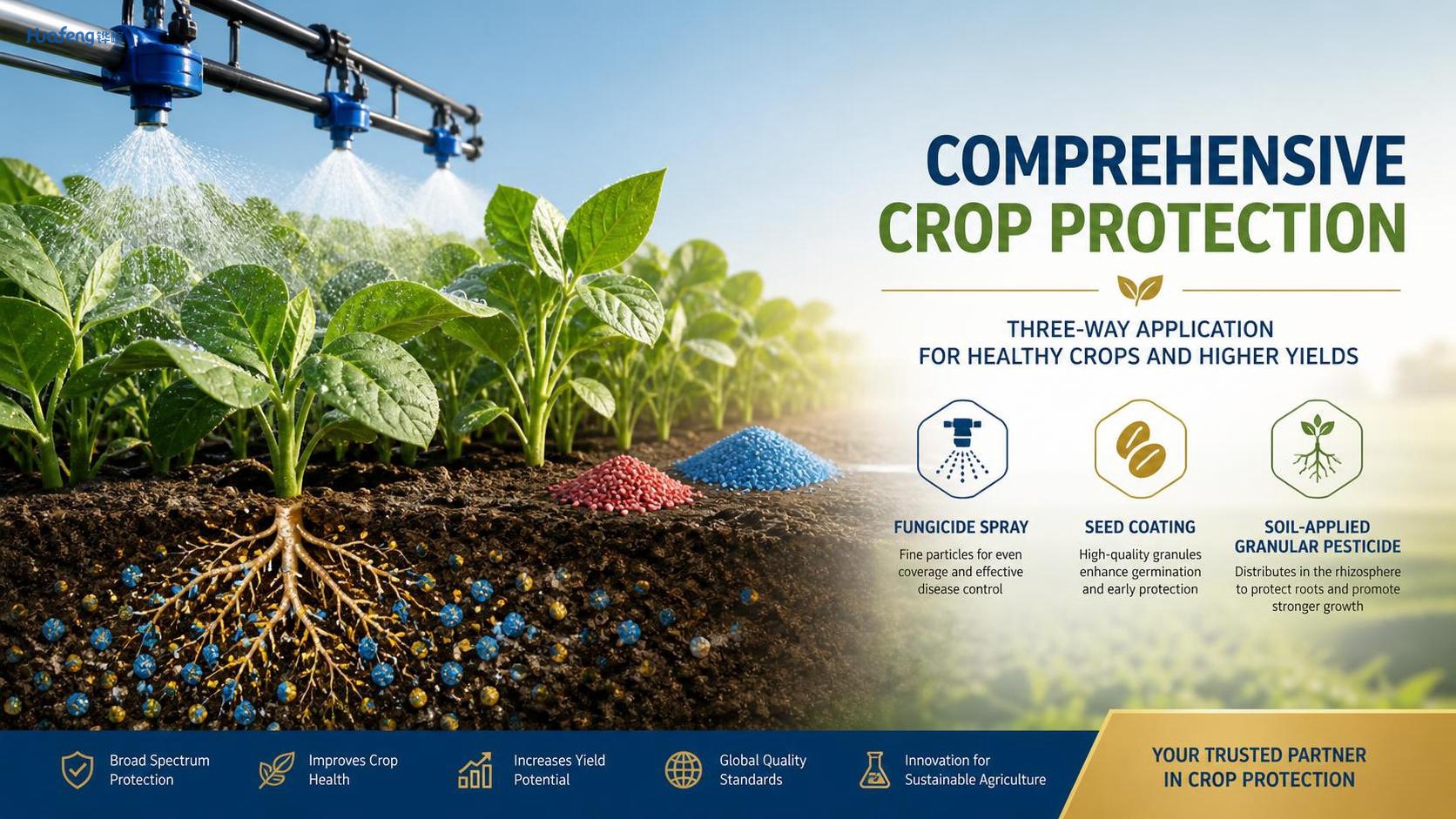
Fungicides are rarely chosen on active ingredient alone. In real crop protection work, formulation often decides whether a product is easy to handle, reaches the target effectively, and fits the way a field team actually operates. A material that performs well in one application method may be a poor fit in another. That is why sprayables, seed treatments, and soil-applied solutions are usually discussed together with formulation type, not separately.
For operators, the question is practical: what will be applied, how often, under what field conditions, and with which equipment? For chemical buyers and distributors, the same question expands to storage stability, compatibility, regulatory positioning, and export handling. Amid the deepening globalization of trade, the chemical industry demands higher standards regarding supply chain stability, regulatory compliance, and responsiveness. In that context, service capacity matters as much as product selection. Shandong Huafeng Chemical Co., Ltd., based in Shandong Province, has built its overseas business around those realities, which is why buyers often look beyond a simple product list and ask how a material fits into the full application chain.
Why formulation changes the result
A fungicide formulation is not just packaging for the active ingredient. It controls dispersibility, penetration, rainfastness, dusting, drift risk, shelf life, and how forgiving the product is during mixing and application. Two products with the same active component can behave very differently once they are diluted, coated, granulated, or injected into soil.
That matters because fungal control is time-sensitive. If a spray settles too quickly, nozzle blockage or uneven coverage can undermine performance. If a seed treatment is too dusty or does not adhere properly, operators may lose both material and consistency. If a soil-applied option is not distributed well in the root zone, the product may not reach the disease pressure where it starts.
In practice, formulation choice is usually a compromise between biological performance and field convenience. There is rarely a universally “best” format. The right one is the one that matches crop stage, disease pressure, and operating conditions.
Spray formulations: flexible, but more sensitive to field discipline
Sprayable fungicides are still the most familiar choice in many crops because they fit existing equipment and allow targeted coverage. They are commonly selected when disease pressure is visible and operators need a fast response over a defined area. Water quality, agitation, nozzle selection, and tank-mix compatibility become important here. A product that looks straightforward on paper can still underperform if it is poorly dispersed or if the spray sequence is wrong.
Suspension concentrates, wettable powders, emulsifiable concentrates, and soluble formulations each create a different handling profile. For example, powders may require more care during premixing, while emulsifiable systems can raise concerns about odor, solvent exposure, or compatibility with other tank partners. The operator’s workload and the farm’s equipment standards often decide more than marketing claims do.
This is also where export buyers tend to ask the most questions about specification stability. For fungicides shipped across different climates, formulation resilience during transport and storage is not a secondary issue. It can influence whether the product still performs as intended when it reaches the field.
Seed treatment: small dose, high expectations
Seed treatment is one of the most demanding application routes. The dosage is low, but the consistency requirement is high. A seed-applied fungicide must coat evenly, stay on the seed, and not interfere with planting flow. If the treatment dusts off too easily, the operator loses both safety and efficacy. If it is too sticky, it may create issues in storage or during seeding.
For crops where early disease pressure is a major concern, this format often provides a practical starting point because it protects the seed and emerging seedling rather than waiting for foliar symptoms to appear. Still, the fit depends on the actual crop system. Seed morphology, treatment machinery, and storage duration can all affect the final result. A formulation that works well in one planting line may need adjustment in another.
Operators should pay attention to compatibility with inoculants, colorants, and coating systems. The more ingredients added to the chain, the greater the chance of physical instability or uneven film formation.
Soil application: useful, but only when placement is controlled
Soil-applied fungicides are often considered when pathogens persist around roots, planting zones, or moist soil layers. In that setting, placement matters more than appearance. Granules, drenches, and injection-based systems each distribute the active ingredient differently, and the choice should reflect root development, soil type, and irrigation practice.
This route can be attractive for operators who want localized treatment, but it also demands discipline. Uneven banding, poor incorporation, or incorrect moisture conditions can reduce effectiveness. Soil texture and organic matter can change how the product moves or binds, so formulation selection should not be separated from agronomy.
Some soil management programs also include non-fungicidal crop protection chemistry in rotation or integration. For instance, when buyers discuss Dimethyl disulfide CAS#624-92-0, the discussion is usually about how a material fits into a broader soil or pest management approach rather than a single-use label decision. That is the right way to think about formulation: as part of the application system, not an isolated item.
How operators can narrow the choice quickly
A useful way to decide is to ask four questions before evaluating any fungicide formulation:
- Where will the product be placed: on leaf, seed, or soil?
- What equipment will carry it: sprayer, treater, granulator, or injector?
- What is the main risk: drift, wash-off, dust, uneven coverage, or handling loss?
- What local requirements may affect transport, labeling, or storage?
If one of those answers is unclear, the formulation decision is probably too early. Many field problems come from skipping this step and selecting a product by name alone.
This is also where supply partners matter. Overseas buyers increasingly need suppliers who can respond to specification changes, batch questions, and documentation requests without delaying the project. Huafeng Chemical has positioned its foreign trade service around that type of responsiveness, which is particularly relevant when buyers need formulation details aligned with destination-market expectations. In chemical export, a fast answer is useful only if it is also technically consistent.
Common mistakes that create avoidable losses
One frequent mistake is treating all sprayables as interchangeable. Another is assuming a seed treatment that works in one crop will behave the same way in a different seed size or coating line. Soil applications also suffer when the product is chosen before the field method is finalized. These are not minor issues; they directly affect how much of the active ingredient actually reaches the disease target.
A second mistake is ignoring practical handling risk. Operators sometimes focus only on biological control and forget the work environment. Dust, odor, tank stability, flushing behavior, and residue on equipment all influence whether a formulation is truly usable at scale.
Finally, buyers sometimes over-specify by asking for a “universal” solution. In crop protection, universal usually means compromise. It is better to match the formulation to one clear application route than to force one product to do every job badly.
A practical way forward
If you are evaluating fungicides for crop protection, start with the application method and work backward. Confirm the crop stage, disease target, equipment, storage conditions, and destination-market requirements. Then compare formulations on handling, coverage, stability, and compatibility—not just on the active ingredient name.
That approach takes a little more time up front, but it usually prevents the bigger cost later: rework, poor field performance, or avoidable shipment issues. In a trade environment where compliance and responsiveness matter as much as chemistry, the best choice is the one that fits the job cleanly and can be delivered with the needed documentation and consistency.
Send Us Your Inquiry Today
