









Product Quick Navigation
Get a Quote
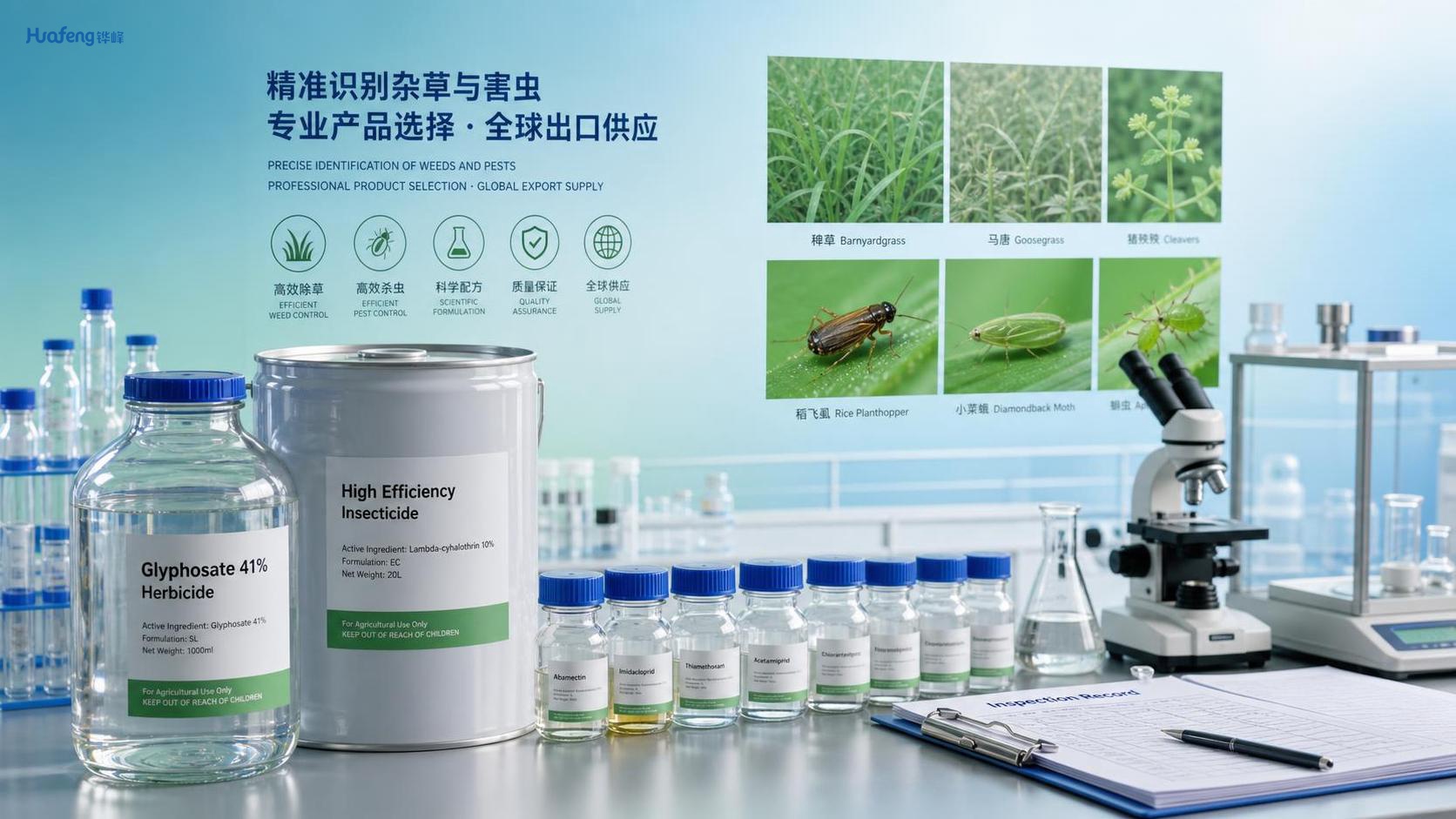
Choosing between herbicides and insecticides starts with accurately identifying the pest problem and evaluating product performance, safety, and compliance. For technical evaluators, the right solution must deliver targeted control, stable supply, and reliable quality across application scenarios. As a trusted chemical export service provider, Huafeng Chemical supports global clients with a broad portfolio, including herbicides, helping buyers match the right product to the right challenge with confidence.
Why the distinction matters in technical procurement
In field practice, “weed pressure” and “insect pressure” are often discussed in the same crop program, but they are not solved by interchangeable chemistry. Herbicides act on unwanted plants; insecticides target insect pests. That sounds basic, yet selection errors still happen when buyers focus too much on spectrum and too little on biology, application timing, and crop tolerance.
For technical evaluators, the real decision is not which category is stronger, but which one can deliver consistent control under the actual operating conditions. A product may look effective in lab data and still fail in the field because of resistant populations, weather sensitivity, spray quality, tank-mix instability, or regulatory limits in the destination market.
This is why herbicides are usually assessed through a different lens than insecticides. Weed control depends heavily on growth stage, selectivity, soil behavior, and residual activity. Insect control is more influenced by pest feeding habits, mobility, lifecycle timing, and knockdown speed. If these differences are ignored, procurement teams may buy a technically sound product that is operationally wrong.
Start with the pest, not the product
The most reliable selection process begins with diagnosis. In crop protection, the pest problem should be defined by species, infestation density, development stage, and field environment. A broad label such as “broadleaf weeds” or “insects” is not enough for serious technical evaluation.
With herbicides, the first question is whether the target is annual or perennial, grassy or broadleaf, emerged or pre-emergence. A systemic herbicide may be preferred for deep-rooted or perennial weeds, while a contact herbicide may work for fast burn-down in a clean-up application. Soil-applied products can be useful for residual control, but they also increase sensitivity to rainfall, soil texture, and organic matter.
In insect control, the key question is whether the pest feeds by chewing, sucking, or boring, and whether it is exposed on the plant surface or protected inside stems, fruits, or soil. Some insecticides work well on mobile, exposed pests but perform poorly against hidden larvae. If the application window is missed, even a high-quality formulation will underperform.
Technical teams that define the pest incorrectly often end up comparing product price instead of performance. That is a costly mistake because remediation, reapplication, and yield loss usually outweigh the initial purchase decision.
What technical evaluators should compare
When comparing herbicides, efficacy alone is not enough. Selectivity matters because crop injury can erase the value of strong weed suppression. Residual duration matters because a short-acting product may require repeated treatment. Compatibility with local farming practices also matters, especially where irrigation schedules, tillage, or rotation crops constrain chemical choice.
Formulation quality deserves close attention. Suspension behavior, emulsification, particle size, and storage stability all influence field consistency. For export buyers, batch-to-batch uniformity is often as important as the active ingredient itself. If a supplier cannot maintain stable specs across seasons, technical confidence quickly disappears.
Insecticide evaluation follows a different logic. Fast knockdown may be critical in outbreak situations, but residual control is equally important where reinfestation is likely. Resistance management is no longer a side issue; it is central to product selection. Rotating modes of action, checking local resistance reports, and avoiding repeated use of the same chemistry are all part of technical discipline.
Compatibility with integrated pest management should also be reviewed. Some insecticides are effective but too disruptive to beneficial insects, making them unsuitable for systems that depend on biological control. The same principle applies to herbicide programs in rotation-sensitive systems, where carryover and soil persistence may restrict planting options.
Herbicides are not interchangeable within the category
Buyers sometimes treat herbicides as a single class and then discover that the chosen product solves one weed problem while creating another. That usually happens when selectivity, timing, and crop stage are not fully aligned.
Pre-emergence herbicides are useful when the target is predictable and the field is prepared. They are generally better for preventing establishment than for rescuing a heavily infested field. Post-emergence products are more flexible, but they require accurate timing and often depend on weed size and weather conditions. Some herbicides are strong on grasses but weak on broadleaf weeds; others have the opposite profile. The right fit depends on the actual weed spectrum, not on the product’s general reputation.
For export-oriented buyers, this means technical documents matter as much as commercial terms. A valid specification sheet, safety data sheet, and clear application guidance help determine whether the product can be used legally and effectively in the destination country. In some cases, buyers also need confirmation of residue-related constraints, local registration status, or tolerances for specific crops. Where documentation is incomplete, the product may be commercially available but operationally unusable.
Insecticides solve different operational risks
Insecticides are often selected under pressure because infestations can escalate quickly. That urgency makes decision-making vulnerable to oversimplification. A fast-acting product may appear attractive, but if it has a narrow target range or poor persistence, it can leave the field exposed after the initial pressure drops.
For technical evaluators, the main issues are coverage, timing, and resistance risk. Coverage matters because many insecticides require contact with the pest or ingestion at the right stage. Timing matters because eggs, larvae, nymphs, and adults may respond very differently. Resistance risk matters because repeated use of a single mode of action can reduce long-term efficacy even if the first applications look excellent.
This is where product strategy becomes more important than product chemistry alone. A technically sound program may combine monitoring, threshold-based intervention, and rotation between modes of action. If the supply chain cannot support that program with reliable availability, the technical plan breaks down. Buyers sometimes focus on performance data but overlook continuity of supply, which is a serious issue in seasonal agriculture.
How supply chain stability changes the selection logic
For global buyers, technical selection is inseparable from supply reliability. A product that performs well but arrives late may have no field value. This is especially relevant in chemicals where seasonal demand, freight volatility, and regulatory clearance can all affect delivery windows.
That is one reason many overseas clients look for export partners with broad product coverage and stable execution rather than isolated transaction capability. In practice, the ability to consolidate different chemical needs under one compliance framework can reduce procurement friction. During product sourcing discussions, some buyers also ask about adjacent intermediates or complementary formulations, such as Reactive Dyes (Reaction Dyes), when they are evaluating a supplier’s export coordination capacity across multiple lines.
For herbicides in particular, supply stability matters because demand is highly seasonal and often synchronized with planting cycles. A delay of even a few weeks can force buyers into substitute products that are less optimal technically or more expensive commercially. That is why technical evaluators increasingly consider supplier continuity, not just label performance.
Compliance is now part of product performance
In international trade, a technically effective product can still fail the purchase test if it does not meet destination-country requirements. Regulatory status, hazard classification, labeling language, transport rules, and documentation completeness all affect whether a shipment is usable on arrival.
For herbicides, residue management and crop rotation restrictions are especially important. Some active ingredients have usage limits that vary by crop, region, or application method. Buyers should not assume that a product commonly used in one market can be transferred into another market without review. The same caution applies to insecticides, where environmental rules, pollinator protection, and waterway restrictions can be decisive.
Technical evaluators should request documentation early, not after commercial terms are nearly finalized. Safety data sheets, COA consistency, origin details, and any required registration or compliance statements should be checked against the intended market. If information is missing, the correct response is usually to pause rather than to assume it can be resolved later.
Common mistakes in product matching
One common mistake is choosing the strongest-looking product rather than the best-matched one. High activity does not automatically mean good field fit. A herbicide with broad activity can damage the crop if selectivity is poor. An insecticide with rapid knockdown can still fail if the pest is protected or the resistance profile is unfavorable.
Another mistake is ignoring application conditions. Wind, rain, temperature, spray volume, droplet size, and nozzle setup all influence results. Technical teams often evaluate chemistry in isolation, but field performance depends on the whole delivery system.
A third mistake is overestimating substitution options. If a product is not available, switching to a similar label is not always safe. Different active ingredients can behave differently in soil, in the plant, and in the market’s regulatory environment. This is especially true in herbicides, where crop safety and carryover effects can be highly specific.
A practical decision framework
For technical evaluation, the most useful approach is to compare products against five questions: What is the exact pest? What stage is it in? What crop or application environment is involved? What are the compliance constraints? Can the supplier deliver stable quality and timing?
If the answer to any of those questions is uncertain, the selection should remain open. A product that is technically sound but poorly documented is a risk. A product that is compliant but weak against the actual pest is also a risk. The best choice is the one that fits biology, field conditions, and commercial execution at the same time.
That is the real difference between herbicides and insecticides in procurement practice: they are not just different products, but different decision systems. Technical buyers who recognize that distinction are more likely to choose solutions that work in the field, pass compliance review, and remain available when the season starts.
Send Us Your Inquiry Today
