










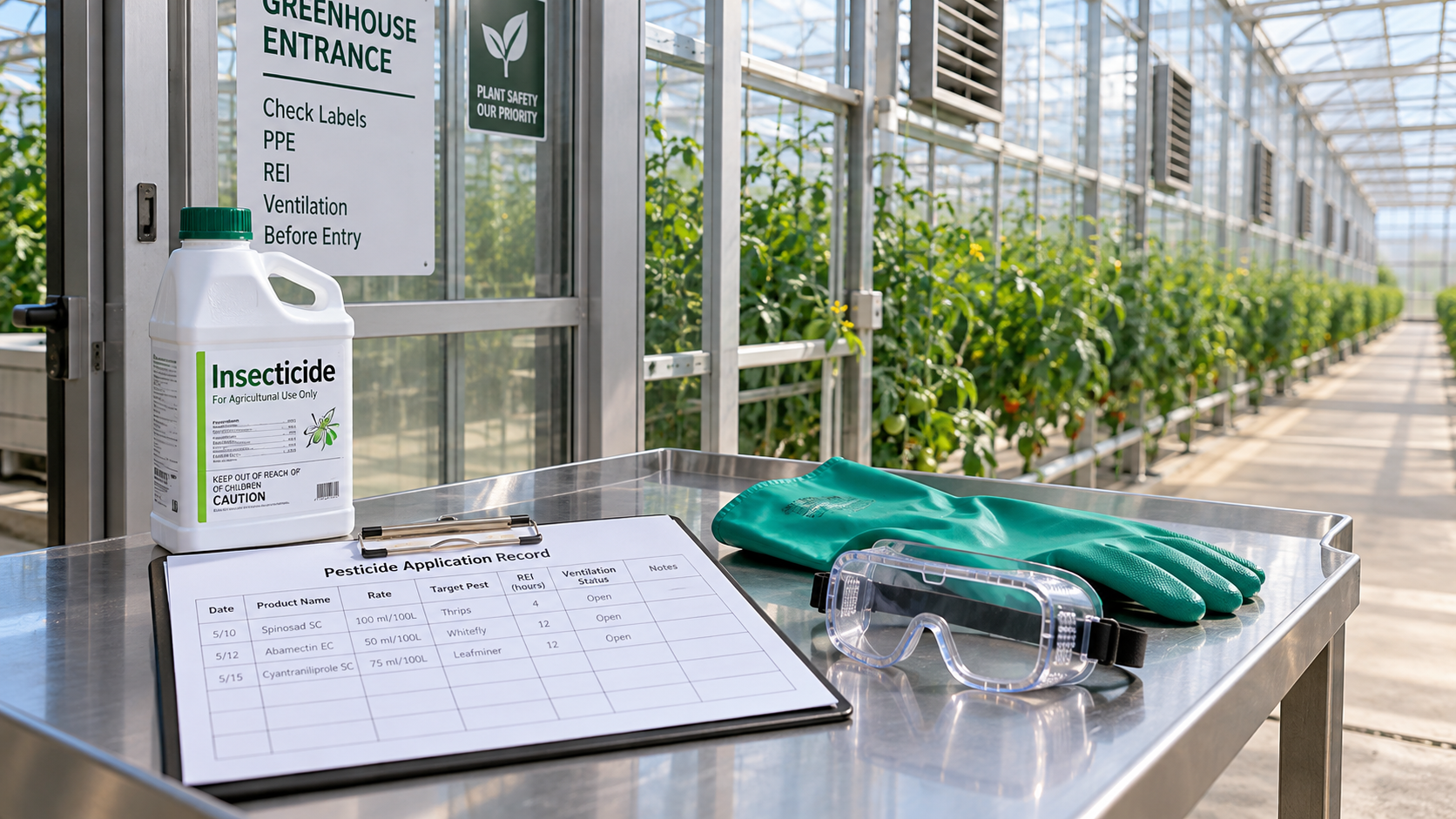
Before workers return to a treated greenhouse, quality control and safety teams need clear answers: Has the restricted-entry interval expired, and does the planned task require specific personal protective equipment?
Insecticides can carry product-specific requirements that vary by label, application method, and local regulations. Checking these details helps prevent premature entry, inappropriate PPE selection, and gaps in application records.
This guide explains how to verify reentry intervals, identify applicable PPE requirements, and translate label instructions into practical greenhouse safety checks—supporting consistent compliance and better-informed procurement decisions.
The release decision should confirm three things together: the applicable entry restriction has ended, required ventilation conditions are satisfied, and the planned work meets remaining label requirements.
What Must Be Checked Before Anyone Enters?
Begin with the exact insecticide product, its approved labeling, and the rules governing your location. This article uses the United States regulatory framework for examples.
Under the Environmental Protection Agency’s Worker Protection Standard, a restricted-entry interval, or REI, limits worker entry after application. Specific exceptions exist, but require separate verification.
Workers performing crop production tasks and handlers mixing, loading, or applying pesticides have different responsibilities and protections. Identify the person’s activity before selecting applicable instructions.
Do not approve entry from elapsed time alone. Greenhouse applications may involve ventilation criteria, entry restrictions during application, and label directions that affect the decision.
A practical release check asks: Which area was treated, when did application finish, what conditions apply, and what will the entering employee actually do?
If any answer is missing, keep the area restricted while the responsible supervisor resolves it. Production urgency cannot establish that entry conditions have been met.
Where Do You Find the Correct REI?
Read the labeling accompanying the actual container, including applicable supplemental labeling. Confirm the product name, registration number, formulation, crop, and permitted greenhouse use before proceeding.
In the United States, agricultural labels commonly state the REI within an Agricultural Use Requirements box. Also read directions specific to the application method.
The active ingredient alone cannot establish the interval. Products containing the same ingredient may have different formulations, registered uses, restrictions, or personal protective equipment requirements.
A safety data sheet supports hazard communication and emergency planning, but does not replace pesticide labeling when determining legally applicable application and entry requirements.
If an online label differs from the container labeling, verify which instructions legally apply to that stock. Consult the registrant or responsible regulatory authority.
For tank mixtures, review every component and applicable mixing directions. Identify the most restrictive relevant requirements, including different REIs, and resolve conflicts before application.
Keep a traceable copy of the labeling used for the decision. Record its revision or identifying information alongside the product details in your application file.
How Do You Calculate the Earliest Return Time?
Record the actual application completion time, rather than the scheduled start or expected finish. Use that documented completion time to calculate the applicable REI.
For example, if application ends Tuesday at 3:30 p.m. and the applicable REI is 12 hours, that interval expires Wednesday at 3:30 a.m.
This calculation addresses only the interval. Before releasing the greenhouse, separately confirm applicable ventilation criteria, additional label restrictions, and any requirements imposed by local rules.
If application occurs in separately managed zones, document completion times and boundaries clearly. Shared airspace or drift may prevent treating neighboring bays as independent areas.
Do not shorten an interval because foliage looks dry or odors have disappeared. Neither observation establishes compliance with a stated REI or ventilation requirement.
Where repeated treatments overlap, assess every restriction still affecting the area. The next permitted entry depends on all applicable conditions, rather than the latest record alone.
Post a clear release time only after checking the calculation. If conditions remain unresolved, identify the restriction explicitly instead of displaying an unconditional reopening time.
Why Does Greenhouse Ventilation Need a Separate Check?
Enclosed production spaces can retain airborne pesticide after application. Under the Worker Protection Standard, entry restrictions and ventilation criteria depend partly on how pesticides are applied.
Fumigants, smoke, mist, fog, and other application types can trigger different requirements. Review the applicable enclosed-space provisions and product labeling before setting access controls.
Where required, establish how ventilation completion will be demonstrated. Depending on the applicable rule, this may involve specified ventilation conditions or an air concentration criterion.
Opening a door does not automatically satisfy a ventilation requirement. Likewise, a running fan provides little assurance without knowing whether the required conditions were achieved.
Document the ventilation method, relevant times, and verification basis. If monitoring is required, use appropriate equipment and personnel capable of interpreting the results correctly.
Keep ventilation verification separate from REI arithmetic on the release form. This prevents a completed time calculation from concealing an unresolved airborne exposure restriction.
Which PPE Applies to the Planned Task?
Start by classifying the work: mixing, loading, applying, cleaning contaminated equipment, or performing permitted early-entry activities. Then locate the label instructions covering that activity.
Handler PPE and early-entry PPE are separate label categories. A list intended for application cannot automatically be used to authorize crop work during an REI.
Translate each requirement into a specific item workers can identify. Examples include the required glove material, coveralls, footwear, eye protection, or specified respiratory protection.
For chemical-resistant gloves, check the label’s stated materials or selection instructions. A generic description such as “protective gloves” is insufficient for purchasing or inspection.
When a respirator is required, confirm the specified type and applicable medical evaluation, fit testing, training, maintenance, and cartridge or filter replacement requirements before work.
Inspect PPE condition and availability before scheduling the task. Torn gloves, damaged seals, contaminated clothing, or unsuitable sizes can make an otherwise correct selection ineffective.
After the REI expires, routine workers do not automatically need handler PPE. Check remaining label requirements and assess other workplace hazards associated with their task.
Can PPE Allow Workers to Enter Before the REI Ends?
Wearing additional PPE does not, by itself, authorize early entry. Under the United States framework, an applicable exception must permit the activity and its conditions.
Evaluate the proposed task against the relevant exception, including contact limitations, timing, duration, training, age restrictions where applicable, and required protections for the workers involved.
Tasks involving foliage contact, irrigation repairs, harvesting, or equipment retrieval can create different exposure patterns. Describe the actual work instead of using a vague maintenance category.
Before authorizing an exception, document its regulatory basis and every applicable condition. Provide the required instructions, PPE, decontamination supplies, and other protections before entry occurs.
If no exception clearly applies, reschedule the work until ordinary entry is permitted. Seek regulatory guidance when uncertainty affects whether an exception can legally be used.
Consider a blocked irrigation line discovered during an REI: first evaluate isolation or remote controls. Entering with gloves alone does not establish a valid exception.
What Records Make the Release Decision Auditable?
Use a standardized record connecting the application to the entry decision. Include product identity, registration number, treated location, application method, and actual completion time.
Add the applicable REI, calculated expiration, ventilation verification, and any remaining restrictions. Identify the person who checked the information and authorized release of the area.
Record task-specific PPE decisions separately when handlers or permitted early-entry workers are involved. This shows why particular equipment was selected for a particular activity.
Coordinate warning signs, required notifications, and physical access controls with the documented restrictions. Include contractors, temporary workers, and employees entering through secondary greenhouse doors.
Supervisors should communicate changes during shift handovers. A correct record provides limited protection if the incoming team receives an outdated reopening time or incomplete instructions.
Follow applicable retention and access requirements for pesticide application and hazard information. Internal release forms should support, rather than replace, legally required records and disclosures.
How Can Procurement Reduce Compliance Gaps?
Before purchasing insecticides, confirm authorized local use, greenhouse suitability, labeling availability, packaging identity, and supplier documentation. Compare operational restrictions alongside price and pest-control performance.
A longer REI can affect scouting, irrigation, harvesting, and shipment schedules. Estimate these scheduling effects before selecting products for greenhouses with frequent worker access.
Procurement specifications should also address PPE availability and training needs. A product requiring unfamiliar protective equipment may introduce costs that its purchase price does not reveal.
Industrial chemical sourcing requires a separate review. 1,4-Butanediol CAS#110-63-4 is an intermediate used in polymers, solvents, and specialty chemicals; its identity does not establish pesticide authorization.
Its inclusion in a supplier portfolio cannot substantiate greenhouse insecticidal use, an REI, or pesticide PPE requirements. Those decisions require the relevant registered product labeling.
For discussions with Huafeng Chemical, request product-specific specifications, safety documentation, batch traceability, and destination-market documentation. Evaluate industrial intermediates and formulated pesticides against their respective requirements.
Make Greenhouse Release a Documented Decision
A reliable release process connects the correct labeling, an accurate application record, verified ventilation conditions, and the intended activity. Every element answers a different safety question.
Assign responsibility for calculating restrictions, checking conditions, communicating access status, and retaining evidence. Clear ownership helps prevent assumptions from passing unnoticed between production and safety teams.
When information conflicts, resolve the discrepancy before entry. Neither a familiar product name nor apparently normal greenhouse conditions can substitute for checking the applicable requirements.
For quality control and safety personnel, the practical standard is straightforward: authorize entry only when the documented conditions support the actual work being planned.