









Product Quick Navigation
Get a Quote
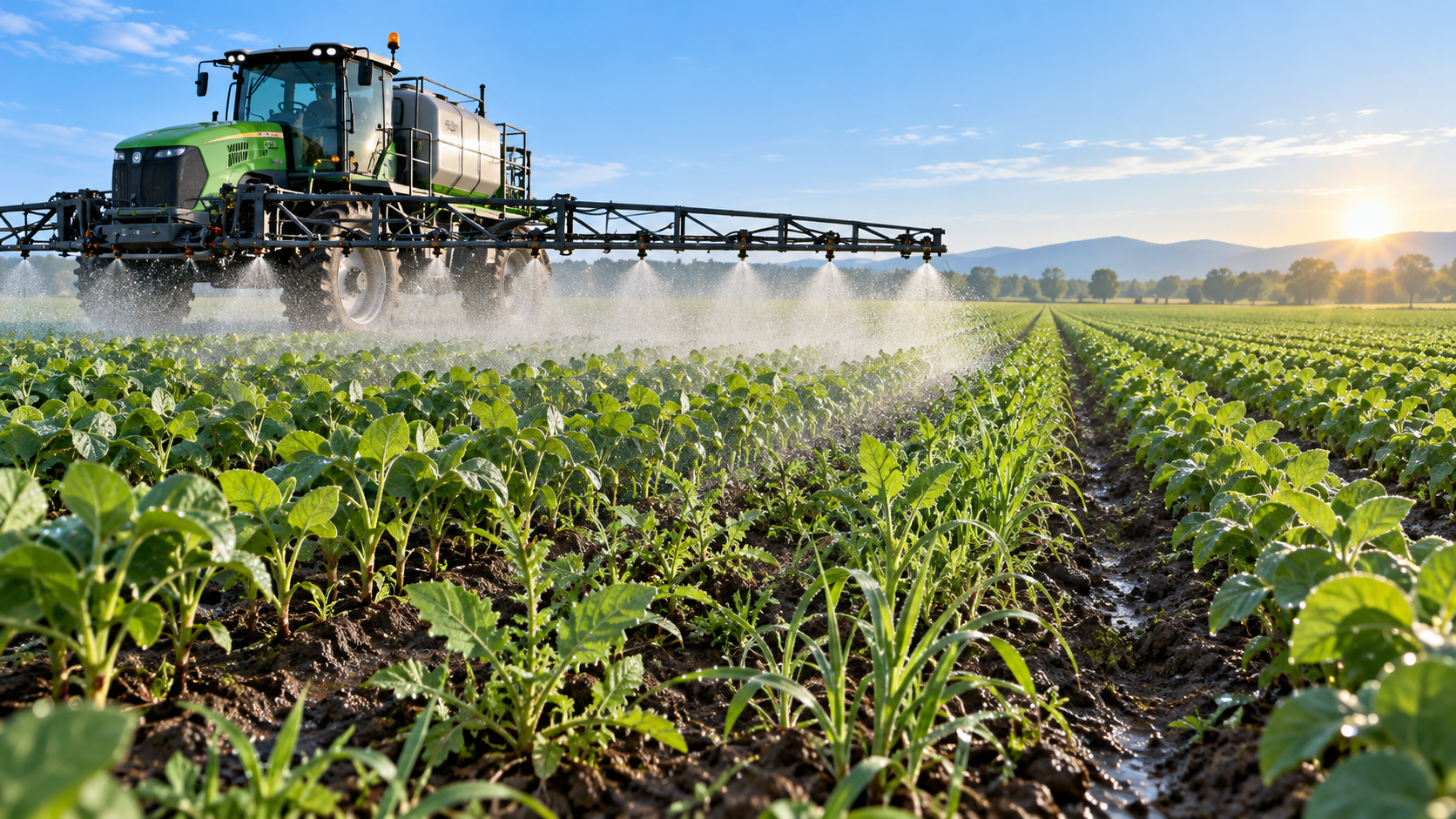
A commercial field can look clean at planting and still develop two different weed problems within a short interval: broadleaf weeds emerging in uneven flushes and grass weeds appearing in rows, wheel tracks, or thin crop stands. Treating both with one product simply because it is available can lead to missed species, crop injury, poor residual control, or a second application made too late to recover yield potential.
The practical answer is to select herbicides by matching weed spectrum, crop tolerance, weed growth stage, and application timing before comparing product names or application rates. A program that controls broadleaf weeds may have little activity on grasses, while a strong grass treatment may leave key broadleaf species untouched. Start with the weeds actually present or expected in the field, then build a labeled pre-emergence, post-emergence, or sequential program around the crop and local use requirements.
Start with the weeds, not the herbicide category
“Broadleaf weeds” and “grass weeds” are useful field categories, but they are not enough for a final selection. Control can vary sharply among species within the same category. Small-seeded annual broadleaves, large-seeded annual broadleaves, perennial vines, annual grasses, volunteer cereals, and rhizomatous grasses each respond differently to active ingredients, timing, and environmental conditions.
Before a spray decision, walk representative areas rather than judging the whole field from the headland. Look at crop rows, wet spots, compacted zones, irrigation edges, field entrances, and areas with a history of poor control. Record the dominant weeds, their approximate size, density, and whether they are emerging, actively growing, flowering, or regrowing after cultivation. A few large weeds may require a different response from a dense carpet of seedlings.
Correct identification matters especially where grass-like plants are present. Sedges, true grasses, volunteer grain, and some narrow-leaved broadleaf seedlings can be confused at an early stage. A grass-selective post-emergence herbicide may not control sedges, and an application intended for annual grasses may not solve a perennial grass problem with established underground structures.
Questions that narrow the choice quickly
- Which two or three species are most likely to reduce crop performance if left untreated?
- Are the target weeds annuals, perennials, or volunteers from the previous crop?
- Are weeds small enough for post-emergence control, or have they passed the labeled growth stage?
- Is a new flush likely after the current application?
- Has the field shown weak control from the same herbicide group in prior seasons?
These answers prevent a frequent operational mistake: choosing a treatment based on one visible weed while ignoring the species likely to emerge next week. In fields with staggered emergence, contact activity alone may produce a clean-looking result immediately after spraying but provide little protection against later flushes.
Separate burndown, residual, and post-emergence jobs
A reliable commercial program often assigns different jobs to different application windows. This does not always mean more products are needed; it means each product must be expected to do the work it is designed and labeled to perform.
For broadleaf and grass weed control, residual herbicides are often valuable when the crop is slow to establish or when early competition is costly. Their performance, however, depends on proper placement and activation. Some need timely rainfall or irrigation to move into the germination zone. Others can lose effectiveness when soil is dry, cloddy, heavily disturbed after application, or covered by excessive residue that prevents uniform soil contact.
Post-emergence products are more dependent on weed size and spray coverage. Small, actively growing weeds are generally easier to control than hardened, drought-stressed, or oversized plants. Waiting until every weed has emerged can turn a manageable pass into a rescue treatment, especially when both grasses and broadleaves are growing rapidly.
Match crop safety to the real field situation
Crop tolerance is not a simple yes-or-no label question. A herbicide may be registered for a crop while still requiring close attention to variety restrictions, planting depth, soil texture, soil pH, temperature, crop stress, and the use of additives or tank-mix partners. The label is the controlling document for approved crops, rates, timings, and restrictions, but field conditions determine how much tolerance margin is available on a particular day.
Crop stress deserves particular attention. Cold nights, saturated soil, drought, wind damage, insect feeding, nutrient deficiency, transplant shock, or herbicide overlap can make a normally acceptable treatment more likely to cause visible injury. This is especially relevant when operators need a post-emergence rescue application and the crop has already been competing with weeds.
Sprayer overlap is another common source of confusing symptoms. Injury concentrated at row ends, turning areas, or sections where boom speed changed may point to excessive dose rather than a general crop sensitivity issue. Check travel speed, nozzle output, boom height, pressure, section control, and mixing order before concluding that the active ingredient itself is unsuitable.
When a broadleaf and grass mix is justified
A tank mix can be efficient when both targets are present, the crop stage permits both products, and all labels allow the combination. It should not be used only because it reduces one trip across the field. Compatibility, required adjuvants, spray water quality, droplet behavior, and the possibility of increased crop response all need review.
Some grass herbicides require specific adjuvants for reliable uptake, while certain broadleaf herbicides may have their own adjuvant limitations. Combining products can alter performance or crop safety. Follow the most restrictive label directions where compatible, conduct a jar test when physical compatibility is uncertain, and maintain agitation as directed. A jar test only indicates whether materials remain physically mixed; it does not confirm crop safety or biological performance.
Resistance management should change the selection process
Repeated use of the same herbicide site of action can gradually leave survivors that are difficult to control. The first warning is often patchy performance: susceptible-looking weeds die while plants of the same species remain healthy in defined areas. Before assuming resistance, rule out application error, wrong weed identification, poor coverage, unsuitable weather, excessive weed size, expired or improperly stored product, and spray equipment problems.
Where resistance is suspected or known, choosing another product with a different trade name is not enough. Check the herbicide group and site of action. A useful program combines effective, labeled modes of action and includes nonchemical practices where practical, such as crop rotation, competitive crop establishment, cultivation where appropriate, sanitation of equipment, and control of escapes before seed production.
Residual protection is particularly helpful in resistance management because it reduces the number of weeds exposed to a late post-emergence rescue treatment. Still, residual products should be selected for actual expected species, not treated as automatic insurance. A residual active ingredient that does not cover the dominant grass or broadleaf weed will not meaningfully reduce selection pressure on that species.
Application conditions can decide whether a good choice performs well
Even correctly selected herbicides can fail when application conditions are poor. Review the forecast, field moisture, crop condition, and equipment setup before filling the sprayer. Avoid treating when drift could reach sensitive crops, ornamentals, water bodies, or other protected areas. Follow all buffer, wind, temperature, and application-method restrictions on the product label.
Coverage is central for contact and foliar-active products. Nozzle type, carrier volume, pressure, boom height, and travel speed should produce the labeled spray pattern without excessive drift. Dense canopies and large weeds may shield smaller targets. In that situation, simply raising the rate beyond the label is not an answer; consider whether timing, nozzle selection, crop canopy, or an approved sequential treatment needs adjustment.
Water quality can also influence some herbicide applications. Hard water, high pH, suspended solids, or incompatible materials may affect mixing or uptake depending on the formulation. Use only conditioners, surfactants, oils, or fertilizers specifically allowed by the label. Add components in the stated order and avoid leaving a mixed spray solution standing longer than label guidance permits.
Formulation chemistry is sometimes relevant when a manufacturer is developing or evaluating an aqueous agricultural formulation, but formulation ingredients are not automatically interchangeable with field-use products. For example, Sodium xylenesulfonate CAS#1300-72-7 is identified as a hydrotropic agent that can improve the aqueous solubility of hydrophobic compounds. That property may be considered during technical formulation work, yet it is not itself a herbicide and should not be added to a spray tank unless the registered product label and formulation instructions specifically permit it. Regulatory status, compatibility, crop safety, and end-use performance must be confirmed for the intended agricultural application.
A field-ready selection sequence
- Map the weed problem. Identify dominant broadleaf and grass species, note growth stages, and separate isolated patches from field-wide pressure.
- Confirm the crop window. Check whether the crop is pre-plant, pre-emergence, early post-emergence, or beyond the timing allowed for key products.
- Decide whether existing weeds, future flushes, or both must be controlled. This determines whether burndown, residual activity, foliar activity, or a sequential approach is needed.
- Compare labeled spectrum and herbicide groups. Select products that are effective on the important species and do not repeat ineffective modes of action where resistance is a concern.
- Review field-specific restrictions. Include soil properties, crop variety, planting depth, rotational crop intervals, nearby sensitive areas, and irrigation or rainfall expectations.
- Set up the application correctly. Calibrate equipment, confirm nozzle condition and boom height, use approved adjuvants only, and avoid conditions that increase drift or crop stress.
- Scout after treatment. Assess control only after enough time has passed for the product to act under prevailing conditions. Record escapes by species and location to improve the next decision.
Post-application scouting should distinguish between missed coverage and true biological failure. A strip-shaped pattern may indicate nozzle blockage, boom instability, or overlap. Surviving weeds clustered in dry ridges may indicate insufficient activation of a residual product. Surviving plants spread across the field despite good coverage may justify closer investigation of species identity, growth stage, and resistance history.
Questions that arise during herbicide selection
Can one herbicide control both broadleaf and grass weeds?
Some products have activity on both groups, but coverage is rarely equal across all species. Confirm that the label lists the important weeds in your field and that the required application timing fits the crop stage. A combination or sequential program may be more dependable where the spectrum is diverse.
Should a post-emergence treatment replace a residual program?
Not necessarily. Post-emergence treatments control weeds that are already visible, while residual products help manage later germination. Where weed emergence occurs over an extended period, relying only on post-emergence treatment can leave the crop exposed to early competition or force applications when weeds are too large.
What should be done when weeds survive a correctly timed application?
First inspect the pattern of survival and verify the species. Review weather, crop and weed stress, nozzle performance, application rate, water volume, mixing procedure, and weed size. If those factors do not explain the result, avoid repeating the same herbicide group without a clear reason and evaluate alternative labeled modes of action.
Are adjuvants always beneficial?
No. An adjuvant can be essential, optional, prohibited, or limited by rate depending on the herbicide and crop. Using an unapproved additive can reduce performance, increase crop injury, or create a mixture that does not meet label directions. Follow the product-specific instructions rather than applying a standard adjuvant practice to every tank.
The strongest weed-control decisions are made before the sprayer enters the field: identify the target species, determine whether residual and foliar activity are both needed, confirm crop and field restrictions, and choose effective herbicide groups with resistance pressure in mind. That approach turns herbicide selection from a last-minute response into a practical program for protecting commercial crops through the critical early growth period.
Send Us Your Inquiry Today
