









Product Quick Navigation
Get a Quote
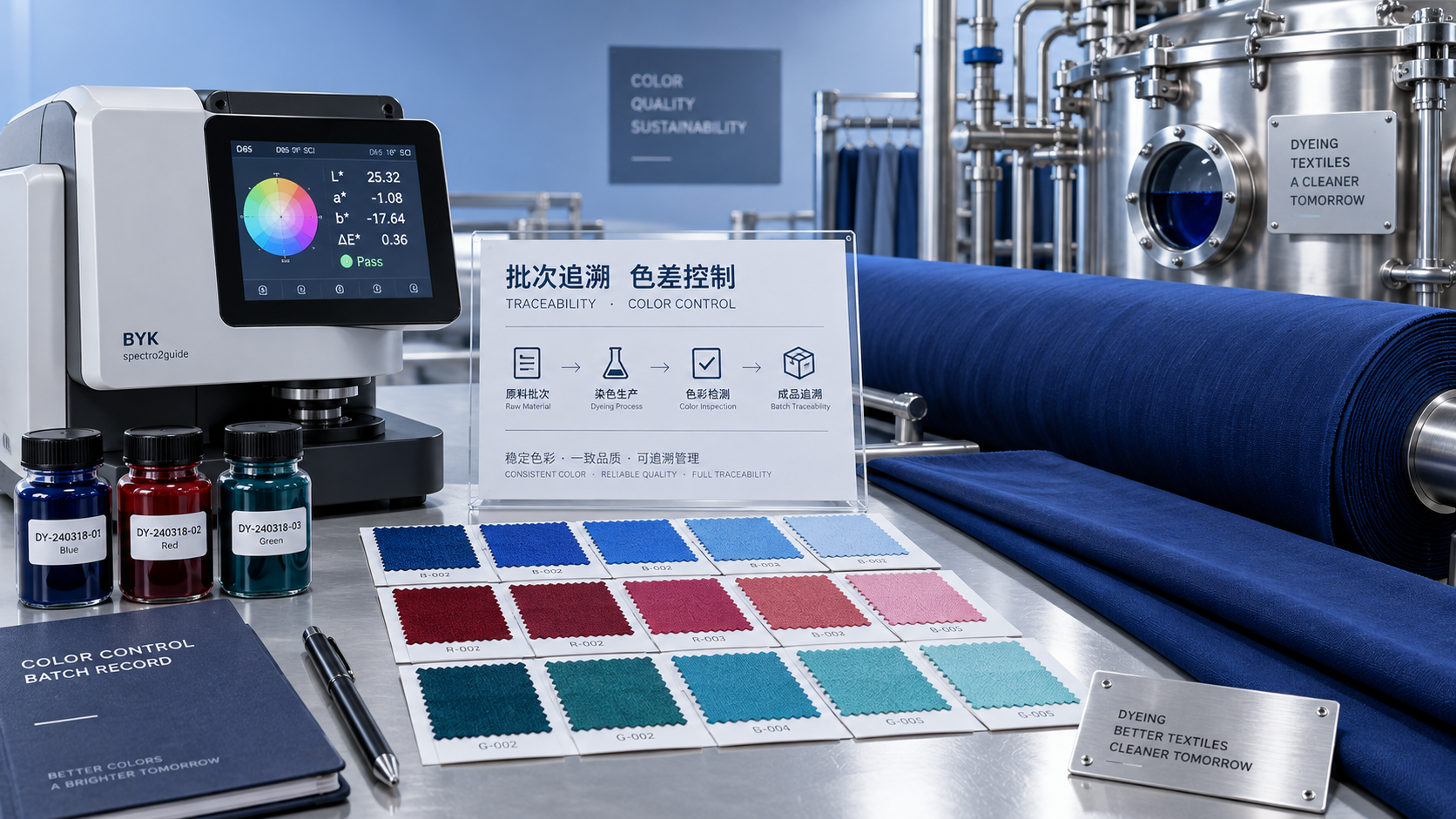
How Can Textile Dye Shade Variation Be Prevented?
How can I prevent shade variation in textile dyes? The practical answer is less about finding one “better” dye and more about controlling a chain of variables that influence color from laboratory approval to bulk delivery. A shade may look correct in a small trial, then shift in production because the substrate changed, the water behaved differently, the dye lot was not checked, or the finishing route altered the final appearance. Textile dyeing is unforgiving in that sense: small differences can become visible differences once fabric is spread across a cutting table or assembled into a garment.
Consistent color starts with reliable dye quality, controlled batch production, accurate formulation, and stable processing conditions. For mills sourcing chemicals internationally, it also depends on traceability, regulatory documentation, packing consistency, and a supplier that can respond when a production question appears. The most effective approach is to treat shade control as a shared system between dye manufacturer, chemical supplier, laboratory, dyehouse, and quality team.
Start with the dye lot, not the recipe sheet
A recipe can be perfectly recorded and still produce variation if the colorant itself changes from one lot to another. Commercial dyes are manufactured products, not abstract color names. Their strength, tone, moisture content, solubility, particle distribution, and impurity profile may affect the final result. This is particularly relevant when dark shades, bright reds, turquoises, navy colors, or delicate pale tones are involved, because these formulations often reveal relatively small deviations.
Before a new delivery is released to bulk production, dyehouses should compare it against an approved reference under the same laboratory conditions. A visual check is useful, but it should not be the only check. Instrumental color measurement can help identify whether the difference is mainly lighter or darker, redder or greener, yellower or bluer. The important point is consistency in the method: the same fabric, preparation route, recipe, drying procedure, and viewing conditions should be used for each comparison.
It is tempting to compensate immediately by changing the dosage. That can solve a single trial while hiding the root cause. If a dye lot requires repeated corrections, record the adjustment separately and ask whether the supplier can provide lot-to-lot standardization information. Retaining a small sealed sample from every received lot is also sensible. When a complaint arises weeks later, that sample may be more useful than memory or an old lab report.
Keep formulation discipline between lab and bulk
Many shade problems begin during scale-up. The laboratory may use carefully weighed materials, clean vessels, fresh auxiliaries, and a controlled liquor ratio. Bulk equipment introduces different realities: dosing pumps may drift, tanks may contain residue, operators may add materials in a different order, and actual liquor volume may not match the nominal setting. The result is often called a dye issue even when it is a process transfer issue.
A production recipe should specify more than dye percentages. It should identify the sequence of additions, dilution requirements, dissolution time, pH target, temperature profile, holding time, salt or alkali addition point where applicable, and washing route. “Use the approved recipe” is too vague when several operators or shifts are involved. A well-written bulk instruction makes it easier to distinguish a genuine dye variation from a change introduced on the floor.
Weighing and dispensing deserve more attention than they usually receive. Fine powders can absorb moisture, settle during storage, or form lumps when introduced too quickly. Liquid products may need gentle homogenization before use, but excessive agitation can create foam or entrain air. For dyes that require dissolution, filtering the prepared solution can prevent undissolved particles from creating specks, streaks, or local shade irregularity. These details are not glamorous, yet they protect a production run far more reliably than last-minute color correction.
Treat the fabric as a variable, because it is one
The same dye formulation will not necessarily behave identically on different textile substrates. Cotton lots may differ in absorbency, whiteness, wax content, preparation quality, or residual alkali. Polyester may vary in yarn structure, delustering level, heat history, and residual spin finish. Blends introduce another layer of risk because each fiber component can take color differently. Even fabric from the same nominal specification can dye differently if it comes from another mill, knitting line, or finishing route.
This is why incoming fabric evaluation matters before a critical color is committed. Check whether the material has received consistent scouring, bleaching, mercerization, heat-setting, or pretreatment. A weak preparation process may appear as poor levelness, lower color yield, or unexpected tone changes. In pale shades, optical brighteners and base fabric whiteness can be especially influential. In deep shades, incomplete washing or poor soaping may leave the surface looking dull, bronzed, or uneven.
Do not assume that a shade approved on one substrate can be copied directly to another merely because the fiber label is the same. A short confirmation dyeing is cheaper than reprocessing a full lot. This is also the moment to consider fabric construction: dense woven goods, bulky knits, microfiber fabrics, and packages or yarns each have different circulation and penetration behavior.
Control water, temperature, pH, and time as a package
Water quality is a routine source of avoidable inconsistency. Hardness, dissolved metals, alkalinity, suspended matter, and seasonal changes in water supply can all influence dye dissolution, migration, fixation, or brightness. The exact sensitivity depends on the dye class and auxiliary system, so there is no universal correction. What matters is monitoring water conditions and using a treatment strategy compatible with the process rather than reacting only after a shade has moved.
Temperature control is equally important. A machine may reach the setpoint but still heat too quickly, circulate unevenly, or hold at temperature for an inconsistent period. Some shade differences are actually rate-of-rise differences, especially where dye migration and uptake are sensitive to thermal conditions. Verify the machine profile periodically instead of relying solely on the display. Likewise, pH should be measured at the relevant process stage, not assumed from the quantity of acid or alkali added. Neutralization, buffering capacity, and residual chemicals in the fabric can change the actual bath condition.
When a shade shifts unexpectedly, avoid changing five variables at once. Compare the current run with the approved run: dye lot, substrate lot, water source, machine, liquor ratio, temperature curve, additions, pH, and wash-off. A disciplined comparison usually reveals a smaller number of meaningful differences. Random correction may create a visually acceptable batch but makes future repeatability worse.
Evaluate color under the conditions in which it will be seen
Color approval should account for illumination, texture, direction, and finishing. Two samples can appear close in one light and noticeably different in another, a familiar metamerism problem. This is why critical shades should be assessed under agreed viewing conditions, especially when fabric may be used with trims, printed panels, or components dyed by another supplier. A glossy finish, brushing, sanding, coating, resin treatment, or softener can also change perceived depth and hue after dyeing is complete.
The best time to identify a finishing-related shift is before the production color is signed off. Keep an approved standard that reflects the final commercial state, not only the fabric immediately after dyeing. If the finished shade cannot be reproduced consistently, the issue may sit in the finishing line rather than the dye bath.
Build traceability into international chemical sourcing
For globally sourced dyes and auxiliaries, technical control begins before the goods reach the mill. Purchase specifications should define the product identity, packaging, batch identification, storage expectations, required technical documents, and any applicable regulatory requirements for the destination market. Documentation alone does not guarantee dyeing consistency, but missing or unclear documentation makes troubleshooting slower and creates unnecessary risk.
Supply continuity matters as well. Switching suppliers or dye lots without a bridging trial can create avoidable shade problems, even where products are described using similar names. Chemical exporters need to understand that a shipment delay can force a mill into unplanned substitutions. Shandong Huafeng Chemical Co., Ltd., based in Shandong Province, operates in a market where overseas buyers increasingly expect not only a broad chemical portfolio, but also responsive communication, traceable shipment information, and support around product consistency. In dyeing applications, those trade capabilities are operationally relevant rather than merely commercial.
The practical standard is simple: every bulk lot should be traceable back to its supplied materials, and every supplied material should be traceable to a receiving and test record. That does not eliminate variation, but it turns a difficult argument into a solvable technical investigation.
Preventing variation is mostly about refusing shortcuts
Shade variation rarely comes from one dramatic failure. More often, it develops through several small departures from the approved process: a substituted auxiliary, a fabric lot accepted without checking, a rushed dye dissolution step, an unverified pH reading, or a new dye batch introduced directly into production. The disciplined dyehouse does not need to test everything endlessly. It needs clear control points and the habit of stopping when one of them has changed.
If a color is commercially sensitive, reserve enough approved dye from the same lot where possible, retain reference samples, and document every adjustment made during bulk production. When color consistency is treated as a supply-chain and process-control issue rather than a final inspection issue, fewer batches need rescuing after the fact.
Send Us Your Inquiry Today
