









Product Quick Navigation
Get a Quote
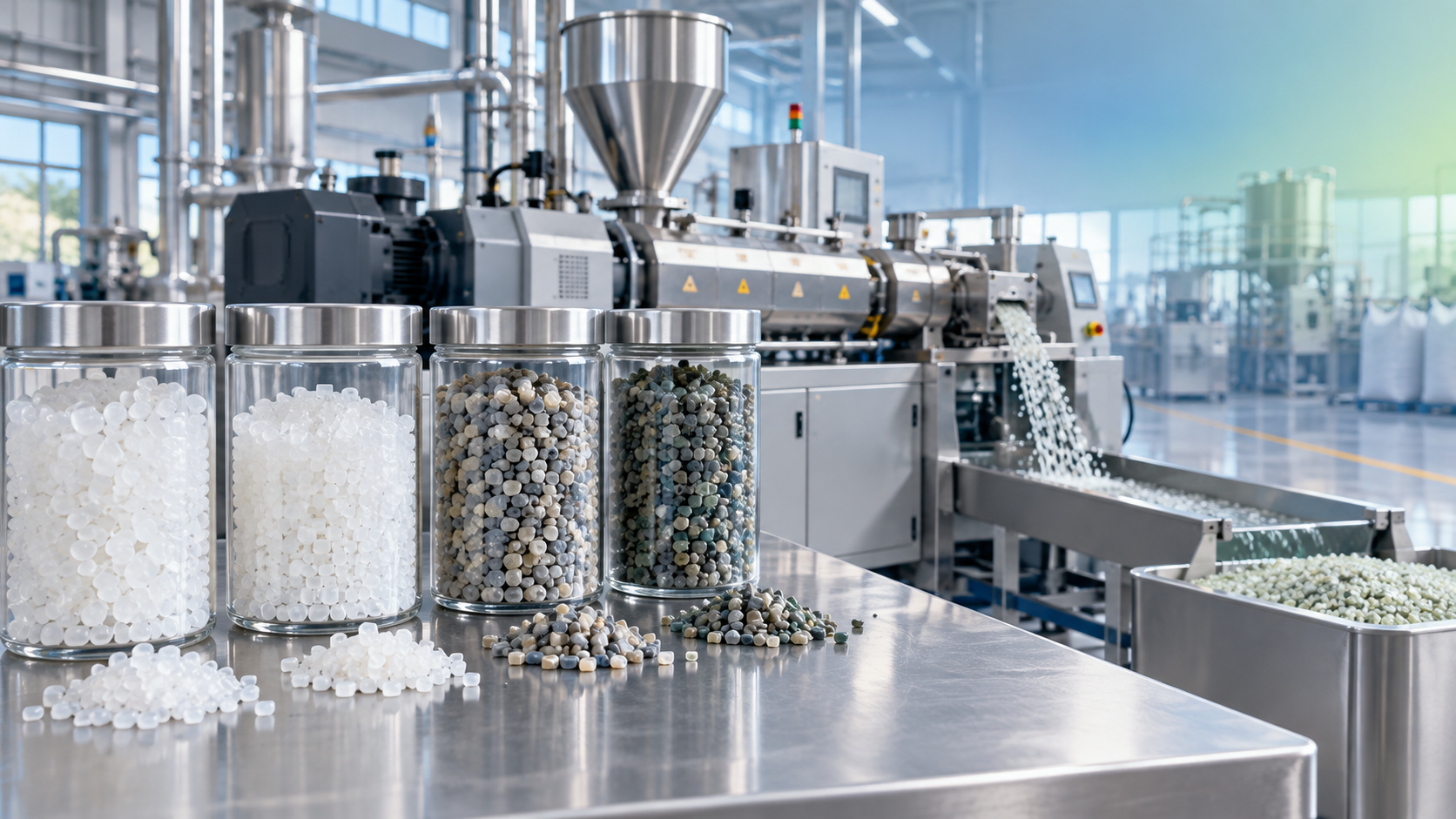
Virgin and recycled polyolefin resins can both be viable industrial materials, but they should not be treated as interchangeable by default. Virgin polyethylene and polypropylene generally offer tighter property consistency, cleaner odor and appearance, and a clearer regulatory path for demanding applications. Recycled grades can lower reliance on fossil feedstock and may support circularity targets, yet their performance depends heavily on feedstock origin, sorting quality, decontamination, stabilization, and batch control.
For a converter, compounder, distributor, or finished-goods manufacturer, the practical question is rarely whether recycled material is “good” or virgin material is “better.” It is whether a particular resin grade can meet the required processing window, finished-part specification, compliance obligations, and supply requirements at an acceptable total cost. The answer may differ between a non-visible pallet, a household product, a pressure-sensitive film, and a food-contact package.
Consistency Is the Largest Functional Difference
Virgin polyolefin resin is produced from controlled petrochemical feedstocks under defined process conditions. Suppliers can therefore target a relatively narrow range for melt flow rate, density, molecular-weight distribution, additive package, color, and mechanical behavior. This does not make every virgin grade identical, but it gives processors a predictable starting point when setting extrusion temperatures, injection pressures, cooling time, film gauge, or blow-molding conditions.
Recycled polyolefin begins with material that has already passed through one or more use and recovery cycles. Its properties reflect the original resin mix, use history, collection system, sorting technology, washing process, contaminants, degradation level, and recompounding method. A recycled pellet may contain polyethylene from several product streams, polypropylene from varied consumer articles, residual labels or inks, or traces of incompatible polymers. Better recycling systems reduce those variables, but they do not remove the need for grade-by-grade evaluation.
This variability is often most visible in melt behavior. A processor that changes from a virgin resin with a stable melt flow rate to recycled content with wider lot variation may see shifts in extrusion pressure, die swell, cycle time, part weight, or surface quality. Recycled material can also show changes in impact resistance, elongation, stiffness, environmental stress-crack resistance, odor, or color. The direction of change is not universal. It depends on the resin family, prior exposure to heat and oxygen, contamination profile, and formulation.
Application Requirements Should Set the Material Choice
Virgin resin is usually the more defensible choice when failure carries a high technical, safety, or compliance consequence. Examples include applications requiring precise mechanical performance, strong optical clarity, consistent weld strength, very low odor, demanding chemical resistance, or tightly controlled migration behavior. Medical, food-contact, pharmaceutical, and certain personal-care packaging applications may involve additional regulatory and customer requirements that cannot be addressed simply by calling a material “recycled.”
That does not mean recycled polyolefin has a limited industrial role. It can be well suited to products with wider tolerance for color variation and moderate property variation, especially where the design can accommodate the recycled grade. Industrial containers, crates, pallets, waste-management products, outdoor articles, protective components, selected household goods, and some non-critical packaging structures are common areas for evaluation. Post-industrial recycled resin may also be easier to control than mixed post-consumer material because its source is often cleaner and more uniform.
The design of the finished article matters as much as the resin label. A thick-walled molded component may tolerate a higher recycled-content level than a thin film where pinholes, gels, odor, or gauge variation become more visible. A black injection-molded item can mask color inconsistency more effectively than a natural or transparent product. A multilayer structure may allow recycled material in a protected middle layer while retaining virgin material where surface contact, sealing, or appearance is critical. Such approaches require technical validation; they are not automatic permission to use any recycled grade.
“Recycled Content” Does Not Describe Enough
Procurement teams sometimes compare offers using recycled-content percentage as the primary indicator. That figure is relevant, but it does not show whether the resin is appropriate for the job. A 30% recycled-content compound made from well-characterized material and stabilized for a defined application may be more useful than a higher-content grade with unclear feedstock composition and broad variation.
Buyers should distinguish among at least three questions: what resin stream was recovered, how it was processed, and what the supplier guarantees in the delivered grade. Polyolefin recycling streams may be predominantly high-density polyethylene, low-density polyethylene, linear low-density polyethylene, polypropylene, or a mixed polyolefin fraction. Those materials have different density, crystallinity, stiffness, heat resistance, and processing characteristics. A vague description such as “recycled PE” does not establish whether it will run satisfactorily on a given line.
Ask for a current technical data sheet that identifies the polymer family, intended processing method, melt flow range or target value, density where relevant, ash or contamination control where relevant, color, moisture recommendation, and applicable mechanical properties. For odor-sensitive or appearance-sensitive products, obtain samples from representative production lots rather than relying on a single pellet photograph. If the grade will be blended with virgin material, test the planned blend ratio, since compatibility and behavior can change as recycled content rises.
- Confirm whether the material is post-industrial, post-consumer, mechanically recycled, chemically recycled, or a blend of sources.
- Define acceptable variation ranges for the properties that affect the specific process and product.
- Request batch identification and retain samples from approved deliveries for comparison.
- Check whether additives, pigments, fillers, or stabilizers are present and whether they affect downstream requirements.
- Run trials using normal production equipment, tooling, cycle times, and quality checks rather than laboratory conditions alone.
Compliance Requires a Specific Review
Regulatory suitability cannot be inferred from polymer type alone. A resin may be chemically identified as polypropylene or polyethylene yet still be unsuitable for a particular regulated application because of its source, additive history, contamination risk, or documentation. Food-contact packaging is a clear example: requirements can vary by market, end use, recycled-material source, process controls, and the nature of the contact layer. Similar care may be needed for toys, medical-related products, electrical applications, transport packaging, and products subject to customer restricted-substance specifications.
The correct review begins with the intended market and article, not with a generic statement on a sales document. Buyers should establish whether the material will contact food or skin, be used at elevated temperature, contain sensitive goods, be exported into regulated markets, or be incorporated into a product with its own certification requirements. They should then request documentation that matches that use case. Where traceability is important, the supplier’s ability to identify feedstock category, processing route, and lot history can be as important as the basic test results.
Claims also deserve precision. “Recyclable,” “recycled,” “recyclable in principle,” and “contains recycled content” describe different things. A product made with recycled resin may still be difficult to recycle after pigments, multilayer construction, fillers, labels, adhesives, or incompatible polymers are added. Conversely, a virgin polyolefin product may be designed for efficient collection and recycling. Sustainability decisions should consider the whole article and its end-of-life pathway, rather than treating a resin category as a complete environmental verdict.
Cost Should Be Measured Beyond Pellet Price
Recycled resin can offer a lower purchase price in some situations, but the delivered economic result depends on more than the price per kilogram. Higher scrap rates, slower processing, additional quality inspections, color masterbatch, odor-control measures, cleaning downtime, or customer rejections can erase an apparent raw-material saving. On the other hand, a stable recycled grade that runs efficiently and meets the article specification may create value through lower material cost, recycled-content commitments, or product positioning.
Virgin resin brings a different cost profile. Its predictability can reduce qualification effort and production variability, particularly when a manufacturer operates high-volume lines with limited room for process disruption. Yet virgin material may not be necessary in every layer, component, or product family. The economically sound approach is to identify the performance floor for each application, then determine whether recycled content can meet it without creating disproportionate operating risk.
For this reason, many manufacturers begin with controlled substitution rather than full conversion. They may introduce recycled polyolefin at a modest percentage, measure processing stability and finished-part performance, then increase content only where results remain acceptable. This creates a practical evidence base for each product rather than assuming that a percentage successful in one item will transfer to another.
A Better Sourcing Decision Uses a Defined Qualification Path
When comparing virgin and recycled polyolefin resins, start with the product’s non-negotiable requirements: polymer type, processing route, strength, appearance, odor, contact conditions, regulatory status, and expected service environment. Then compare candidate grades against those requirements using documents, samples, and production trials. A supplier should be able to explain the material’s origin, consistency controls, available specifications, packaging, lot identification, and change-notification practice in terms relevant to the buyer’s application.
The final choice may be virgin resin, recycled resin, or a designed blend. Virgin material is the logical baseline where tight consistency and compliance confidence are essential. Recycled material becomes compelling where the grade is sufficiently characterized and the product can absorb its characteristics without sacrificing reliability. The useful comparison is therefore not between “new” and “green,” but between two material options measured against the same manufacturing and product requirements.
Send Us Your Inquiry Today
