









Product Quick Navigation
Get a Quote
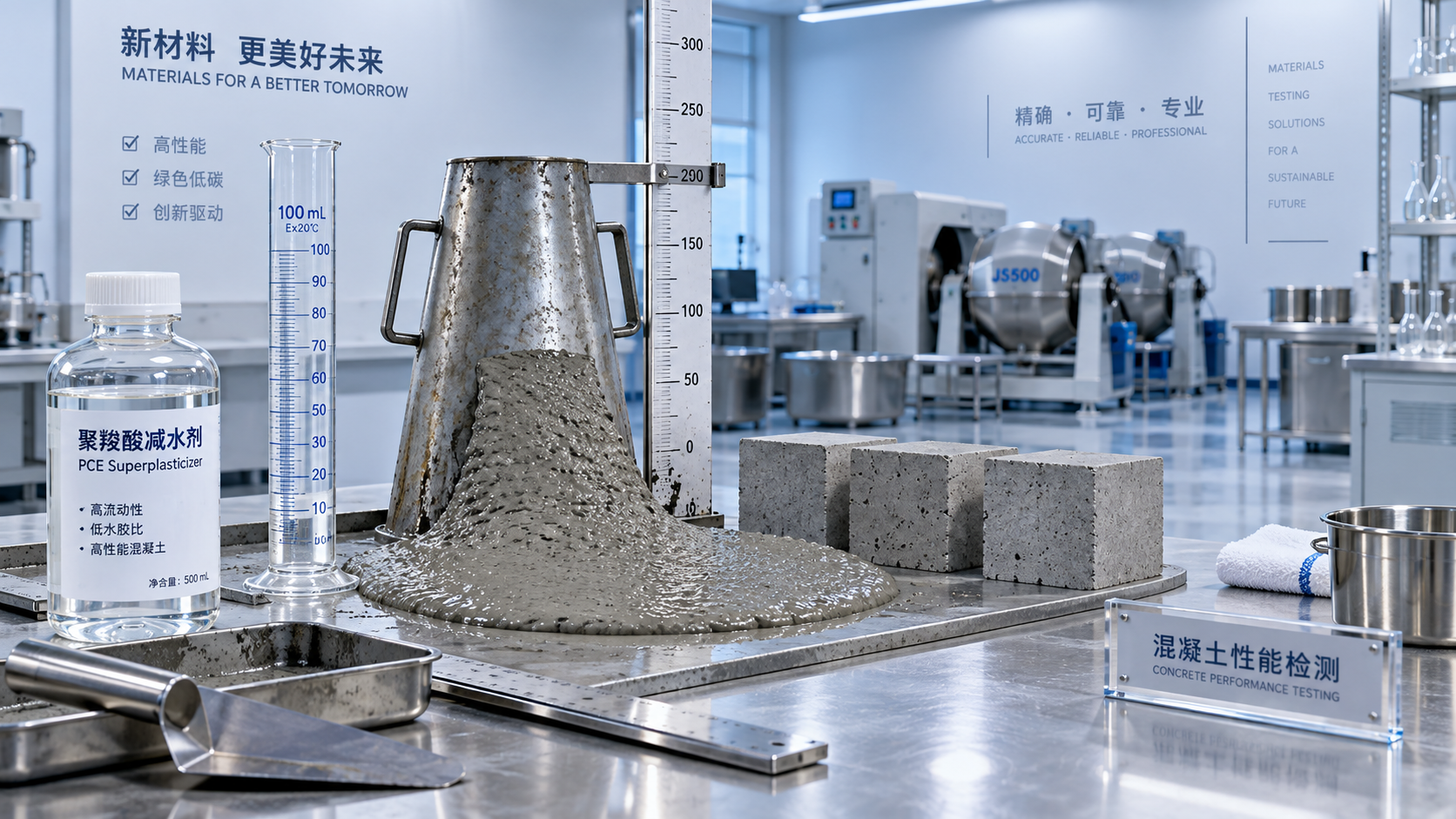
How to Evaluate a Polycarboxylate Superplasticizer Sample
A polycarboxylate superplasticizer sample should never be judged by appearance alone, or by the water-reduction figure printed on a technical sheet. In concrete production, an admixture is only “good” when it behaves predictably with the actual cement, aggregates, supplementary materials, water temperature, mixing sequence, and delivery time involved in the job. A sample that produces an excellent initial slump in a laboratory bucket can still create trouble at a batching plant if it loses workability too quickly, delays strength development, entrains unexpected air, or reacts differently with another cement delivery.
The practical purpose of sample evaluation is to reduce uncertainty before a purchasing decision becomes a production problem. This is especially relevant where concrete is pumped over distance, placed in hot conditions, cast into congested reinforcement, or transported from a ready-mix plant to a site with unpredictable waiting time. The right approach is not to search for one impressive result. It is to identify whether the admixture gives a useful performance window and whether that window can be repeated.
Start With the Project, Not the Bottle
Before testing a polycarboxylate superplasticizer sample, define what the concrete actually needs to do. A precast producer may prioritize rapid strength gain and stable low water-to-binder ratios. A ready-mix producer may care more about slump retention after sixty, ninety, or more minutes. For pumped concrete, viscosity and cohesion can matter as much as slump. A mix used for self-compacting concrete needs separate attention to slump flow, passing ability, segregation resistance, and air content.
This step sounds obvious, yet it is often skipped. Buyers sometimes request a “high-range water reducer” without stating cement type, target strength, binder content, aggregate grading, required slump, or expected transport time. That leaves the supplier guessing, and a sample selected for one purpose may be used for another. A meaningful test request should include the current mix design, fresh-concrete target, curing conditions, and any project limits on chloride, alkali, setting time, or air content.
Check Basic Product Information Before Mixing
A quick document review prevents avoidable confusion. Confirm whether the sample is supplied as a liquid or powder, its stated solids content, density range, recommended dosage basis, storage conditions, shelf life, and intended application. Dosage is commonly expressed as a percentage of cementitious material, but the basis must be clear. Comparing two products simply by liters per cubic meter can be misleading when solids content differs. The more relevant comparison is performance at equivalent binder conditions and at a controlled dosage basis.
Look at the safety data and regulatory documentation needed for the destination market as well. For imported chemical products, labeling, transport classification, customs paperwork, and local compliance requirements can affect whether a technically suitable admixture is practical to buy. In global trade, supply reliability and response speed are part of product evaluation. A supplier should be able to explain what is routinely available, which documents can be provided, and how product identification is maintained from sample to commercial shipment.
Use a Controlled Comparison Mix
The most useful trial compares the candidate product with the admixture currently used, or with a control mix containing no high-range water reducer. Keep cement source, aggregates, moisture correction, water content, mixer, mixing time, and test method unchanged. If several variables move at once, it becomes impossible to know whether a result came from the polycarboxylate chemistry, a wet sand correction, altered mixing energy, or a different operator routine.
Run more than one dosage. One dose may achieve the target slump, but the response curve is equally important. Some admixtures show a gradual increase in fluidity; others become highly sensitive near a certain addition point. A narrow dosage window can be difficult to manage in normal plant production, where aggregate moisture and batching tolerances are never perfectly constant. Record the actual dose, added water, mixing sequence, fresh properties, ambient temperature, and time elapsed after water contact.
Mixing sequence deserves more attention than it usually receives. A polycarboxylate-based admixture may perform differently when added with the initial water, after short dry mixing, or near the end of the cycle. The supplier’s recommendation is a starting point, not a substitute for plant verification. If the trial mix only works under an unusually long mixing cycle, the result may not transfer to a busy commercial operation.
Evaluate Fresh Concrete Beyond Initial Slump
Initial slump or slump flow is useful, but it is only the first reading. Observe the concrete at practical intervals that reflect delivery and placing conditions. Note whether the mix remains cohesive, whether mortar rises excessively, whether coarse aggregate separates, and whether the surface becomes sticky or harsh. A mix can retain a numerical slump while becoming difficult to pump or finish. Conversely, a modest slump loss may still be acceptable if the concrete remains uniform and easy to place.
Air content should be checked whenever possible, particularly when the concrete uses an air-entraining agent, certain sands, or supplementary cementitious materials. Some combinations can alter the air-void system or make readings less stable. Also watch for foam during mixing. Visible foam is not automatically a failure, but it is a signal to investigate air content, density, and hardened strength rather than assuming the admixture is behaving normally.
Setting behavior is another area where a short trial can mislead. Ask whether the sample changes finishing time, early stiffening, or the time at which the concrete becomes difficult to rework. In warm weather, an admixture that looks satisfactory at the plant may lose its margin on site. In cool weather, excessive retardation may interfere with stripping schedules or finishing operations. These effects should be judged against the local placement routine, not against a generic expectation.
Do Not Assume Cement Compatibility
Polycarboxylate superplasticizers are sensitive to binder chemistry. Cement fineness, sulfate balance, alkali content, mineral additions, and even normal variation between cement deliveries can change adsorption and dispersion behavior. This is why a sample should be tested with the cement actually expected for production. Results obtained with a convenient laboratory cement are useful for screening, but they are not enough to approve a product for a project.
Compatibility also includes other admixtures. Retarders, accelerators, viscosity-modifying agents, air entrainers, and recycled wash-water systems may all influence the final response. If the concrete plant uses a combined admixture package, test the package. A candidate that performs well alone may require dosage adjustment when paired with existing materials. Where project specifications refer to standards such as ASTM C494 or EN 934-2, confirm the applicable category and verification requirements with the project team rather than assuming one document covers every local obligation.
Check Hardened Performance and Repeatability
Fresh properties are only half the decision. Prepare specimens using the same curing approach applied in normal quality control, then compare early-age and later-age strength with the reference mix. The key question is not whether one cube or cylinder gives an unusually high result. Look for a coherent pattern: does reduced water demand translate into expected strength, and does the admixture create any concern around delayed early strength or variable density? Durability-related testing may also be needed when the project has specific exposure requirements.
Repeat the trial on another day if the purchase will support ongoing production. One batch proves possibility; repeated batches reveal consistency. Check whether the product’s density, appearance, and performance remain stable after normal storage. For liquid products, follow the supplier’s guidance on protection from freezing, overheating, and contamination. A superplasticizer can be technically sound but operationally unsuitable if storage conditions at the plant are incompatible with its handling requirements.
Assess the Supplier as Part of the Sample
For an imported chemical, evaluation should extend beyond the drum. Can the supplier answer concrete technical questions clearly? Can it provide consistent product identification, batch records, safety documentation, and reasonable support when a mix changes? These details matter when a site team needs an answer quickly rather than after several days of email exchanges. Shandong Huafeng Chemical, operating from Shandong’s established chemical manufacturing region, represents the type of export-oriented supplier relationship that buyers increasingly seek: broad chemical sourcing capability combined with attention to documentation, logistics coordination, and communication across markets.
That does not remove the need for independent testing. It makes proper testing easier to manage. Send the supplier the trial observations, including failures, instead of reporting only that the sample was “not good.” Details such as cement type, temperature, dosage, slump loss timing, and air content give a technical team something real to diagnose. A reliable polycarboxylate superplasticizer sample is not the one that produces the highest initial slump; it is the one that delivers controllable, repeatable concrete under the conditions where the mix must actually perform.
Send Us Your Inquiry Today
