









Product Quick Navigation
Get a Quote
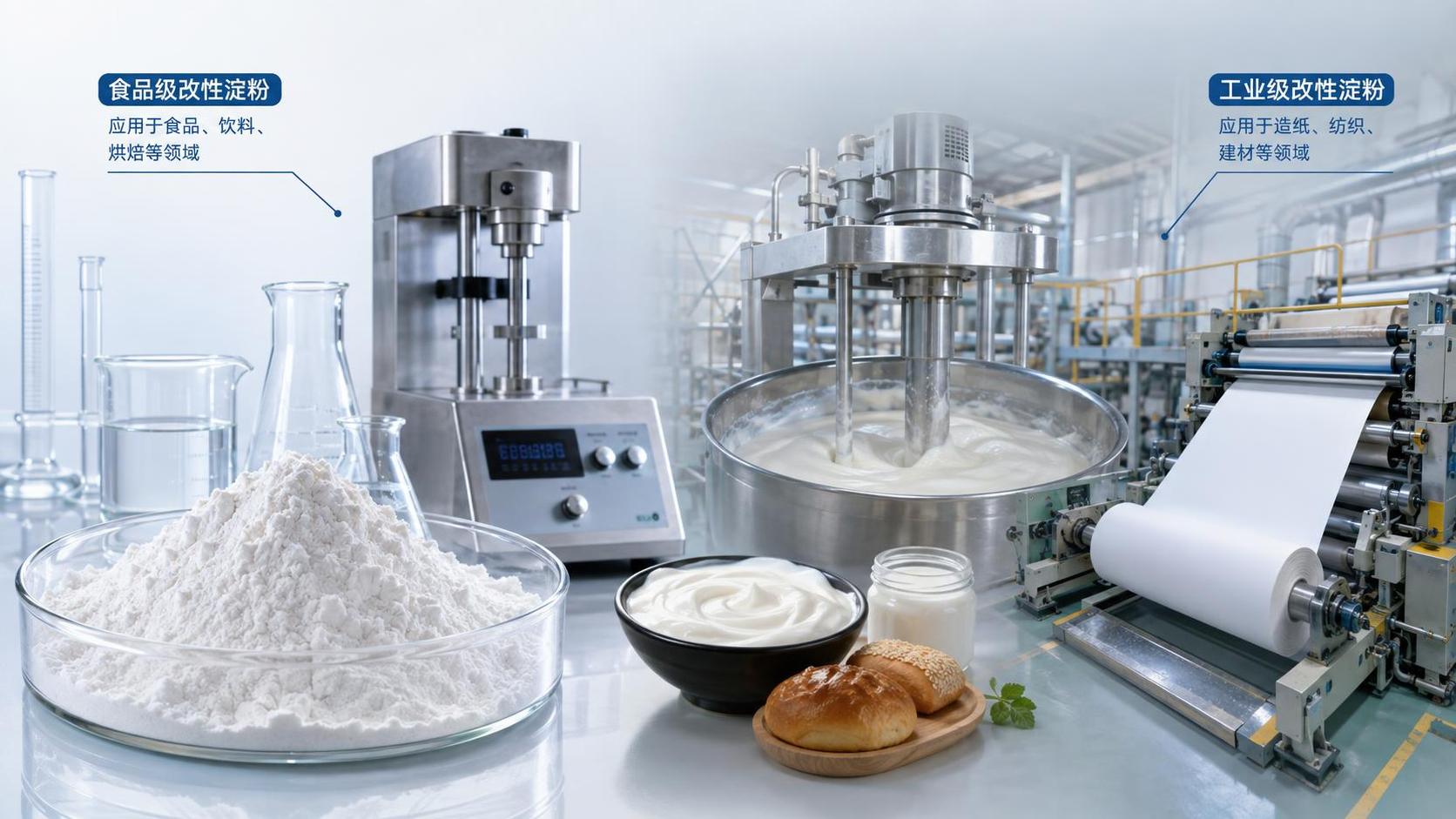
How Do Food-Grade and Industrial Modified Starch Differ?
Modified starch is often treated as a simple commodity: a white powder, a viscosity target, a price per metric ton, and a delivery date. That view works only until a batch enters a food plant, a paper-coating line, a textile mill, or an adhesive formulation. Then the difference between food-grade and industrial modified starch becomes very real.
Both grades may originate from corn, tapioca, potato, wheat, or other starch-bearing crops. Both can be physically, enzymatically, or chemically modified to improve stability, thickening behavior, adhesion, film formation, resistance to shear, or tolerance to heat and acid. Yet they are not interchangeable. The decisive difference is not merely how well the starch performs in water; it is whether the material has been manufactured, documented, controlled, and approved for its intended end use.
For buyers asking how to choose between food grade and industrial modified starch, the most useful starting point is not the product name. It is the application pathway: Will the starch be intentionally consumed? Could it contact food? Is it used in packaging, pharmaceuticals, or a process where trace transfer matters? Or is it strictly used in a non-food system such as corrugated board, gypsum board, paper, drilling fluid, foundry work, or textile sizing?
The Grade Defines the Control System, Not Just the Powder
Food-grade modified starch is produced for food use under controls designed to support food safety, legal compliance, and consistent sensory performance. Depending on the destination market and the particular starch modification, buyers may need evidence that the product is permitted for the intended food category, that relevant purity requirements are met, and that manufacturing practices align with applicable food-production expectations.
That normally means closer attention to raw-material traceability, cleaning and segregation practices, foreign-material prevention, lot identification, packaging hygiene, and documentation. It may also involve controls for microbiological quality, heavy metals, residual processing substances, allergens, genetically modified organism status, or other items requested by the customer or local regulations. The exact document set varies by country and product. A buyer should never assume that a general “food grade” statement automatically covers every market, food category, or label claim.
Industrial modified starch is designed around technical performance in non-food applications. Its specifications may prioritize viscosity development, solids handling, adhesive strength, water retention, penetration, drying behavior, or compatibility with resins, pigments, salts, and other process chemicals. It may be supplied with sound quality controls, but those controls are not necessarily designed to meet food-use requirements.
This is where costly mistakes happen. An industrial starch can look identical to a food-grade starch in a basic visual inspection. It may even show a similar viscosity in a quick laboratory test. That does not make it suitable for food processing or food-contact use. Food suitability depends on the full manufacturing and compliance chain, not on appearance or a single performance result.
The Same Modification Can Serve Very Different Markets
Modified starch is a broad family rather than one material. Pregelatinized starch may be selected because it disperses or thickens in cold water. Cross-linked starch can be useful where processing involves heat, acid, or high shear. Oxidized starch is common in applications requiring lower viscosity or film-forming behavior. Acetylated, hydroxypropylated, cationic, and dextrinized starches each bring different functional characteristics.
The modification itself does not decide the grade. What matters is the approved chemistry for the destination, the permitted use level where relevant, the quality system used during manufacture, and the supplier’s ability to provide supporting records. A starch modified for a food sauce and a starch modified for paper coating may both have been engineered for stability, but their specifications, documentation, and regulatory status can differ substantially.
Food Applications Need More Than a “Food Grade” Label
In food manufacturing, modified starch is often selected for a very specific processing problem. A dairy dessert may require body without excessive syneresis. A fruit filling may need viscosity that remains stable after heating and storage. A powdered beverage system may need a carrier that disperses predictably. A fried coating may need crispness and adhesion rather than simply high viscosity.
These needs are formulation-specific. The buyer should define the process temperature, pH, shear level, solids content, expected shelf life, freeze-thaw exposure, and desired texture before requesting samples. A starch that works well in a neutral system may fail in an acidic fruit preparation. Another may survive retort conditions but produce an unwanted mouthfeel. The commercial name alone rarely tells the whole story.
For food use, sensory details deserve attention as well. Odor, taste neutrality, color, hydration behavior, and batch-to-batch consistency can matter just as much as a viscosity number. A procurement team may focus on a lower delivered cost, while the production team later discovers that the new material requires longer mixing, creates fish-eyes, or changes filling behavior. A low-cost starch is not low cost if it disrupts a high-value production run.
Industrial Users Should Buy Against Process Conditions
Industrial starch selection is equally technical, but the performance priorities shift. In corrugating adhesives, a buyer may care about gel point, bonding speed, water retention, and stability in a borax- or caustic-containing system. In paper manufacturing, the relevant questions can include charge demand, retention behavior, surface strength, coating rheology, and compatibility with the existing wet-end chemistry. In textile sizing, film strength, abrasion resistance, desizing behavior, and yarn penetration may guide the choice.
One practical mistake is to specify only “viscosity.” Viscosity is important, but it is measured under defined conditions. Different test concentrations, temperatures, instruments, and preparation methods can generate figures that are not directly comparable. Buyers should ask how the value was measured and use their own process trial to confirm suitability.
Industrial applications also reward a candid discussion of the actual process. Is the slurry prepared in cold water? Is it cooked in a jet cooker? Will it encounter high salt levels, high alkalinity, recycled water, or long hold times? Does the plant need a dust-reduced grade or packaging suitable for automated dosing? Those details often determine whether a standard product is adequate or whether a tailored grade is worth the additional effort.
How to Choose Between Food Grade and Industrial Modified Starch
The first decision is straightforward: if the starch is intended for human consumption, choose a grade supported for food use in the relevant market. Do not attempt to “upgrade” an industrial material through internal testing or rely on a supplier’s verbal assurance. The compliance basis must be established before purchase and should match the actual application, not a loosely related one.
The second decision is less obvious: food contact is not the same as direct food addition. For packaging adhesives, coatings, paper, or other materials that could come into contact with food, requirements may depend on the product construction, intended contact conditions, migration considerations, and local rules. Some buyers automatically request food-grade starch; others assume industrial grade is acceptable because the starch is not eaten directly. Neither shortcut is reliable. Confirm the end-use scenario with regulatory and technical stakeholders.
A disciplined purchase inquiry should include the following information:
- Starch source and requested modification type, if known
- Final application and whether direct food use or food contact is involved
- Destination country or region and any customer-specific compliance requirements
- Process conditions, including pH, temperature, shear, cooking method, and solids level
- Critical performance targets such as viscosity profile, gel strength, adhesion, clarity, or freeze-thaw stability
- Required documents, testing expectations, packaging format, and expected lot traceability
This information allows a supplier to distinguish between a technically workable product and a commercially usable one. Those are not always the same thing.
Documentation Is Part of the Material
In international trade, a modified starch shipment is more than bags and pallets. Buyers often need a technical data sheet, certificate of analysis, safety documentation, origin information, and declarations relevant to their own compliance review. For food-related uses, requests can be more extensive. The sensible approach is to identify required paperwork before confirming the order, especially when materials will pass through a brand owner’s vendor-approval system.
It is also worth separating routine specifications from special claims. A request for a particular allergen statement, non-GMO statement, religious certification, pesticide-related declaration, or food-contact declaration should be raised early. These claims may require specific sourcing, controls, or documentation. Treating them as an afterthought can delay shipment or force a buyer to requalify material.
For overseas buyers, supply-chain responsiveness matters alongside technical quality. Shandong Huafeng Chemical Co., Ltd., based in Shandong Province, works within a major chemical-production region and supports export customers across a broad chemical portfolio. In a starch inquiry, the useful value of an export-oriented supplier is not a generic promise of availability; it is the ability to clarify technical requirements, align documentation before dispatch, and communicate honestly when a requested grade needs further confirmation.
Do Not Let Price Decide the Grade
Food-grade material often carries additional costs because the supply chain, production environment, quality controls, and documentation burden can be more demanding. That does not mean industrial buyers should automatically pay for food grade. If the application is clearly non-food and does not require food-contact support, an industrial grade may be the more rational choice.
The reverse is more important: industrial grade should not be selected for a food-related application simply because the technical data look similar or the price is attractive. The savings can disappear quickly if material is rejected during incoming inspection, blocked by a customer audit, or found to lack the declarations needed for market entry.
Before approving a new modified starch, run a trial under realistic conditions and review the documents against the destination market’s requirements. If the product will be consumed or may contact food, involve the appropriate regulatory or quality personnel before issuing the purchase order. In starch sourcing, the right question is not “Which grade is better?” It is “Which grade is properly supported for this use, and will it perform reliably in our process?”
Send Us Your Inquiry Today
