









Product Quick Navigation
Get a Quote
How Should Epoxy Resin Crystallization During Storage Be Handled?
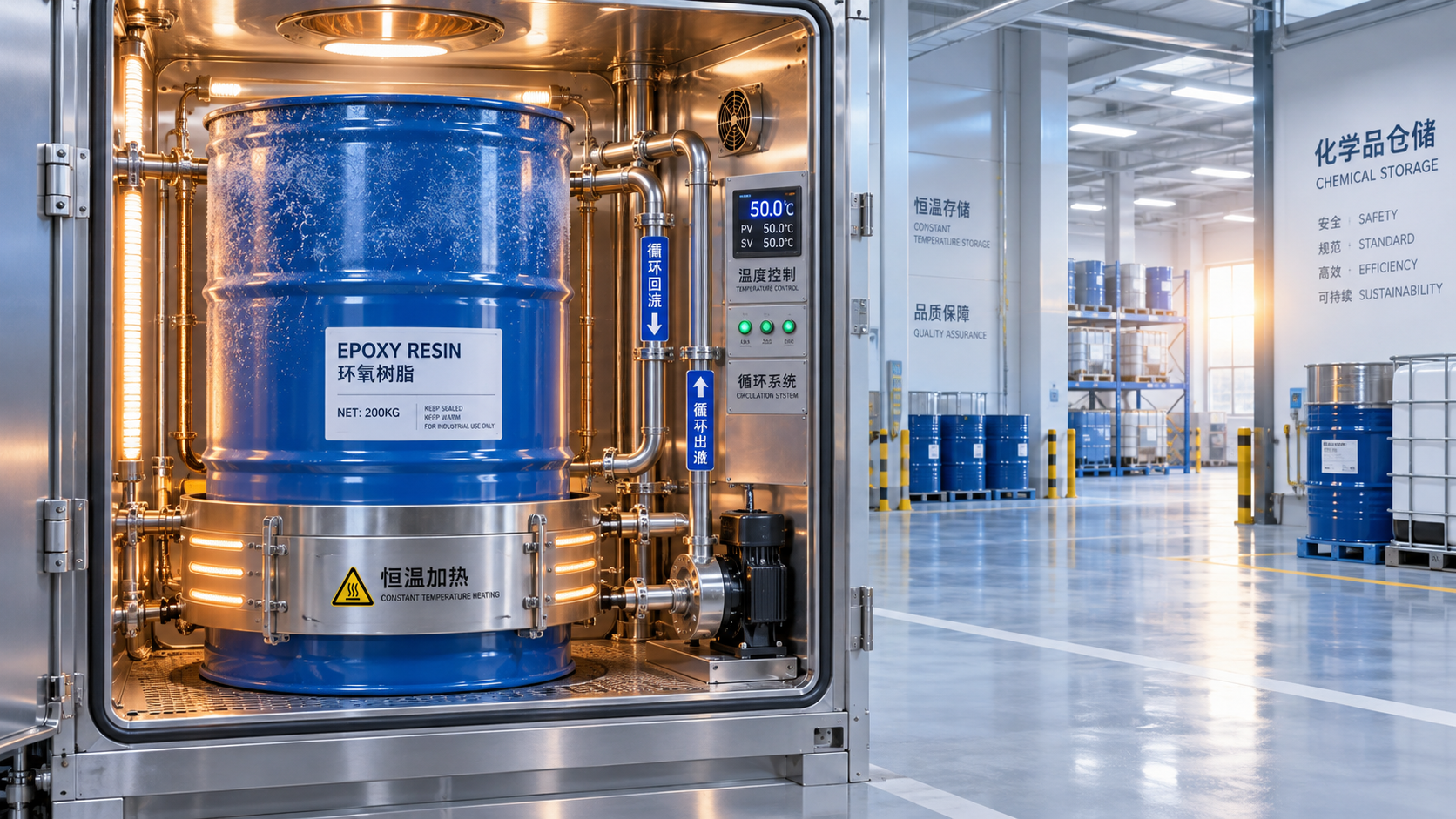
Epoxy resin crystallization during storage can affect viscosity, processing consistency, and production schedules if it is not addressed correctly. How do I handle epoxy resin crystallization during storage? The practical answer is to identify the material, warm it in a controlled way, restore homogeneity without contamination, and verify that the recovered resin still meets the specification required for its intended use. A partly solid or cloudy drum is not automatically a defective drum. For several liquid epoxy resins, especially bisphenol-A-based grades, crystallization is a known physical change that may occur when storage temperatures remain low or fluctuate over time. It does, however, require disciplined handling. Improvised heating, excessive temperatures, or uncontrolled mixing can create a much larger quality problem than the crystals themselves.
For buyers, formulators, and plant operators, the concern is rarely limited to appearance. A resin that has not been fully redissolved may feed unevenly, give misleading viscosity readings, or disrupt stoichiometric calculations when it is later blended with hardener, diluent, filler, or pigment. In cross-border supply chains, the issue also connects with transit duration, container conditions, warehouse capability, packaging integrity, and the clarity of technical communication between supplier and consignee.
Why Liquid Epoxy Resins Crystallize
Crystallization occurs when molecules in a resin arrange into an ordered solid structure. It is different from curing: the resin has not necessarily reacted, and crystallized material can often be returned to a uniform liquid state. Whether this happens depends on resin chemistry, purity, molecular distribution, storage temperature, time at temperature, and the presence of nuclei that encourage crystal growth. Some grades are more prone to crystallization because of their molecular structure. Others may stay liquid for long periods under the same warehouse conditions.
Early signs can be subtle. Operators may notice haze, fine particles, a grainy layer near the bottom of a pail, increased resistance during pumping, or opaque areas on the inner wall of a drum. More extensive crystallization can produce a wax-like mass or a material that appears almost fully solid. Do not assume that all thickening is crystallization. Low temperature alone raises viscosity, while contamination, partial advancement, moisture ingress, or an incorrect material release can produce different symptoms. The product label, batch documentation, safety data sheet, and technical data sheet should be reviewed before recovery work begins.
Confirm the Condition Before Applying Heat
A sensible first step is to isolate the affected package from routine production use and record the observed condition. Check the lot number, date received, storage history if available, and whether the package has remained sealed. Compare the appearance with the supplier’s description of normal crystallization behavior for that grade. If multiple packages from one shipment show the same change after exposure to cold weather, crystallization becomes a more likely explanation. If only one damaged or opened container behaves differently, contamination or localized degradation deserves more attention.
Sampling should be performed only after the material is sufficiently fluid and homogeneous to give a representative result. Taking a sample from a clear liquid layer above a crystalline deposit can lead to a false acceptance decision. Where the resin is used in regulated coatings, electrical systems, composites, adhesives, or food-contact-related applications, internal release procedures may require additional checks. The relevant acceptance criteria are product-specific; common controls can include visual uniformity, viscosity, epoxy equivalent weight, color, or other agreed release tests. A warehouse team should not invent pass/fail limits when the purchasing specification or supplier guidance already defines them.
Controlled Warming Is the Usual Recovery Method
The preferred approach is gradual, uniform heating in equipment suitable for the package and chemical involved. Depending on plant practice, this may mean a temperature-controlled warming room, heated cabinet, drum oven designed for chemical containers, jacketed vessel, or a recirculating warm-water arrangement. The correct temperature range and holding time must come from the resin supplier’s current technical instructions. There is no universal heating temperature for epoxy resin, and a method suitable for one grade may be unsuitable for another.
Heat should be distributed around the container rather than concentrated at one point. Localized hot spots may discolor the resin, accelerate unwanted reactions, distort plastic packaging, or create uneven viscosity that masks remaining crystals. Direct flames, unregulated heaters, and placing containers against a high-temperature surface are poor practices. Microwave heating is also inappropriate for industrial packages because heating can be non-uniform and difficult to control. If the material has been transferred to a compatible process vessel, the vessel should remain closed or protected from moisture and dust while warming.
Do not treat heating as a race against the production schedule. A larger drum warms slowly through its center, and the exterior can feel warm while the core remains partly crystallized. Allow the package to equilibrate, then inspect again. If crystals remain, continue the supplier-approved warming cycle rather than increasing temperature impulsively. Repeated rapid heat-and-cool cycles should be avoided whenever possible because they can make warehouse control harder and may affect handling characteristics.
Rehomogenization Matters as Much as Melting
Once the resin has become fluid, it must be mixed carefully until it is visually uniform. Gentle mechanical agitation, drum rolling where appropriate, or recirculation through compatible closed equipment may be used according to the package format and site procedure. The purpose is to dissolve residual crystals and equalize the composition throughout the container, not to whip air into the resin. Excessive agitation can entrain bubbles, complicate downstream degassing, and increase exposure if the container is opened unnecessarily.
Compatibility is important. Pumps, seals, hoses, stirrers, and transfer lines should be suitable for the resin and cleaned according to site controls. A material that is simply “melted” but not mixed can still show inconsistent viscosity from one draw-off point to another. After homogenization, allow entrained air to release if required, then conduct the agreed quality checks. If the resin does not return to a clear or expected homogeneous condition after the documented recovery procedure, it should be referred to the supplier’s technical team rather than forced into use.
What Not to Do When a Drum Looks Solid
Several shortcuts create avoidable risk. Do not add solvent, reactive diluent, hardener, or another resin merely to reduce viscosity unless the formulation owner has approved that change. Such additions can alter epoxy value, cure behavior, volatile content, labeling, and customer qualification status. Do not chip solid material out of an open package with unclean tools. Apart from worker safety concerns, the action can introduce foreign matter and moisture into a product intended for controlled chemical processing.
Avoid venting, opening, or resealing containers without understanding the packaging instructions. Heating can change internal pressure conditions, particularly in closed containers, and site safety procedures should govern any handling step. If a drum is swollen, leaking, visibly damaged, or associated with an unexpected odor, do not assume ordinary crystallization. Quarantine it and investigate through the responsible quality and safety channels. The distinction between a reversible physical change and a damaged package is operationally important.
Storage Controls That Reduce Repeat Incidents
The most effective prevention measure is maintaining the supplier-recommended storage temperature consistently, rather than merely avoiding freezing. Seasonal cold, overnight warehouse temperature drops, unheated loading areas, and winter port delays can all expose resin to conditions that encourage crystallization. Temperature monitoring should cover the locations where products actually wait: receiving bays, staging zones, high racks, export consolidation areas, and container loading points. A temperature record taken only in an office does not describe the condition inside a steel drum near an exterior wall.
Inventory rotation also helps. Use the oldest suitable batches first, observe stated shelf-life requirements, and avoid storing sensitive resin beside doors or heat sources. During international transport, packaging selection and shipment planning deserve the same attention as the resin grade itself. Buyers should discuss expected route, season, transit time, destination warehouse conditions, and any need for thermal protection before dispatch. These discussions are especially useful when material will pass through several climate zones or wait for customs clearance.
A Supply-Chain Issue, Not Just a Warehouse Issue
Amid the deepening globalization of trade, the chemical industry demands higher standards regarding supply-chain stability, regulatory compliance, and responsiveness. Epoxy resin storage behavior illustrates why technical product knowledge and export coordination cannot be separated. The consignee needs clear handling guidance, but also accurate shipping documents, correct labeling, responsive communication about batch information, and a realistic understanding of the journey between production site and plant floor.
Located in Shandong Province, a major hub for China’s chemical industry, Shandong Huafeng Chemical Co., Ltd. is serving an increasing number of overseas clients through comprehensive foreign-trade capabilities and an extensive product portfolio. In practice, this type of export service is most useful when it supports technical alignment rather than simply moving containers. Before an order is released, buyers can clarify the resin grade, expected storage environment, applicable documentation, packaging format, inspection needs, and escalation route if crystallization occurs after arrival.
A crystallized epoxy resin package should therefore be handled methodically: verify the condition, consult the grade-specific guidance, warm uniformly, rehomogenize completely, and confirm suitability before production use. That sequence protects process consistency without turning a manageable storage event into a quality deviation. When the material will travel internationally, documenting those expectations before shipment is usually far easier than resolving uncertainty when a cold-weather delivery reaches the warehouse.
Send Us Your Inquiry Today
