









Product Quick Navigation
Get a Quote
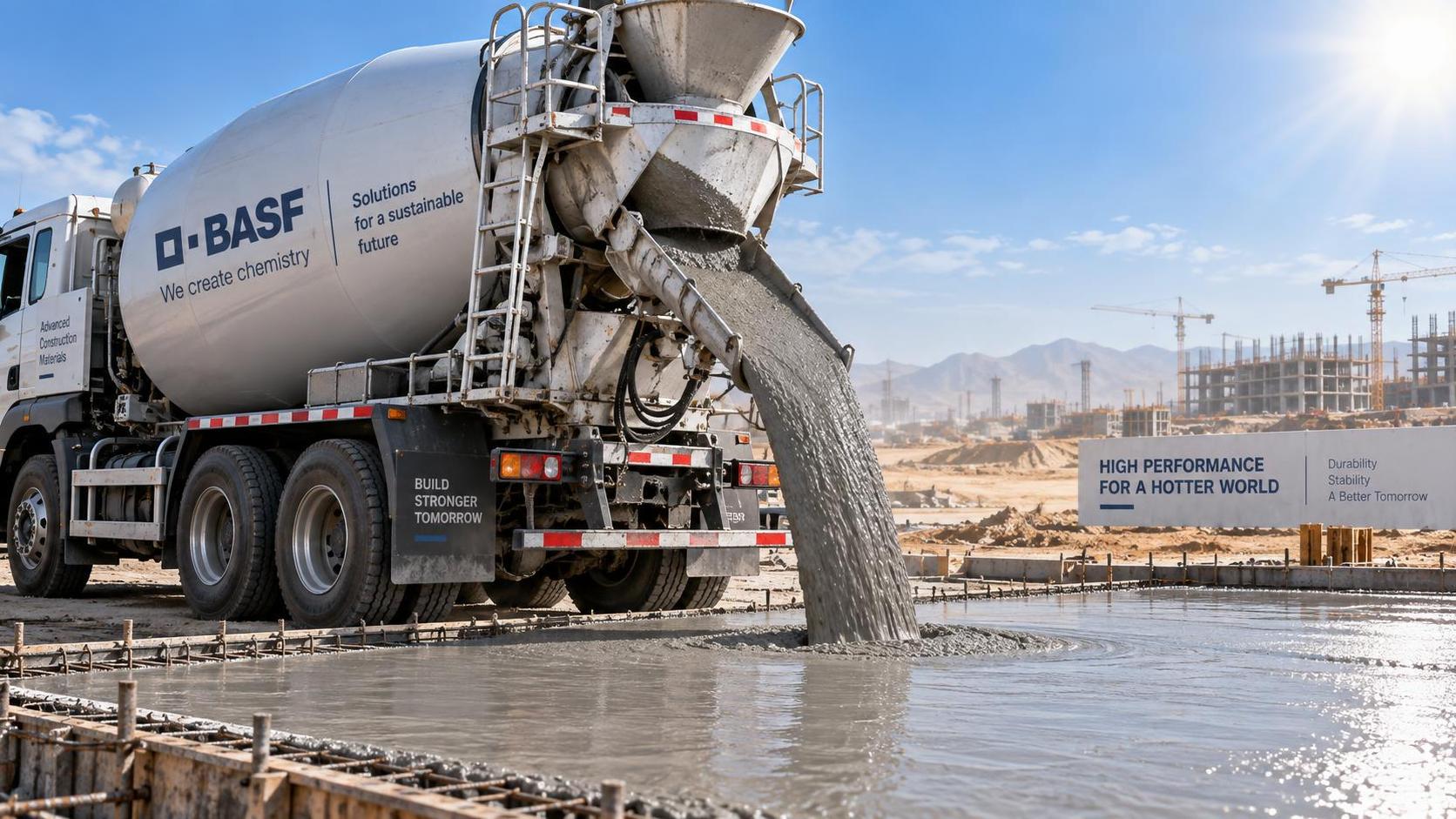
Hot Weather, Hot Problems: Why Your PCE Dosage Isn’t Just a Number
You’re on site. Ambient temperature hits 35°C. Humidity’s low. The ready-mix truck arrives—and the slump drops 40 mm before the first pour even starts. You adjust the Polycarboxylate Superplasticizer dosage on the fly. But instead of stabilizing workability, the mix begins bleeding at the edges and stiffens unevenly by 45 minutes. No lab report, no consultant—just you, the foreman, and the concrete setting faster than your crew can place it.
This isn’t theoretical. It’s what Huafeng Chemical’s field support team hears weekly—from Dubai to Veracruz, from Jakarta to Riyadh. When exporting Polycarboxylate Superplasticizers into volatile climates, we don’t ship formulas. We ship context-aware dosing logic. And in hot weather, that logic starts with one uncomfortable truth: dosage isn’t linear. It’s exponential, time-sensitive, and deeply entangled with cement chemistry, aggregate moisture, and ambient evaporation rates.
The “Too Little / Too Much” Trap Is Real—And It’s Not Symmetrical
Most operators default to “add 0.1–0.3% by weight of cement.” That works fine in spring in Berlin. In summer in Doha? It fails—not gradually, but abruptly. Under high temperatures, early hydration accelerates, consuming sulfate and calcium ions faster. PCE molecules adsorb less efficiently onto rapidly forming C-S-H surfaces. So the same dose delivers less dispersion—and worse, less retention.
But doubling the dose rarely fixes it. Excess PCE doesn’t just extend slump—it destabilizes the colloidal balance. You get segregation, surface water sheen, or delayed set (especially with slow-reacting cements). Worse: some PCEs hydrolyze faster above 30°C, losing effectiveness mid-pour. That’s why Huafeng’s export batches include region-specific stability data—not just shelf life, but *performance half-life* under simulated site conditions (e.g., 38°C/25% RH for 90 minutes).
Three Field-Tested Adjustments That Actually Work
No algorithm replaces experience—but these adjustments are grounded in repeated observations across 17+ countries:
- Pre-cool the mixing water—and verify its temp, not just the spec sheet. A 5°C drop in water temp can buy you 12–15 minutes of retention without touching PCE dosage. But if your plant uses recycled washwater at 32°C, pre-cooling is non-negotiable.
- Use staged addition—not just “add all at once.” Add 70% at batching, then meter the remaining 30% continuously during transit or at the hopper. This counters hydrolysis and maintains molecular coverage as hydration progresses. Works best with mid-range PCEs (Mw ~40,000–60,000), not ultra-high-Mw types.
- Accept that “optimal” changes hourly. At 10 a.m., 28°C and 40% RH may need 0.22% PCE. By 2 p.m., same location at 36°C and 22% RH often demands 0.28–0.31%—but only if the cement alkali content is ≤0.6%. Higher alkalis? Drop back to 0.25% and accept tighter placement windows.
Why Cement Matters More Than You Think
PCE performance hinges on cement surface charge—and that shifts with temperature. High-alkali cements (common in Middle Eastern and Southeast Asian clinkers) develop stronger positive zeta potential when heated. That repels anionic PCE chains more aggressively. Result: faster desorption, steeper slump loss. We’ve seen identical PCE doses perform 3× better on low-alkali European cement vs. local GCC cement at 35°C—even with identical w/c ratio and admixture brand.
Solution? Don’t rely on generic compatibility charts. Ask your supplier for actual zeta potential curves at 30°C and 40°C—measured on *your* cement batch, not a reference sample. Huafeng includes this in technical dossiers for export clients working with regional cement suppliers. If unavailable, run a simple field test: mix three 5-L batches at 0.2%, 0.25%, and 0.3% PCE, record slump every 5 minutes for 60 min at site temperature. Plot the curves—not just final values.
A Note on Analytical Rigor—When It Counts
Slump retention isn’t just about placement—it’s about consistency in strength development and durability. That means verifying raw material purity matters. For example, trace phosphate impurities in gypsum or limestone can interfere with PCE adsorption kinetics. In such cases, precise phosphorus quantification becomes critical—not for compliance, but for troubleshooting unexpected retention loss. Ammonium Molybdate CAS#13106-76-8 remains a reliable reagent for quantitative phosphorus detection in cementitious materials testing, especially where spectrophotometric methods are deployed onsite or in regional labs.
What Not to Do—Even When Pressured
• Don’t substitute PCE with lignosulfonates or naphthalene-based superplasticizers in hot weather—they lack retention control and increase air entrainment unpredictably.
• Don’t assume “higher molecular weight = better retention.” Some ultra-high-Mw PCEs show sharp performance cliffs above 32°C due to thermal unfolding.
• Don’t ignore aggregate pre-wetting—even crushed stone absorbs 0.5–1.2% water at 40°C. Unaccounted moisture loss accelerates stiffening faster than PCE can compensate.
Final Thought: Dosage Is a Dialogue, Not a Directive
The right Polycarboxylate Superplasticizer dosage in hot weather isn’t found in a table. It’s negotiated—in real time—between ambient conditions, material variability, and crew responsiveness. Huafeng’s role isn’t to prescribe numbers. It’s to equip you with the right questions: What’s your cement’s alkali content *today*? Is your water truly at 18°C—or has it warmed in the tank? Did the last truck’s slump hold at 30 minutes, or was it already bleeding?
That’s how reliability gets built—not in the lab, but at the pump, under the sun.
Send Us Your Inquiry Today
