









Product Quick Navigation
Get a Quote
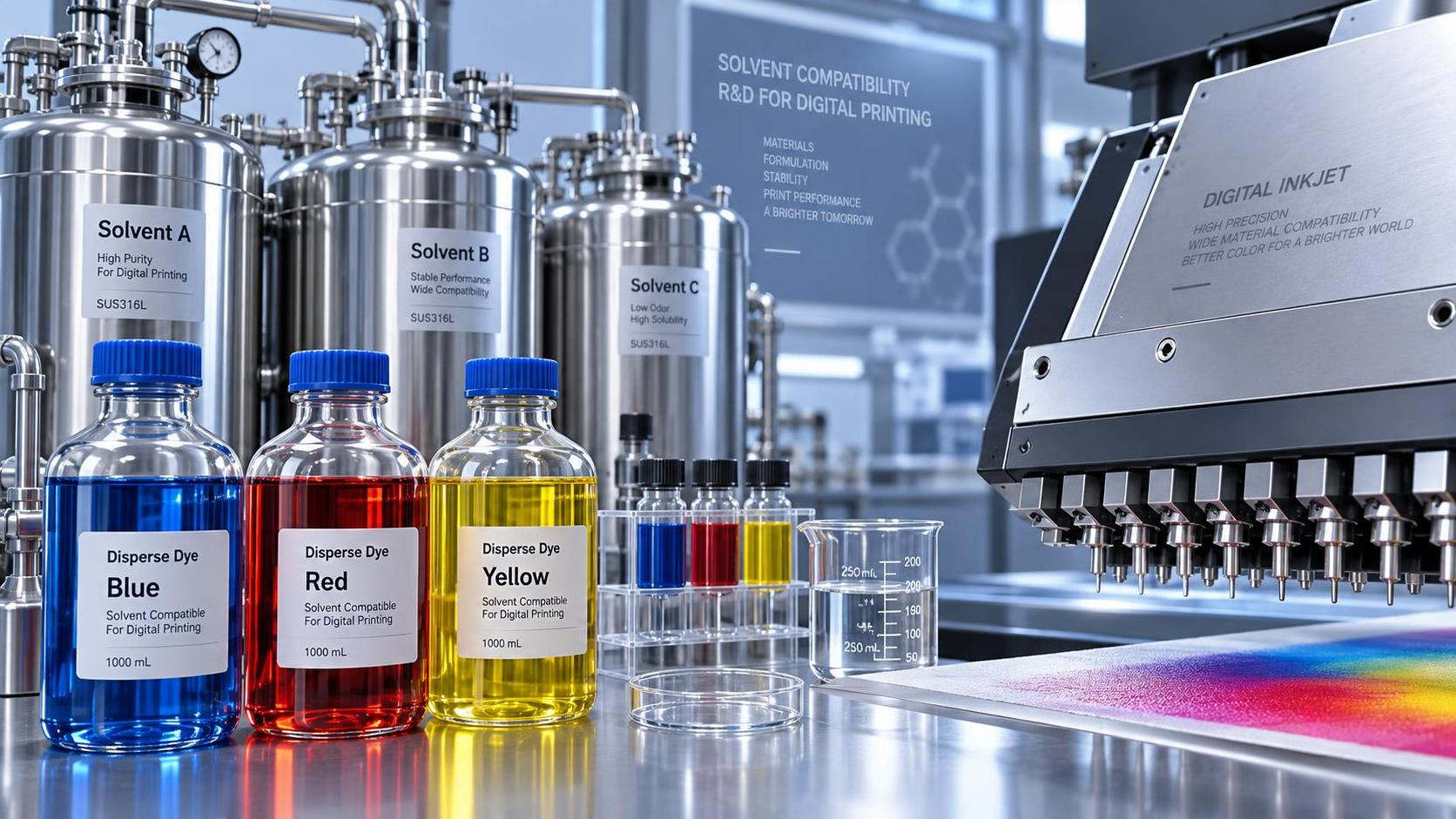
Disperse dyes are indispensable in polyester digital inkjet inks—but their performance hinges critically on solvent compatibility. When technical evaluators assess formulations, the primary concern isn’t just solubility in isolation; it’s whether the dye remains stably dispersed under dynamic jetting conditions, across thermal cycling, and during prolonged storage. Incompatible solvents trigger rapid aggregation, leading to nozzle clogging, inconsistent droplet formation, color metamerism, or even irreversible filter blockage. These failures aren’t theoretical—they occur in production runs where marginal solvent choices pass initial lab tests but fail under real-world printhead shear stress and evaporation profiles.
The core constraint lies not in absolute solubility, but in *kinetic stability* of the dispersed phase. Disperse dyes lack ionic groups and rely on molecular dispersion aided by low-polarity solvents that balance dye solvation with carrier fluid rheology. Solvent selection must therefore satisfy three concurrent criteria: (1) sufficient solvating power to prevent crystallization at operating temperatures (typically 40–65°C), (2) low volatility to avoid premature drying in nozzles without inducing excessive surface tension, and (3) chemical inertness toward both dye molecules and ink vehicle components—including dispersants, humectants, and defoamers. Violating any one criterion compromises reliability.
Glycol Ethers: High Solvency with Narrow Operational Windows
Glycol ethers—especially diethylene glycol monobutyl ether (DEGBE) and dipropylene glycol methyl ether (DPM)—are widely used due to strong hydrogen-bonding capacity and moderate boiling points (180–220°C). However, their polarity index (~9–11) sits near the upper limit for stable disperse dye dispersion. Over-solubilization occurs when concentration exceeds 15–20 wt%, causing partial dissolution rather than true dispersion—leading to dye migration during drying and reduced washfastness. More critically, DEGBE hydrolyzes slowly in acidic environments, generating butyraldehyde that reacts with dye anthraquinone cores, shifting hue toward duller blues. Evaluators should verify pH stability of the full ink system—not just solvent purity—and avoid mixing glycol ethers with carboxylic acid-based dispersants unless buffered above pH 5.5.
Lactones and Sulfolane Derivatives: Stability at the Cost of Viscosity Control
γ-Butyrolactone (GBL) and sulfolane offer exceptional solvating strength (Hansen solubility parameter δp ≈ 11–12 MPa1/2) and thermal stability up to 220°C. They maintain dye dispersion integrity across wide temperature ranges and resist oxidation better than glycol ethers. Yet their high viscosity (GBL: ~1.9 cP at 20°C; sulfolane: ~9.6 cP) demands careful rheology balancing. Adding >8 wt% GBL often necessitates co-solvents like 1-methoxy-2-propanol to meet target jetting viscosity (<12 cP at 40°C). Sulfolane’s high boiling point (285°C) also risks residue accumulation in recirculating ink systems, requiring more frequent maintenance cycles. For high-speed industrial printers operating >100 m/min, sulfolane-based inks show superior long-term nozzle fidelity—but only when paired with robust filtration (≤0.2 µm) and strict moisture control (<30% RH in ink lines).
Emerging Alternatives: Bio-Based Esters and Modified Siloxanes
Regulatory pressure and supply chain diversification have accelerated adoption of bio-derived solvents such as ethyl lactate and isosorbide diesters. While ethyl lactate offers low toxicity and biodegradability, its ester linkage hydrolyzes above pH 7.5, releasing lactic acid that destabilizes anionic dispersants. Isosorbide diesters provide higher hydrolytic stability but exhibit poor miscibility with traditional humectants like glycerol—requiring reformulation of the entire humectant package. Notably, certain modified silicone oils—particularly low-viscosity Silicone Oil (Dimethyl Silicone Oil, Polydimethylsiloxane, PDMS) CAS 63148-62-9 grades—have demonstrated utility as *co-dispersants* rather than primary solvents. Their ultra-low surface tension (18–20 mN/m) improves wetting of dye aggregates during milling, while their chemical inertness prevents interaction with reactive dye moieties. Huafeng Chemical’s medium-viscosity PDMS variants (100–1000 cSt) have been validated in pilot-scale ink formulations to reduce post-milling particle growth by 30–40% compared to conventional polymer dispersants alone—without altering final color gamut or lightfastness.
Solvent-Dye Interaction Thresholds: Practical Assessment Protocol
Technical evaluators should avoid relying solely on literature solubility data. Actual compatibility depends on formulation context. A three-step screening protocol yields actionable insight:
- Step 1 – Thermal Cycling Test: Prepare 10 wt% dye/solvent mixture; cycle between 5°C and 65°C for 72 h (12 h per cycle); inspect for haze or sediment under 10× magnification. Visible particles >1 µm indicate instability.
- Step 2 – Shear Stability Challenge: Subject mixture to 30 min ultrasonication (50 W, 40 kHz), then centrifuge at 12,000 rpm for 15 min. Supernatant absorbance at λmax must retain ≥95% of initial value.
- Step 3 – Printhead Simulation: Load into a test cartridge; fire continuously at 10 kHz for 8 h at 45°C. Monitor drop weight variation (target: ±2.5%) and nozzle dropout rate (acceptable: ≤0.05% per nozzle).
Failure at Step 1 suggests thermodynamic incompatibility; failure at Step 2 indicates insufficient kinetic stabilization; failure at Step 3 reveals interfacial instability under shear—a domain where surfactant architecture and solvent polarity matching become decisive.
Compliance and Export Readiness Considerations
Global textile ink developers face divergent regulatory frameworks: EU REACH restricts certain glycol ether metabolites (e.g., 2-butoxyethanol), while Japan’s JIS L 0217 prohibits residual sulfolane above 50 ppm in final fabric. Huafeng Chemical supports compliance through batch-specific CoA documentation, including ICP-MS trace metal analysis and GC-MS residual solvent profiling. All solvent-grade disperse dyes shipped from Qingdao, Tianjin, or Shanghai ports carry UN 3082 classification documentation and SDS aligned with GHS Rev. 7—ensuring seamless customs clearance in EU, US, and ASEAN markets. For clients scaling from lab trials to commercial production, Huafeng’s small-batch trial order capability allows validation of solvent-dye combinations under actual export logistics conditions—not just bench-scale chemistry.
No single solvent satisfies all requirements across all printer architectures and end-use applications. The optimal choice emerges from iterative testing against defined performance boundaries—not from catalog specifications alone. What matters most is how the solvent behaves *within the complete ink matrix*, under *real operational stress*, and across *the full lifecycle of the printed article*. Rigorous evaluation at the formulation stage prevents costly recalibration downstream.
Send Us Your Inquiry Today
