









Product Quick Navigation
Get a Quote
Why Packaging, Labeling, and UN Classification Diverge—And Why It Matters for Your QC & Safety Protocols
For quality control and safety professionals managing global chemical shipments, the distinction between bulk industrial chemical products and specialty grades isn’t academic—it’s operational, regulatory, and often liability-defining. Bulk materials—shipped in IBCs, tank trucks, or 1,000-kg super sacks—are governed by fundamentally different packaging integrity requirements, labeling hierarchies, and UN transport classification logic than high-purity, application-specific grades like medical-grade HydroxyapatiteCAS#1306-06-5. Misapplying specialty-grade compliance frameworks to bulk logistics—or vice versa—invites customs holds, audit findings, and worst-case scenario: hazardous release during transit. This article cuts through regulatory ambiguity with actionable clarity—focused squarely on what your team must verify, document, and enforce.
Core Regulatory Drivers: Where Bulk and Specialty Paths Split
Bulk industrial chemical products are regulated under a “mass-and-movement” paradigm: volume, containment integrity, and hazard mitigation at scale dominate. In contrast, specialty grades fall under “function-and-fidelity” oversight—where purity, traceability, and end-use performance dictate packaging and labeling rigor. The UN Model Regulations (UN TDG) reflect this split: bulk shipments trigger distinct packing instructions (e.g., P001 for non-pressurized tanks), while specialty grades often qualify for exceptions based on low-hazard formulations or small-quantity exemptions (e.g., Limited Quantity or Excepted Quantity provisions). For example, even a chemically stable material like hydroxyapatite—though non-hazardous under GHS Category 5—requires full UN classification documentation if shipped in >1,000 kg quantities due to dust explosion potential in confined spaces. Your lab’s purity report alone doesn’t override transport law.
Packaging: Structural Integrity vs. Functional Protection
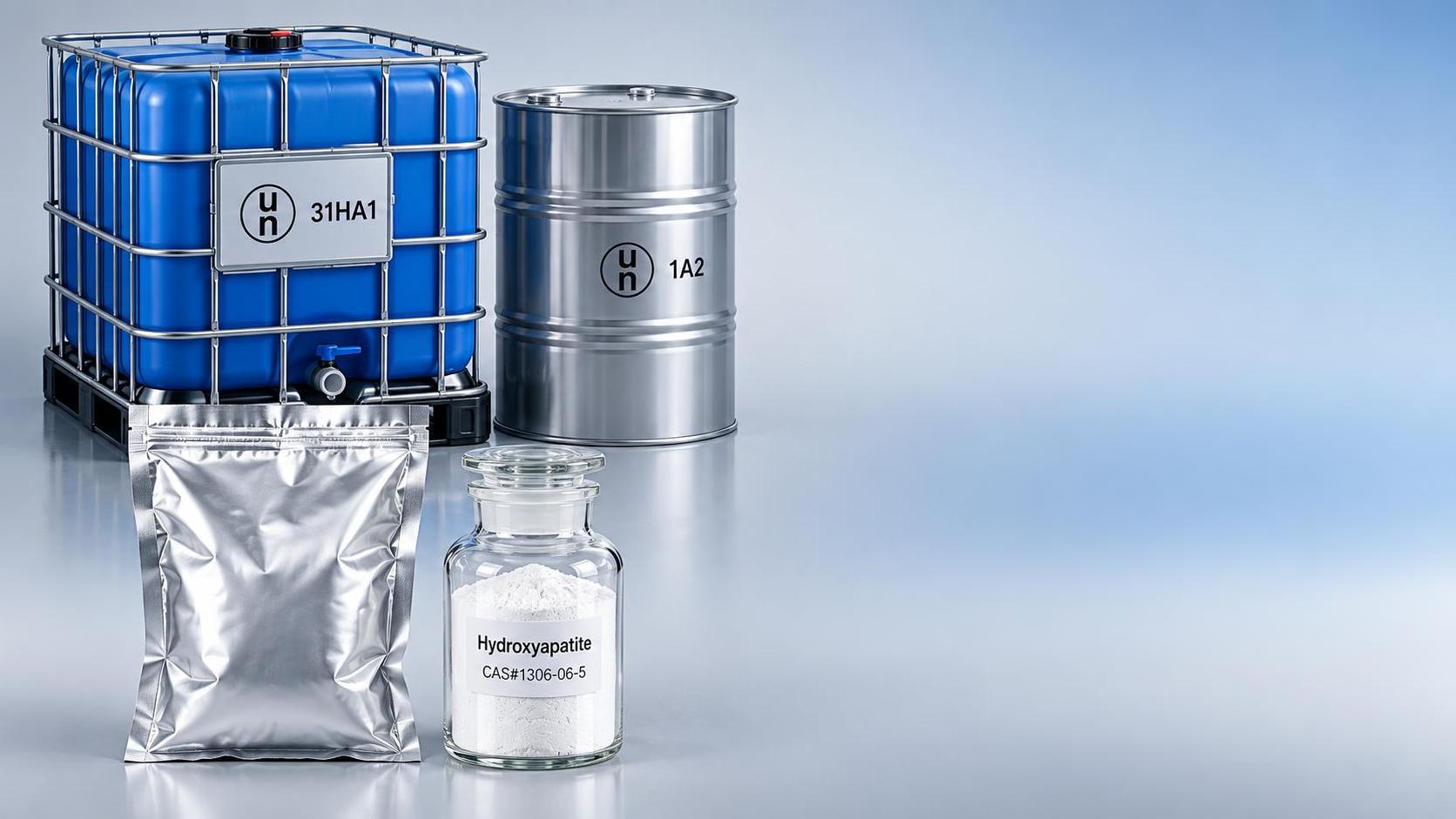
Bulk packaging prioritizes mechanical resilience and leak prevention over sterility or moisture barrier. Think UN-certified steel drums (1A2), composite IBCs (31HA1), or lined FIBCs rated for ≥1,000 kg. Liners must pass drop tests and stacking load validation—not just compatibility with the chemical. Specialty packaging, however, emphasizes protection against degradation: nitrogen-flushed aluminum-laminated pouches, double-bagged HDPE with oxygen scavengers, or glass vials with septum seals. For medical applications like bone grafts or implant coatings, HydroxyapatiteCAS#1306-06-5 requires cold-chain-compatible, particulate-free containment—even though its thermal stability (1353°C) and water insolubility reduce environmental sensitivity. Bulk hydroxyapatite shipped for ceramic filler use? A certified 500-kg FIBC with static-dissipative liner suffices. Same molecule. Radically different packaging specs.
Labeling: From Hazard Communication to Traceability Architecture
Bulk labeling is hazard-forward and legally minimalist: UN number, proper shipping name, hazard class diamond, and consignor/consignee identifiers—printed directly on the container per IMDG/ADR standards. No batch numbers, no expiry dates, no SDS QR codes. Specialty labeling embeds functional intelligence: lot-specific CoA references, ISO 13485-compliant traceability barcodes, storage condition icons (e.g., “Store at 2–8°C”), and dual-language regulatory statements for regional markets. Crucially, bulk labels are validated for weather resistance (ISO 17025-accredited abrasion testing), while specialty labels undergo biocompatibility and sterilization cycle validation. If your QC team audits a shipment of bulk calcium phosphate against a medical-grade label template, you’ll fail—not because the content is wrong, but because the *purpose* is misaligned.
UN Transport Classification: When “Not Dangerous” Isn’t “Not Regulated”
This is where most safety teams stumble. Bulk industrial chemical products often carry UN classifications based on *physical form and quantity*, not just intrinsic hazard. Example: Hydroxyapatite (CAS#1306-06-5) is classified as UN 3077, “Environmentally hazardous substance, solid, n.o.s.” (Class 9) when shipped in bulk volumes exceeding thresholds defined in Section 2.2.9.1 of the UN TDG—even though its acute toxicity (LD50 >2,000 mg/kg) and lack of flammability would exempt smaller packages. Why? Dust cloud formation during unloading poses inhalation and explosion risks. Conversely, a 100-g vial of the same material, packaged for R&D use, may ship under “Consumer Commodity” (ORM-D) rules with zero UN marking. Your classification decision must anchor to *how it ships*, not just what it is.
Operational Safeguards: What Your Team Must Verify—Every Shipment
Move beyond checklist compliance. Implement three non-negotiable verifications: First, confirm UN packaging certification matches the *exact* container type, capacity, and test report number—not just the UN code. Second, validate that bulk labels include the consignee’s EORI number (EU) or FDA registration (US), not just company name. Third, cross-check transport classification against both the SDS *and* the latest edition of the UN Manual of Tests and Criteria—especially for borderline substances like metal phosphates where particle size distribution can shift classification. At Huafeng Chemical, our export team pre-validates all bulk dossiers against China’s MIIT chemical registry *and* destination-country hazard databases—because a “non-regulated” status in one jurisdiction rarely guarantees equivalency elsewhere.
Conclusion: Clarity Starts With Intent—Not Just Chemistry
The critical takeaway isn’t that bulk and specialty grades differ—but that their differences serve distinct risk models. Bulk industrial chemical products demand vigilance around containment failure modes, mass-driven hazard escalation, and regulatory harmonization across transport legs. Specialty grades demand precision in identity preservation, functional consistency, and end-use regulatory alignment. When your QC or safety team reviews a hydroxyapatite shipment, ask first: “Is this supporting orthopedic device manufacturing—or ceramic tile production?” That intent determines whether a 25-kg drum or a 1,200-L tote triggers Class 9 classification, whether “white powder” suffices on the label—or whether “sterile, pyrogen-free, ≤10 μm particle size” is mandatory. With Huafeng Chemical’s integrated export compliance framework—including real-time UN TDG updates, certified packaging sourcing, and multi-jurisdictional labeling support—you gain not just shipment execution, but proactive risk insulation. Because in global chemical trade, the safest shipment isn’t the most heavily labeled—it’s the one correctly interpreted from the start.
Send Us Your Inquiry Today
