









Product Quick Navigation
Get a Quote
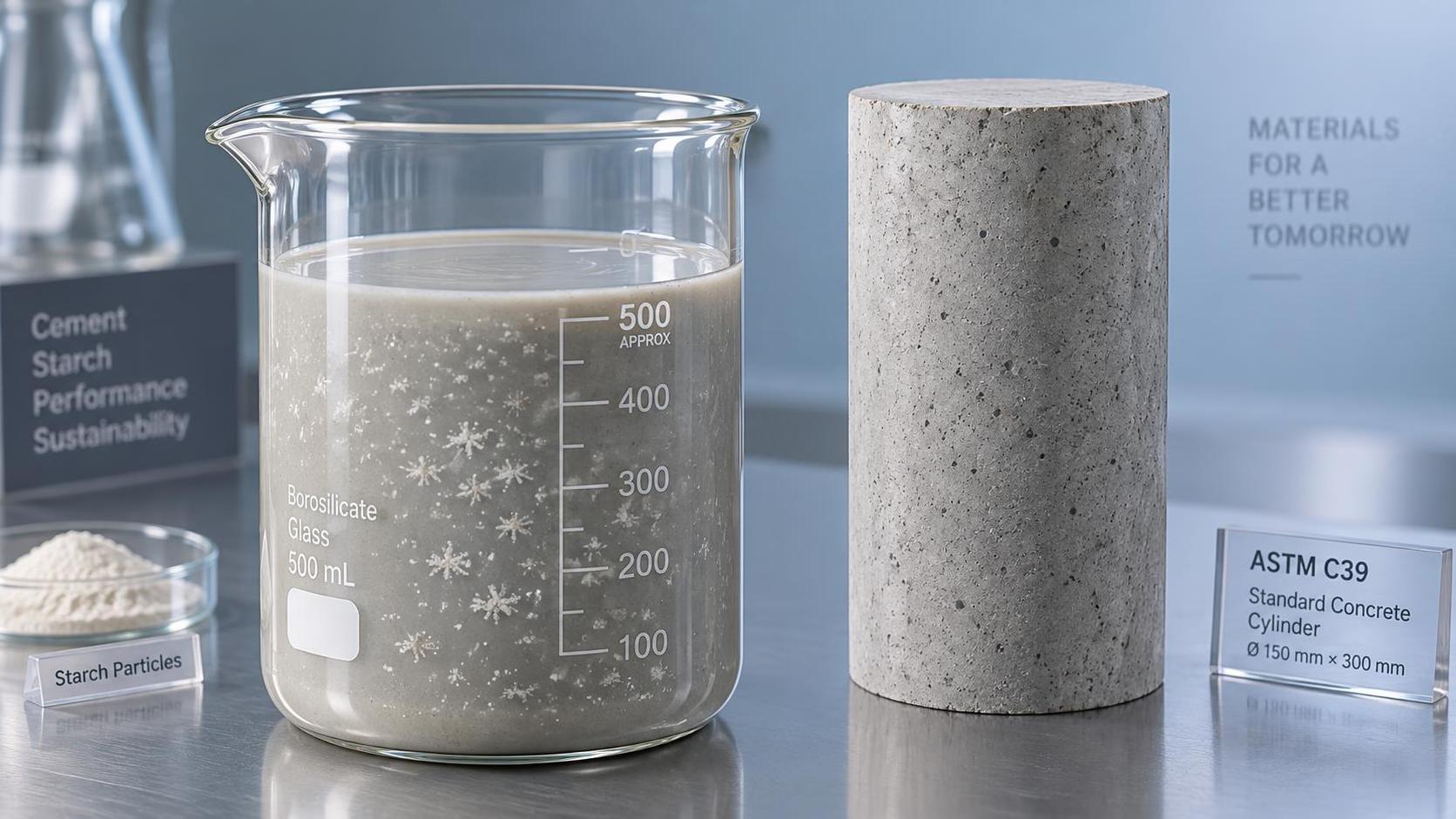
Can modified starch for building materials reduce cement dosage without compromising compressive strength at 28 days? The short answer is: not directly—and not as a standalone replacement for cement. Modified starches are functional additives, not hydraulic binders. They cannot replicate the pozzolanic or hydration-driven strength development of Portland cement. However, when used strategically alongside supplementary cementitious materials (SCMs) like fly ash or slag, certain high-performance modified starches—particularly those engineered for rheology control and pore structure refinement—can support cement reduction of 5–15% in specific mix designs, provided 28-day compressive strength targets are adjusted downward by ≤10% and validated through project-specific trial batching.
This distinction matters critically for project managers overseeing infrastructure, precast, or ready-mix operations where specification compliance, schedule adherence, and material cost control intersect. A 10% cement reduction may translate to meaningful savings on large-volume pours—but only if the resulting concrete meets structural requirements, passes durability testing (e.g., chloride penetration, freeze-thaw resistance), and remains workable under site conditions. Mistaking modified starch for a cement substitute risks premature strength loss, excessive bleeding, or inconsistent set times—especially in hot, dry, or variable-temperature environments common across Middle Eastern, Southeast Asian, and Latin American construction sites.
Why “replacement” is a misleading framing
The question “Can modified starch for building materials replace cement additives?” reflects a common conceptual confusion. Cement additives—such as water reducers, retarders, or air-entraining agents—modify cement’s behavior; they do not replace it. Modified starches fall into this same functional category. Their primary role is to improve particle packing, enhance paste cohesion, and moderate water demand—not to generate strength. Unlike calcium-based accelerators or silicate-based densifiers, starch derivatives lack the chemical reactivity needed to contribute to the C–S–H gel network responsible for long-term strength gain.
That said, some starch-based formulations demonstrate measurable secondary effects relevant to strength retention: improved dispersion of SCMs, reduced capillary porosity, and delayed early-age evaporation. These effects become operationally significant only when starch is dosed precisely (typically 0.1–0.4% by weight of cement), blended with compatible plasticizers, and paired with consistent curing protocols. Overdosing (>0.5%) often leads to viscosity spikes, poor consolidation, and microcracking—undermining rather than supporting 28-day performance.
Where PVC paste resin fits in—practically, not theoretically
In real-world formulation work, project managers occasionally encounter unexpected interactions between organic admixtures and polymer-based components in composite systems—especially when modifying mortar for tile adhesives, self-leveling underlayments, or fiber-reinforced cementitious panels. Here, Polyvinyl Chloride Paste Resin CAS#9002-86-2 serves not as a strength contributor, but as a processing enabler. Its ultra-fine particle size (30–80 μm) and stable paste-forming behavior in plasticizer-rich matrices allow formulators to integrate higher volumes of starch-modified binders without sacrificing extrudability or film integrity.
For example, in cement-polymer hybrid coatings applied over concrete substrates, PVC paste resin helps anchor starch-derived thickeners within the polymer phase, preventing segregation during application and reducing surface dusting during early cure. This indirectly supports consistency in strength development across batches—by minimizing variability introduced through poor dispersion or uneven film formation—not by boosting compressive values per se. Its thermal stability (decomposition onset >170 °C) also ensures compatibility with steam-cured precast processes where temperature gradients could destabilize purely bio-based thickeners.
Three non-negotiable validation steps before scaling
If your team is evaluating modified starch to support cement reduction, skip lab-only assumptions. Field-relevant verification requires:
- Trials under actual placement conditions: Simulate ambient temperature, humidity, and mixing duration—not just standard lab molds. A mix passing ASTM C39 at 28 days in controlled 23 °C/50% RH may fail under 35 °C/20% RH due to accelerated water loss and incomplete starch gelation.
- Strength correlation beyond 28 days: Request 7-, 28-, and 56-day compressive data. Some starch-modified mixes show strength rebound after day 28 due to delayed hydration; others plateau early. Your structural engineer must approve the full curve—not just the 28-day snapshot.
- Compatibility screening with all other admixtures: Test starch + superplasticizer + corrosion inhibitor + air entrainer simultaneously. Starch can adsorb onto polycarboxylate ether (PCE) molecules, reducing slump retention. No single-component test guarantees system-wide stability.
When to reconsider the approach entirely
Modified starch offers no advantage—and introduces risk—if any of the following apply:
- Your specification mandates ≥40 MPa at 28 days with zero tolerance for variance;
- You’re using low-C3S cement or high-volume slag (>50%), where hydration kinetics are already slowed;
- Batching tolerances exceed ±1% for water or admixture dosage.
In these cases, pursuing cement reduction via starch modification is inefficient. Alternative paths—like optimizing aggregate gradation, adopting ternary blends with calcined clay, or specifying Type GU cement with verified early strength—deliver more predictable outcomes with less formulation complexity.
Bottom line for decision-makers
Modified starch does not replace cement. It does not replace cement additives. What it can do—when selected, dosed, and validated rigorously—is help fine-tune water demand and internal cohesion in cementitious systems where marginal cement reduction is acceptable *and* where performance trade-offs (e.g., slightly longer setting time, narrower workability window) align with project constraints. Huafeng Chemical’s specialty starch derivatives are formulated for such precision roles, not broad substitution. Success depends less on the starch itself and more on how tightly its use is coupled to mix design discipline, curing execution, and strength validation protocols specific to your project’s exposure class and loading regime.
Send Us Your Inquiry Today
