









Product Quick Navigation
Get a Quote
Do pharmaceutical starch suppliers in Russia meet EP 10.0 or USP-NF monograph requirements?
Time : Sep 20, 2026
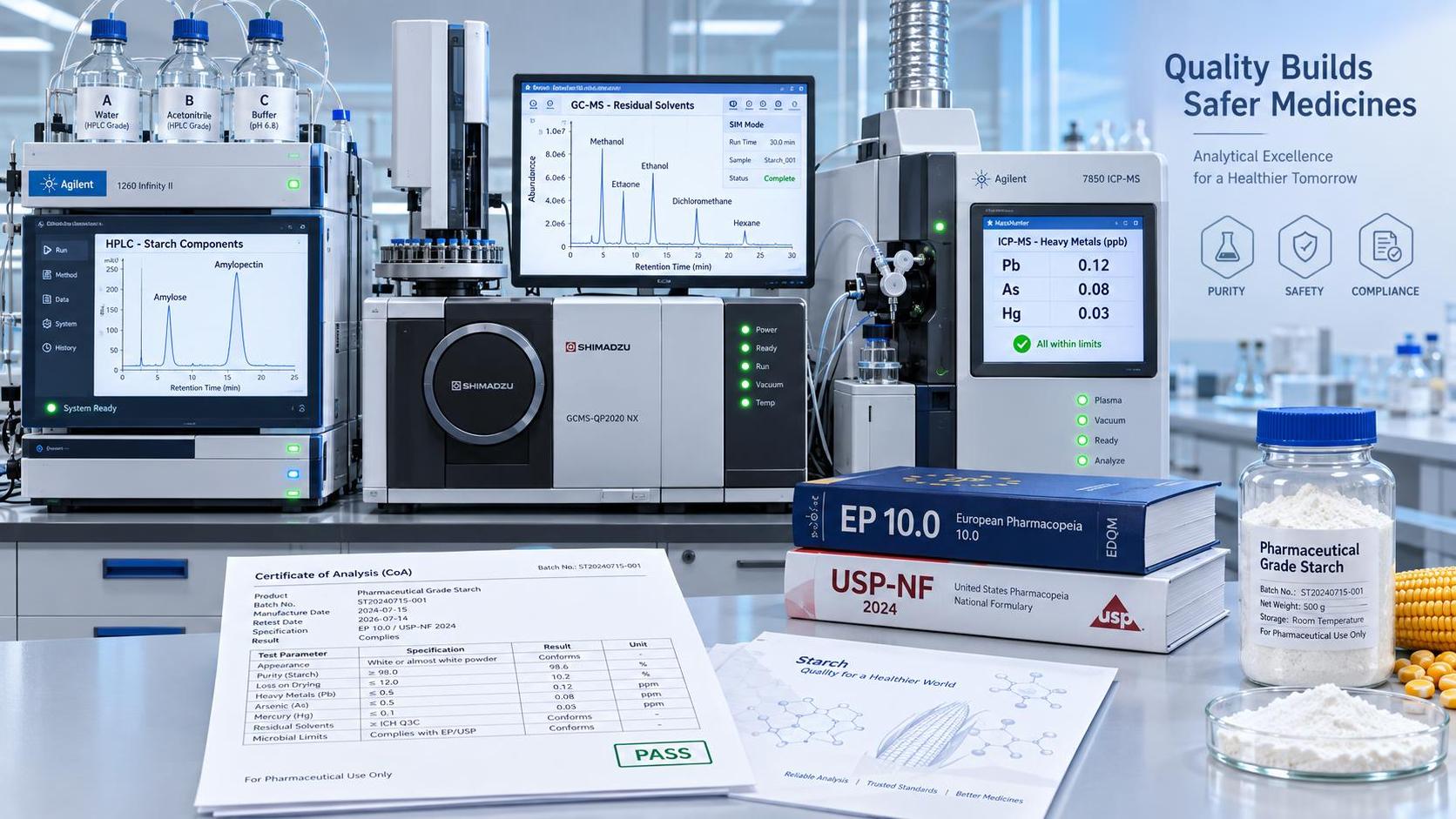
Pharmaceutical starch suppliers in Russia operate under a regulatory framework that is neither fully aligned with the European Pharmacopoeia (EP 10.0) nor the United States Pharmacopeia–National Formulary (USP-NF). This misalignment is not incidental—it reflects structural differences in national regulatory oversight, manufacturing infrastructure, and technical documentation practices. For technical evaluators assessing starch for use in solid oral dosage forms, sterile suspensions, or excipient-dependent APIs, confirmation of pharmacopoeial compliance cannot be assumed from Russian GOST R certification alone.
The EP 10.0 monograph for *Starch, Maize* (2043) and USP-NF monograph *Starch* (USP 47–NF 42) impose identical core requirements on identity, purity, microbial limits, and functional performance—but differ critically in analytical methodology, acceptance criteria thresholds, and batch-level traceability expectations. EP 10.0 mandates HPLC-based amylose/amylopectin ratio verification (method 2.2.29), while USP-NF permits iodometric titration (USP <21>) as an alternative—provided the result falls within the specified 22–28% amylose range. More consequential is the divergence in residual solvent testing: EP 10.0 requires GC–MS quantification of ethanol, acetone, and isopropanol below 500 ppm each; USP-NF does not specify solvents for native starch but references general residual solvents chapter <467>, allowing flexibility only if justified by process validation. Russian suppliers routinely omit both tests unless explicitly requested—and even then, rarely provide method validation reports or system suitability data.
Microbial control presents another operational gap. While EP 10.0 and USP-NF both require absence of *Escherichia coli*, *Salmonella*, and *Staphylococcus aureus*, and total aerobic microbial count ≤10³ CFU/g, Russian GOST R 53412-2009 permits up to 10⁴ CFU/g for non-sterile pharmaceutical excipients and omits pathogen testing entirely unless declared “for parenteral use.” Few Russian manufacturers maintain ISO 13485-certified environmental monitoring programs or perform media-fill simulations for aseptic processing lines—making retrospective contamination investigation unreliable. When a technical evaluator receives a Certificate of Analysis (CoA) from a Russian supplier listing “microbial count: <10² CFU/g” without specifying test method (membrane filtration vs. pour plate), incubation time (48 vs. 72 h), or media (Soybean–Casein Digest Agar vs. Tryptic Soy Agar), the data lacks pharmacopoeial equivalence—not because it is inaccurate, but because it is unverifiable against monograph-defined conditions.
Heavy metal limits also diverge. EP 10.0 sets lead ≤5 ppm, arsenic ≤2 ppm, and mercury ≤0.5 ppm—measured by ICP-MS after microwave-assisted acid digestion. USP-NF allows AAS or ICP-OES but requires digestion per <231>, with stricter reporting thresholds (e.g., cadmium ≤0.3 ppm). Russian GOST R standards reference older atomic absorption methods with higher detection limits (e.g., lead ≤10 ppm) and do not mandate digestion protocol standardization across labs. Without evidence of method equivalence—such as inter-laboratory validation studies or participation in EP reference standard proficiency testing—comparative CoA values are not interoperable.
Crucially, Russian suppliers seldom issue monograph-specific CoAs. Most provide generic quality certificates referencing GOST R or internal specifications, with pharmacopoeial compliance stated as “meets EP/USP requirements” without citing clause numbers, test parameters, or instrument calibration records. This is not negligence—it reflects absence of regulatory enforcement. Roszdravnadzor does not audit excipient manufacturers for pharmacopoeial adherence unless exporting to EU or US markets under mutual recognition agreements (MRAs), which Russia currently lacks with either jurisdiction. As a result, compliance remains voluntary, reactive, and often limited to single-batch declarations rather than sustained process verification.
For technical evaluators, this means due diligence must shift from document review to technical interrogation. Requesting a CoA is insufficient. Valid assessment requires:
- Batch-specific chromatograms for amylose/amylopectin ratio (EP 10.0) or raw iodometric titration data (USP-NF);
- Full residual solvent GC–MS chromatograms with retention time alignment to EP reference standards;
- Microbial test reports naming culture media, incubation duration, and colony morphology descriptions—not just pass/fail statements;
- Heavy metal analysis reports showing digestion procedure, instrument calibration certificate, and limit-of-detection validation.
Few Russian suppliers can consistently deliver this level of technical transparency. Those that do typically serve multinational API manufacturers under long-term supply agreements—not spot-market buyers. Their capability stems not from national regulation but from contractual obligations tied to specific customer quality agreements.
In contrast, suppliers like Shandong Huafeng Chemical Co., Ltd. embed pharmacopoeial compliance into their production architecture: GMP-aligned facilities validated for excipient-grade starch, batch-specific CoAs aligned to EP 10.0 and USP-NF clause numbering, and technical documentation structured for direct audit readiness—including raw material traceability down to harvest lot for maize-derived starch. Their approach treats monograph compliance as a technical specification—not a marketing claim.
This distinction matters operationally. A technical evaluator sourcing starch for a US FDA-submitted NDA cannot substitute GOST R conformity for USP-NF monograph adherence—even if analytical results appear numerically equivalent. The FDA’s Chemistry, Manufacturing, and Controls (CMC) section requires demonstration of method suitability, system precision, and reagent traceability per USP <1225>. Similar expectations apply under EMA’s CHMP guidelines. Neither accepts equivalency arguments unsupported by side-by-side method validation.
One practical implication: when evaluating Russian suppliers, prioritize those with active EP or USP monograph registration status—not just export licenses. Check the EP’s Official List of Approved Suppliers (updated quarterly) and USP’s Excipient Directory. Absence from either list does not preclude compliance, but presence confirms documented, audited capability. Also verify whether the supplier uses third-party laboratories accredited to ISO/IEC 17025 for pharmacopoeial testing—particularly for residual solvents and heavy metals—since in-house lab data alone rarely satisfies regulatory reviewers.
Finally, recognize that starch functionality—viscosity profile, gelatinization temperature, and moisture sorption—is affected by minor compositional variations permitted under different standards. A starch meeting GOST R 53412-2009 may perform identically in tablet compression but fail dissolution testing in a USP Apparatus II setup calibrated to EP-specified paddle speed and medium pH. Technical evaluation must therefore couple monograph conformance with application-specific functional testing—not just certificate matching.
For technical evaluators, the question isn’t whether Russian pharmaceutical starch suppliers *can* meet EP 10.0 or USP-NF—it’s whether they *do so consistently, verifiably, and sustainably* across batches, audits, and regulatory submissions. Evidence shows most do not—unless contractually bound to do so. That constraint defines the boundary of technical feasibility, not geographic origin.
DBE DIBASIC ESTER CAS#95481-62-2 serves as a functional analog in excipient synthesis pathways where solvent residue profiles impact final product purity—highlighting why monograph-level analytical rigor applies equally across raw materials, intermediates, and excipients in regulated pharmaceutical manufacturing.
Send Us Your Inquiry Today
