










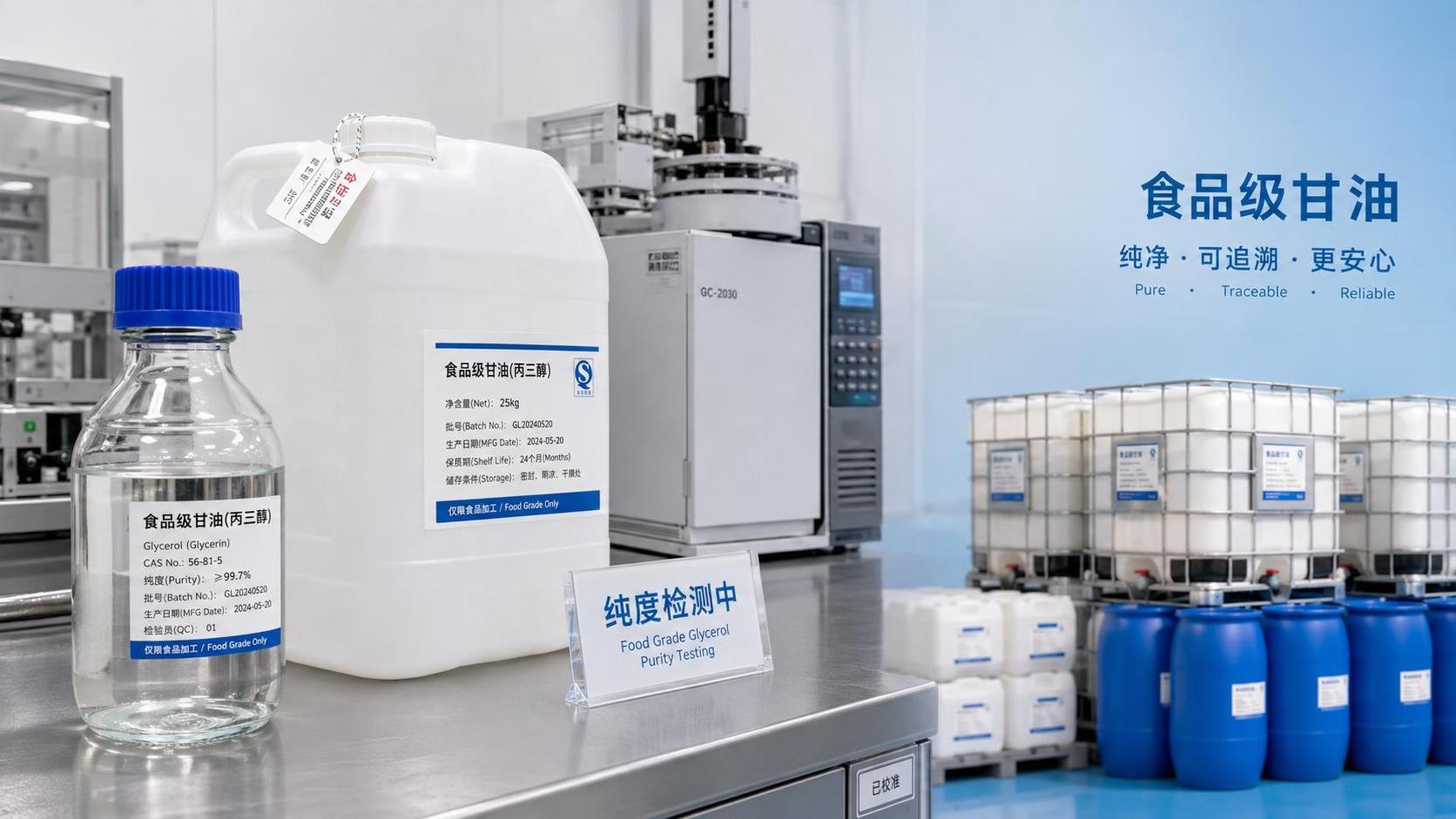
Knowing how to verify food-grade glycerol purity before import protects finished-product quality, regulatory compliance, and procurement continuity across food, beverage, pharmaceutical-adjacent, and personal-care supply chains.
The practical answer is straightforward: never rely on a stated purity percentage alone. Confirm identity, assay, impurities, testing competence, traceability, packaging integrity, and documentation before approving a supplier.
For importers, glycerol verification is a risk-management process rather than a single laboratory check. A compliant shipment must meet specifications consistently, survive transit, and remain fully defensible during audits.
What Importers Are Really Trying to Confirm
Buyers searching how to verify food grade glycerol purity before import usually need confidence that the material is genuinely suitable for human-consumption applications, not merely chemically similar glycerol.
Food-grade glycerol, also called glycerin, is commonly used as a humectant, sweetener, solvent, carrier, texturizer, and processing aid. These applications make contaminant control commercially important.
A product labeled “99.5% glycerol” may still be unsuitable when its remaining fraction contains excessive water, methanol, salts, fatty residues, heavy metals, or process-derived contaminants.
Importers also need to know whether each batch will satisfy local food regulations. A supplier’s domestic specification does not automatically prove compliance in the destination market.
The central procurement question is therefore broader than purity: can the supplier demonstrate that the delivered batch matches your approved specification, applicable regulation, and intended application?
Start by defining your internal acceptance criteria before requesting quotations. This prevents procurement teams from comparing prices for materials that have different quality, compliance, or testing standards.
Begin With a Clear, Written Product Specification
A strong food-grade glycerol specification provides the baseline against which certificates, samples, laboratory reports, and incoming inspections can be evaluated objectively and consistently.
At minimum, identify the required glycerol assay, usually expressed as a percentage by mass, together with density, refractive index, color, odor, appearance, and water content.
For many food applications, buyers request glycerol assay of at least 99.5%. However, the exact threshold should reflect the applicable food standard and intended formulation.
Include impurity limits explicitly. Relevant parameters may include methanol, diethylene glycol, ethylene glycol, ash, chlorides, sulfates, aldehydes, fatty acids, heavy metals, and organic impurities.
Specify the regulatory framework that applies to your market. Depending on destination and use, this may involve FCC, USP, Ph. Eur., GB standards, Codex-related requirements, or local regulations.
Do not assume that one standard covers every requirement. Food-grade, pharmaceutical-grade, and technical-grade glycerol can have overlapping assay values while differing materially in impurity controls and documentation.
Your specification should also state acceptable feedstock sources. Glycerol may originate from vegetable oils, animal fats, biodiesel production, synthetic processes, or other industrial routes.
For products requiring vegan, halal, kosher, non-GMO, allergen-controlled, or palm-free claims, feedstock traceability is as important as analytical purity. Ask for documentary evidence before contracting.
Review the Certificate of Analysis, but Do Not Stop There
The certificate of analysis, or COA, is the first document importers review. It should identify the product, production batch, test results, specifications, methods, dates, and authorization.
A useful COA lists actual measured values rather than simply showing “passes” or “conforms.” Numerical reporting enables your quality team to identify borderline or unusual results.
Check whether the batch number on the COA can be tied directly to the production record, packaging labels, bill of lading, commercial invoice, and shipment documents.
Verify that the listed assay method is appropriate. Glycerol assay may be determined through gas chromatography, titration, density-based approaches, or validated methods recognized by relevant standards.
Ask the supplier whether each listed parameter is tested on every batch, periodically, or only when requested. A generic specification sheet is not evidence that a shipment was tested.
Compare several historical COAs, ideally covering at least three recent production lots. Repeatedly identical values, inconsistent formats, or unexplained test gaps may require further investigation.
Pay attention to reporting units and detection limits. A result marked “not detected” is meaningful only when the method’s limit of detection is suitable for your regulatory threshold.
Confirm that the certificate is issued by the manufacturer or an authorized quality function. Trading companies can provide useful service, but they should disclose the actual producer and batch origin.
Test the Impurities That Create the Highest Risk
Assay confirms how much glycerol is present, but impurity testing determines whether the material can safely enter a food supply chain. Both evaluations are necessary.
Methanol deserves particular attention because it can arise from certain manufacturing processes. Even low-level contamination can create compliance, safety, and reputational consequences for food manufacturers.
Ethylene glycol and diethylene glycol should also be controlled. These substances have been associated with serious adulteration incidents involving glycerin and similar polyol materials worldwide.
Request targeted testing for these compounds using a competent chromatographic method. A supplier should be able to explain the test procedure, detection capability, and laboratory responsibility.
Water content affects concentration, handling, freight economics, and formulation performance. Excess water can reduce effective glycerol content even when a reported assay appears technically acceptable.
Ash and inorganic salt content can indicate incomplete purification, contamination, or feedstock variation. These parameters may affect taste, clarity, stability, and compatibility in sensitive formulations.
Heavy-metal requirements depend on market and product category, but buyers commonly examine lead, arsenic, mercury, and cadmium. Use limits aligned with destination-market rules and customer standards.
Color, odor, and appearance should never be treated as minor cosmetic checks. They can reveal oxidation, residual processing materials, microbial issues, foreign contamination, or unsuitable storage conditions.
Confirm the Testing Laboratory and Analytical Methods
Reliable results depend on more than a printed COA. Importers should understand who performed the tests, whether methods are validated, and whether the laboratory has appropriate quality controls.
Ask whether testing occurs in the manufacturer’s internal laboratory, an accredited third-party laboratory, or both. Internal testing is common, but independent verification reduces first-order import risk.
For high-value, high-volume, or regulated applications, commission pre-shipment testing from a laboratory acceptable to your organization. Retain samples and reports for future traceability.
Laboratory competence is particularly important for trace contaminants. A basic density measurement cannot substitute for validated gas chromatography when screening for toxic glycols or methanol.
Request the method reference for key quality attributes. Appropriate references may include recognized pharmacopeial procedures, FCC methods, ISO methods, or internally validated methods with available details.
Ask for calibration and quality-control information when results are unusually close to limits. This may include reference standards, duplicate testing, recovery data, and quality-control sample results.
A credible supplier will answer technical questions clearly. Evasive responses, unsupported claims of “international quality,” or refusal to share basic test information are legitimate procurement warning signs.
Verify Raw Material Origin and Manufacturing Traceability
Food-grade glycerol quality begins upstream. Understanding the manufacturing route helps buyers assess potential contaminants, certification needs, supply stability, and changes that may affect product consistency.
Vegetable-derived glycerol is often preferred for food applications requiring plant-based positioning. However, “vegetable origin” should be supported by declarations and traceable supply-chain records.
If the glycerol comes from biodiesel production, ask how crude glycerol is purified and whether the producer controls residual methanol, soaps, salts, catalysts, and feedstock variability.
Ask whether the material is produced in a dedicated food-grade line or whether equipment is shared with technical-grade products. Shared equipment requires documented cleaning and segregation controls.
Traceability should extend from finished batch to production date, raw-material source, processing records, storage tanks, filling operation, and final packaging. This supports effective recalls and investigations.
Request information about change-control procedures. A supplier should notify customers before changing feedstock origin, production site, purification process, packaging material, or critical analytical methods.
For import programs involving recurring orders, conduct a supplier audit remotely or on-site. Review HACCP controls, contamination prevention, sampling procedures, complaint records, and batch-release authorization.
Check Regulatory and Food-Safety Documentation
Food-grade claims must be supported by documents relevant to your destination market. Importers should build a compliance file before goods leave the port of origin.
Common documents include a product specification, batch COA, safety data sheet, statement of conformity, food-contact or food-use declaration, allergen statement, and country-of-origin declaration.
Depending on your commercial claims, request halal, kosher, vegan, non-GMO, RSPO, or allergen-free certificates. Ensure certificates cover the exact producer, site, product, and validity period.
A GMP, ISO 22000, FSSC 22000, HACCP, or similar certification can provide useful assurance. Yet certification should supplement, rather than replace, batch-specific evidence and supplier qualification.
Review documents for internal consistency. Differences in manufacturer name, product grade, address, batch format, or raw-material declaration may indicate a documentation-control problem requiring clarification.
Importers should also confirm labeling obligations before purchase. Container labels may need product name, lot number, net weight, origin, handling conditions, manufacturer details, and applicable hazard information.
Consult a regulatory specialist when entering a new market or using glycerol in infant nutrition, supplements, medical nutrition, or other highly controlled categories. These uses can impose additional restrictions.
Inspect Packaging, Storage, and Shipping Controls
Even correctly manufactured glycerol can become nonconforming through poor packaging or transport. Import verification should therefore include physical supply-chain controls, not just laboratory documentation.
Food-grade glycerol is commonly supplied in HDPE drums, IBC totes, flexitanks, or bulk tanks. Select packaging that supports your volume, handling method, sanitation requirements, and storage duration.
Require food-suitable packaging materials and clean, dedicated, or demonstrably sanitized transport equipment. Bulk tanks previously used for incompatible chemicals create an avoidable contamination risk.
Before loading, confirm seal numbers, container condition, cleanliness certificates where applicable, and tanker history. Record these details in shipping instructions and receiving procedures.
Glycerol is hygroscopic, meaning it can absorb moisture from the environment. Properly sealed containers and controlled handling help preserve concentration and prevent external contamination during transit.
Establish acceptance rules for damaged drums, broken seals, leakage, unusual odor, cloudiness, or mismatched labels. Quarantine suspect goods until quality personnel complete a documented assessment.
For large shipments, retain a sealed pre-shipment sample and take an arrival sample using a controlled procedure. Comparing results can help distinguish manufacturing issues from logistics-related changes.
Use a Practical Pre-Import Approval Workflow
A repeatable approval workflow gives procurement, quality, logistics, and regulatory teams a common decision path. It also prevents urgent purchasing from bypassing essential food-safety checks.
First, issue a written specification and destination-market requirements to prospective suppliers. Require them to confirm compliance point by point rather than responding with a general product brochure.
Second, collect a technical document package, including recent COAs, certifications, impurity test reports, manufacturing information, packaging details, and declarations relevant to your market and claims.
Third, review samples from representative production batches. Test critical parameters through your internal laboratory or an independent laboratory, particularly glycerol assay, methanol, and toxic glycols.
Fourth, approve the supplier only after quality, regulatory, and procurement stakeholders agree that documented evidence meets the established acceptance criteria. Record approval conditions and expiry dates.
Fifth, place the first commercial order with enhanced controls. Consider pre-shipment inspection, third-party testing, retained samples, and stricter release procedures until performance is established.
Finally, monitor every received lot. Review batch documentation, inspect packaging, conduct risk-based incoming testing, and investigate deviations promptly before glycerol is released for production use.
Recognize Warning Signs Before You Commit
Low pricing alone is not proof of a problem, but pricing far below comparable food-grade offers should trigger a deeper assessment of feedstock, purification, testing, and logistics controls.
Be cautious when a supplier cannot provide current batch COAs, refuses third-party testing, offers conflicting purity claims, or cannot identify the actual manufacturing site and production route.
Other warning signs include incomplete traceability, copied certificates, absent toxic-glycol data, unclear packaging standards, unusually long document response times, and unexplained changes between batches.
Do not accept technical-grade glycerol relabeled as food grade without comprehensive evidence. Similar appearance and high glycerol assay do not prove food suitability or regulatory compliance.
Contract terms should support quality control. Include specifications, document requirements, sampling rights, rejection standards, notification obligations, claims procedures, and responsibility for nonconforming material.
Conclusion: Purity Is a Documented, Repeatable Proof
Importing food-grade glycerol safely requires more than confirming a 99.5% assay. Buyers need evidence that the product is authentic, controlled, traceable, compliant, and protected through delivery.
The most effective approach combines a written specification, batch-specific COA review, targeted contaminant testing, manufacturing traceability, regulatory documentation, and controlled shipping and receiving practices.
When learning how to verify food grade glycerol purity before import, prioritize the contaminants and records that affect your actual market, application, and customer commitments.
Suppliers with transparent quality systems, responsive technical support, and consistent batch documentation reduce the risk of rejected cargo, production delays, regulatory exposure, and costly brand damage.