









Product Quick Navigation
Get a Quote
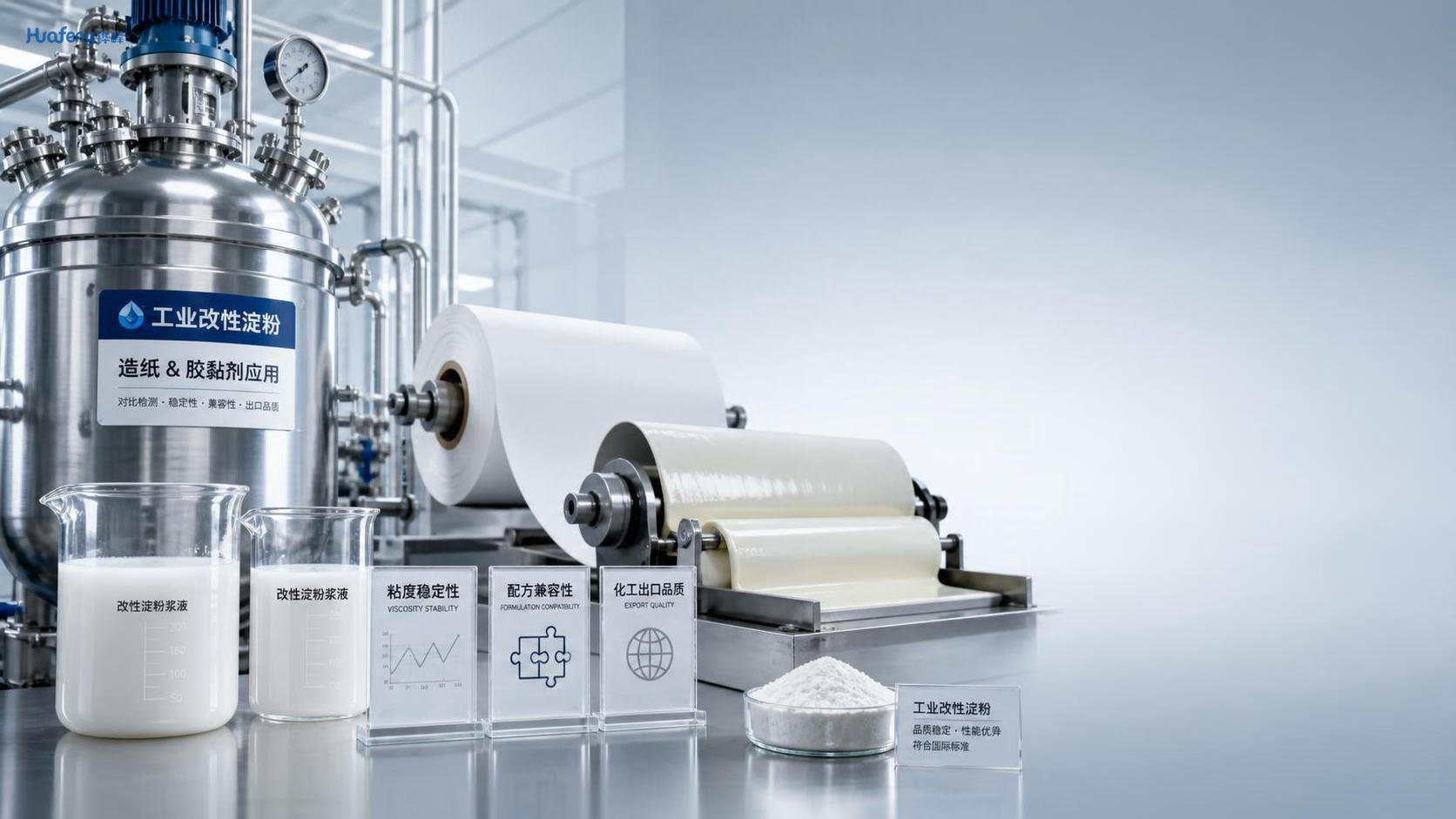
How to compare industrial modified starch for paper and adhesive use
Selecting an Industrial Modified Starch for paper and adhesive applications looks simple on paper: compare viscosity, solids, and price, then move on. In practice, that is where many evaluations go wrong. Two starches can look similar on a basic data sheet and behave very differently once they meet a high-shear kitchen, a coating circulation loop, recycled fiber fines, borax, or a plant that does not run under stable conditions every day.
For technical evaluation, the better question is not “which modified starch is best,” but “which starch remains controllable in my process while still meeting the end-use target.” That distinction matters in both paper and adhesive lines, because modified starch is rarely judged by one number alone. It is judged by what happens over time: viscosity drift, film formation, bonding consistency, machine cleanliness, and whether the supplier can support compliant delivery across borders without introducing avoidable risk.
This is especially relevant in international sourcing. As trade becomes more global and chemical procurement more scrutinized, buyers are not only comparing product performance. They are also checking whether a supplier can respond quickly, provide stable export documentation, and align with destination-market requirements. Companies such as Huafeng Chemical, based in Shandong, operate in that space where product selection and foreign trade execution are tied together. For many buyers, that operational layer matters almost as much as the starch chemistry itself.
Start with the application, not the modification name
A common mistake is to begin with categories like oxidized starch, cationic starch, etherified starch, or dextrinized products and assume the chemistry label tells the whole story. It does not. The same modification route can be tuned for very different outcomes depending on substitution level, molecular weight control, cooking behavior, and target solids.
In paper, the first split is usually between wet-end use, surface sizing, and coating binder systems. For adhesives, the split is just as important: corrugating, paper tube, label gum, envelope adhesive, laminated board, or construction-related paper bonding do not stress starch in the same way. A starch that performs well in one system may fail in another simply because the temperature profile, residence time, and interaction with other additives are different.
So before comparing suppliers, lock down a short application profile:
- Where the starch sits in the process
- Target solids and operating viscosity window
- Whether bonding, film strength, surface properties, or runnability is the main priority
- How much tolerance the line has for viscosity fluctuation or settling
- Whether local food-contact, packaging, or chemical disclosure rules apply
Without that baseline, comparisons stay too generic to support a sound decision.
What paper mills usually need to compare more carefully
For paper applications, modified starch is often doing several jobs at once. It may improve fiber-to-fiber bonding, support retention, increase surface strength, or stabilize coating rheology. That is why one attractive lab result can be misleading. A starch that gives a strong dry sheet in a bench trial may still create deposit issues or unstable viscosity in full production.
Three areas usually deserve closer attention.
Viscosity behavior under real shear and temperature. A single viscosity value is not enough. Ask how the cooked starch behaves after holding, recirculation, and dilution. In surface sizing and coating kitchens, viscosity stability over time can be more useful than peak viscosity. Some products look fine right after cooking but thin out too quickly or build unpredictably during storage.
Interaction with the papermaking system. Cationic character, solids tolerance, and compatibility with fillers, dyes, optical brighteners, and retention aids can change performance substantially. Recycled fiber systems often expose these issues faster because the water loop is already carrying more variability. In those environments, a technically acceptable starch may still increase troubleshooting time.
End-use target versus machine cleanliness. It is tempting to push for maximum strength gain or surface performance. But if that comes with more foam, deposits, or poor filtration behavior, the total cost picture changes. Evaluators who only compare laboratory strength data often miss this trade-off.
How adhesive applications shift the comparison logic
In adhesive formulations, modified starch is judged more directly by bonding speed, tack profile, film integrity, and processability. Here the comparison often becomes less about paper strength contribution and more about how the starch behaves in a mixed chemical system.
Corrugating adhesive is a good example. Plants usually care about stable gelatinization behavior, predictable water retention, and bonding under fast line speeds. If viscosity drifts too far, operators compensate elsewhere, and the whole formulation becomes harder to control. In paper converting adhesives, the concern may shift toward initial grab, open time, machinability, and whether dried films become brittle in certain storage conditions.
This is why substitution by “equivalent grade” often fails. A product can match broad specifications and still behave differently with caustic, borax, plasticizers, or preservatives. Technical evaluators should ask for compatibility guidance, not just a standard specification sheet. If the supplier cannot discuss mixing order, hydration behavior, or pH sensitivity in practical terms, that is already useful information.
Parameters worth requesting beyond the basic TDS
The technical data sheet is only the starting point. For a serious comparison, it helps to request a few additional details, even if they are given as internal control ranges rather than public brochure values.
One practical note: if two suppliers quote different viscosity values but use different preparation methods, the comparison is not valid yet. Ask them to normalize the test condition or provide a joint lab trial protocol.
Do not separate performance from sourcing risk
For imported chemical materials, technical suitability and supply reliability should be reviewed together. A starch that works in the lab but arrives with inconsistent documentation, unclear labeling, or long response times during a shipment issue is not a low-risk choice.
This is where experienced export support becomes part of technical selection. In chemical trade, especially across regions with different customs and disclosure expectations, buyers often need more than product availability. They need timely communication on specifications, packing, shipment coordination, and regulatory paperwork. Suppliers operating from established chemical manufacturing regions such as Shandong often have an advantage if they also understand foreign trade execution rather than only domestic product supply.
Huafeng Chemical is relevant here not because every buyer needs a one-stop supplier, but because the company profile reflects a common procurement reality: overseas customers increasingly prefer partners that can combine product range with export responsiveness. For technical evaluators, that can shorten decision cycles when multiple candidate materials must be reviewed under time pressure.
A useful trial sequence before approval
When the shortlist is down to two or three products, the cleanest path is usually a staged evaluation rather than a one-step plant trial.
- Run a document review to confirm testing basis, handling guidance, and compliance fit.
- Do a small bench or kitchen preparation under your own standard operating method.
- Check short-term and hold-time viscosity, not only the initial result.
- Evaluate compatibility with the real additive package or process water where possible.
- Move to controlled production trial with clear acceptance criteria: bond quality, machine behavior, waste level, cleanup, and operator adjustment frequency.
That last point is easy to underestimate. If operators must keep correcting viscosity or dilution during the shift, the starch may still be technically usable, but it is not truly robust for the process.
Common comparison mistakes
Some of the most expensive mistakes are not dramatic. They are small assumptions made early.
One is focusing too heavily on price per ton instead of usable performance at the actual solids and process condition. Another is assuming that a sample prepared carefully in a lab will behave the same in plant equipment with less controlled heating or mixing. A third is ignoring packaging and transit stability for export shipments, especially in humid or variable-temperature routes.
There is also a documentation mistake: evaluators sometimes request generic compliance statements but do not verify whether they match the destination market and end use. For packaging-related applications, this usually needs project-specific confirmation rather than broad assumptions.
What a balanced decision usually looks like
A good selection is rarely the starch with the highest performance on one metric. More often, it is the grade that gives enough bonding or paper performance while staying predictable in preparation, stable during use, and manageable in global supply. That balance is what keeps production teams comfortable after the trial team has moved on.
If you are comparing Industrial Modified Starch across paper and adhesive uses, insist on application-specific testing conditions, ask harder questions about viscosity stability and formulation compatibility, and include export execution in the evaluation instead of treating it as a separate purchasing issue. The chemistry matters, of course. But in real production, controllability and supply discipline are what turn a promising sample into a workable long-term choice.
Send Us Your Inquiry Today
