









Product Quick Navigation
Get a Quote
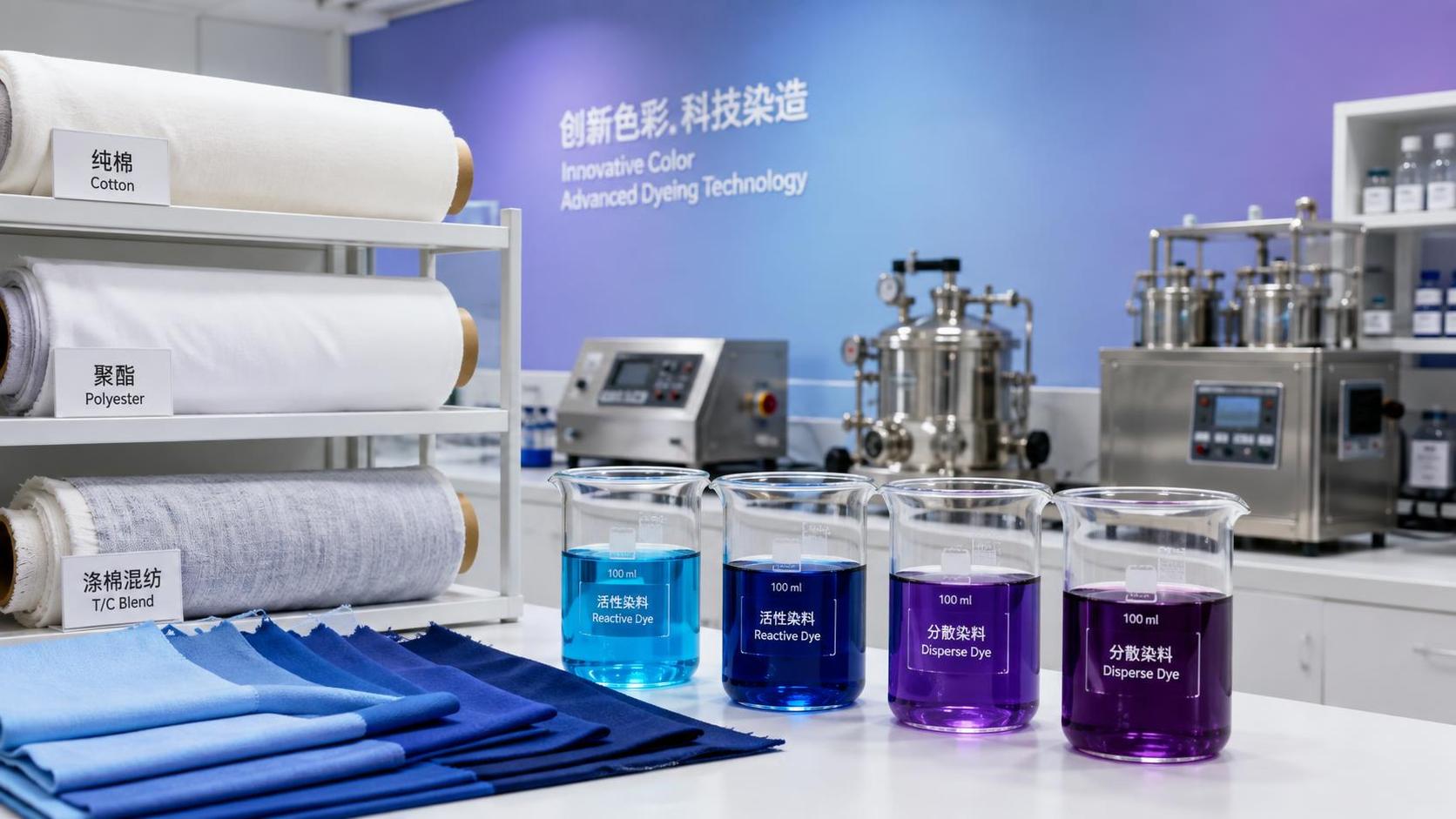
Matching Textile Dyes to cotton, polyester, and blended fabrics is not a shade-card exercise. A blue that looks correct in a laboratory swatch can fail after washing, migrate during heat setting, stain an adjacent fiber, or fall short of restricted-substance requirements. For technical evaluators, the real decision is whether a dye system can deliver repeatable color, required fastness, workable production conditions, and an acceptable compliance profile on the actual substrate.
That decision begins with fiber chemistry. Cotton is a hydrophilic cellulosic fiber with reactive hydroxyl groups. Polyester is a hydrophobic synthetic polymer whose tightly packed structure requires heat to allow dye molecules to diffuse inside. Blended fabrics combine both behaviors, often creating a trade-off between shade consistency, process complexity, and fastness performance.
The most reliable approach is to evaluate the fabric first, then select the dye class and process route. Starting with a familiar dye type and forcing it onto every substrate is one of the costliest mistakes a mill or sourcing team can make.
Start with the substrate, not the target color
Before comparing Textile Dyes, confirm what the fabric really is. “Cotton-rich” or “polyester blend” is not sufficiently specific for production approval. Fiber percentages, yarn construction, fabric weight, optical brightener content, pretreatment quality, finishing agents, and the intended end use can all change dyeing behavior.
A 65/35 polyester/cotton workwear fabric, for example, will not behave like a 50/50 lightweight shirting material. The polyester portion may dominate visual appearance after dyeing, while the cotton portion may still determine wash-off requirements and staining risk. A brushed fabric, a resin-finished woven fabric, and a moisture-management knit can each need different pretreatment controls even when their nominal fiber content is identical.
Technical review should therefore begin with a short material profile:
- Exact fiber composition, including elastane, viscose, nylon, or recycled content where applicable
- Fabric construction, weight, density, and surface characteristics
- Previous treatments such as bleaching, mercerization, heat setting, optical brightening, or water-repellent finishing
- Required shade depth and color tolerances
- End-use fastness expectations: washing, rubbing, perspiration, light, chlorine, sublimation, or dry cleaning
- Applicable chemical restrictions, customer specifications, and destination-market requirements
This profile prevents a common sourcing problem: approving a dye based on an attractive lab result without confirming whether the production fabric, process equipment, and finishing sequence can support the same result.
Cotton: reactive dyes are usually the reference point
For cotton and other cellulosic fibers, reactive dyes are often the preferred choice where bright shades and strong wet fastness are required. Their key advantage is chemical bonding. Under controlled alkaline conditions, the dye reacts with cellulose, creating a covalent bond that can provide durable color when fixation and washing-off are properly managed.
That last qualification matters. Reactive dyeing is not simply “add dye, salt, and alkali.” Hydrolysis competes with fixation. A hydrolyzed reactive dye no longer bonds to cotton and must be removed through effective soaping and rinsing. If wash-off is inadequate, the fabric may show poor wash fastness, back-staining, or inconsistent rubbing performance even though the initial shade looks acceptable.
When assessing reactive Textile Dyes for cotton, reviewers should look beyond the nominal color strength. Important questions include:
- Does the dye have suitable reactivity for the mill’s available temperature and time window?
- How stable is the shade against small changes in salt dosage, alkali addition, liquor ratio, and water quality?
- Is the dye compatible with the selected dyeing method: exhaust, pad-batch, continuous pad-steam, or garment dyeing?
- Can the mill achieve the required wash-off efficiency without excessive water, energy, or cycle time?
- Does the selected trichromatic combination build evenly at pale, medium, and dark depths?
Direct dyes may still be considered for certain cotton applications, particularly where economy and simpler processing are more important than demanding wet fastness. They generally rely on physical affinity rather than covalent bonding, however, so their suitability must be judged carefully for apparel, towels, children’s textiles, or articles exposed to frequent laundering.
Vat, sulfur, pigment, and natural dye systems also have specific places in the market. Vat dyes may be selected for demanding fastness requirements; sulfur dyes are commonly relevant for dark economical shades; pigments can be useful where binder-based coloration is acceptable. None of these systems should be treated as interchangeable with reactive dyes. Their process chemistry, handle impact, shade range, and compliance considerations differ materially.
Polyester: disperse dye selection depends on heat behavior
Polyester has little affinity for water-soluble dyes. Its standard coloration route uses disperse dyes, which are finely dispersed, low-water-solubility colorants designed to diffuse into polyester under elevated temperature. In exhaust dyeing, this commonly means high-temperature conditions. In thermosol or transfer processes, controlled dry heat becomes central to dye transfer and fixation.
For polyester, the most important question is not merely whether a disperse dye matches the target shade. It is whether the dye remains stable through the fabric’s thermal history. Heat setting, curing, printing, lamination, and ironing can all influence migration or sublimation behavior.
Disperse dye evaluation should therefore include the following:
- Build-up: Can the dye reach the required depth without unacceptable leveling problems or excessive dosage?
- Leveling and reproducibility: Does it dye evenly across lots, particularly on high-density fabrics or textured yarn constructions?
- Reduction clearing response: Can unfixed surface dye be removed efficiently to improve wet fastness?
- Sublimation fastness: Will the shade remain stable during downstream heat exposure?
- Light fastness: Is the dye appropriate for curtains, automotive interiors, outdoor articles, or other light-exposed uses?
- Compatibility: In compound shades, do the individual dyes have similar dyeing rates and heat stability?
A frequent production issue arises when polyester is dyed successfully at the dyehouse but later shows shade change after heat transfer printing, coating, or high-temperature finishing. The root cause may be an inadequate sublimation profile rather than an error in the original recipe. Testing should reflect the full manufacturing route, not only the dyeing stage.
Blended fabrics demand a process strategy, not a compromise dye
Polyester/cotton blends are among the most common and challenging substrates in textile coloration. Because cotton and polyester require different dye classes, a blend normally needs a coordinated dyeing strategy. The right route depends on fiber ratio, shade depth, production equipment, quality standard, and whether one fiber should visually dominate.
For many polyester/cotton fabrics, a two-bath route offers clearer control. Polyester is dyed with disperse dyes under high-temperature conditions, followed by cotton dyeing with reactive dyes. This approach can support strong shade development and more manageable correction steps, though it requires more time, water, and handling.
One-bath or one-step systems may reduce process time in suitable circumstances, but they require carefully matched disperse and reactive dye combinations. Temperature profiles, pH changes, electrolyte use, and auxiliaries must be controlled so that one dye class does not impair the performance of the other. A route that looks efficient on paper can become expensive if it creates tailing, off-tone staining, or repeated shade corrections.
Blend evaluation should also account for visual metamerism. Two formulas may appear equivalent under one light source but differ under daylight, retail lighting, or LED illumination because cotton and polyester reflect color differently. For branded apparel, uniforms, and coordinated collections, multi-light assessment should be part of lab approval.
Colorfastness targets should guide dye selection early
Fastness testing is often treated as a final quality gate. In reality, it should influence dye selection from the beginning. A dark navy for fashion apparel, a black for industrial workwear, and a bright red for home textiles may each require different priorities.
Wet rubbing fastness can be difficult at deep shades, especially if surface dye removal is incomplete. Washing fastness depends on fixation, clearing, and dye chemistry. Perspiration fastness matters for apparel worn close to the skin. Light fastness becomes more decisive in furnishings, transportation textiles, and outdoor products. Chlorinated-water resistance may be essential for swimwear, while sublimation fastness matters for polyester articles exposed to heat.
Technical evaluators should request testing that mirrors the actual article and its likely exposure, rather than relying on a generic “good fastness” statement. The test method, shade depth, fabric construction, and finishing condition should be documented alongside the result. A dye that performs well at a medium depth may behave differently in a saturated black or fluorescent-inspired shade.
Do not separate compliance from color development
In global textile supply chains, the suitability of Textile Dyes includes chemical compliance, traceability, and documentation readiness. Buyers may apply restricted substance lists, specific limits for aromatic amines, requirements relating to formaldehyde or heavy metals, and brand-specific rules on sensitizing or environmentally concerning substances. Requirements vary by market and customer, so a general statement of suitability is not enough.
During supplier qualification, ask for current technical data sheets, safety data sheets, color index information where available, and declarations relevant to the intended market. Confirm whether the supporting documents refer to the exact product grade and current production status. For blends and complicated shade formulations, the compliance review should cover every colorant and relevant auxiliary, not only the main dye component.
Supply continuity deserves equal attention. A technically acceptable dye is of limited value if batch consistency, export documentation, packaging suitability, or response to shade corrections cannot be managed reliably. Chemical exporters serving international textile customers need to connect product selection with practical foreign-trade execution: clear specifications, controlled communication, appropriate shipping documentation, and realistic lead-time planning.
As a chemical export service provider based in Shandong, Huafeng Chemical supports overseas buyers who need to evaluate not only dye suitability but also the commercial and documentation path behind a supply decision. For technical teams, the most useful supplier conversation is specific: identify the substrate, process route, performance target, market destination, and approval tests before discussing a final dye package.
A practical approval sequence for technical teams
Reliable dye selection rarely comes from a single lab dip. It comes from reducing uncertainty in stages. Begin with a representative fabric sample, including the same pretreatment and finish expected in production. Screen candidate dye systems for shade, leveling, and basic fastness. Then move the most promising formulations into pilot conditions that resemble the mill’s actual machinery, liquor ratio, heating curve, and wash-off capability.
For blends, test both fiber components after each major process stage. Review not only the final color but also staining, cross-contamination, tensile or stretch changes, fabric handle, and heat stability. When a shade needs correction, identify whether the problem comes from fiber affinity, dye compatibility, pretreatment variation, or process control before changing the dye recipe.
Finally, establish an approval record that includes the dye class, product identification, recipe range, process conditions, target standard, test methods, and approved reference. This record becomes particularly valuable when production moves between mills, fabric lots change, or a customer requests a repeat order months later.
The best match is the one that remains dependable after production reality intervenes
Cotton generally calls for dye systems that can form durable bonds with cellulose; polyester requires disperse dyes that perform under heat; and blended fabrics demand coordination between both chemistries. Yet the most suitable option is never defined by fiber type alone. It is defined by the relationship between substrate, process, shade, fastness, compliance obligations, and supply capability.
For technical evaluators, that perspective turns dye selection from a color-matching task into a controlled materials decision. When Textile Dyes are assessed against real production conditions rather than ideal laboratory assumptions, the result is more than the right shade: it is a coloration route that can be approved with confidence.
Send Us Your Inquiry Today
