









Product Quick Navigation
Get a Quote
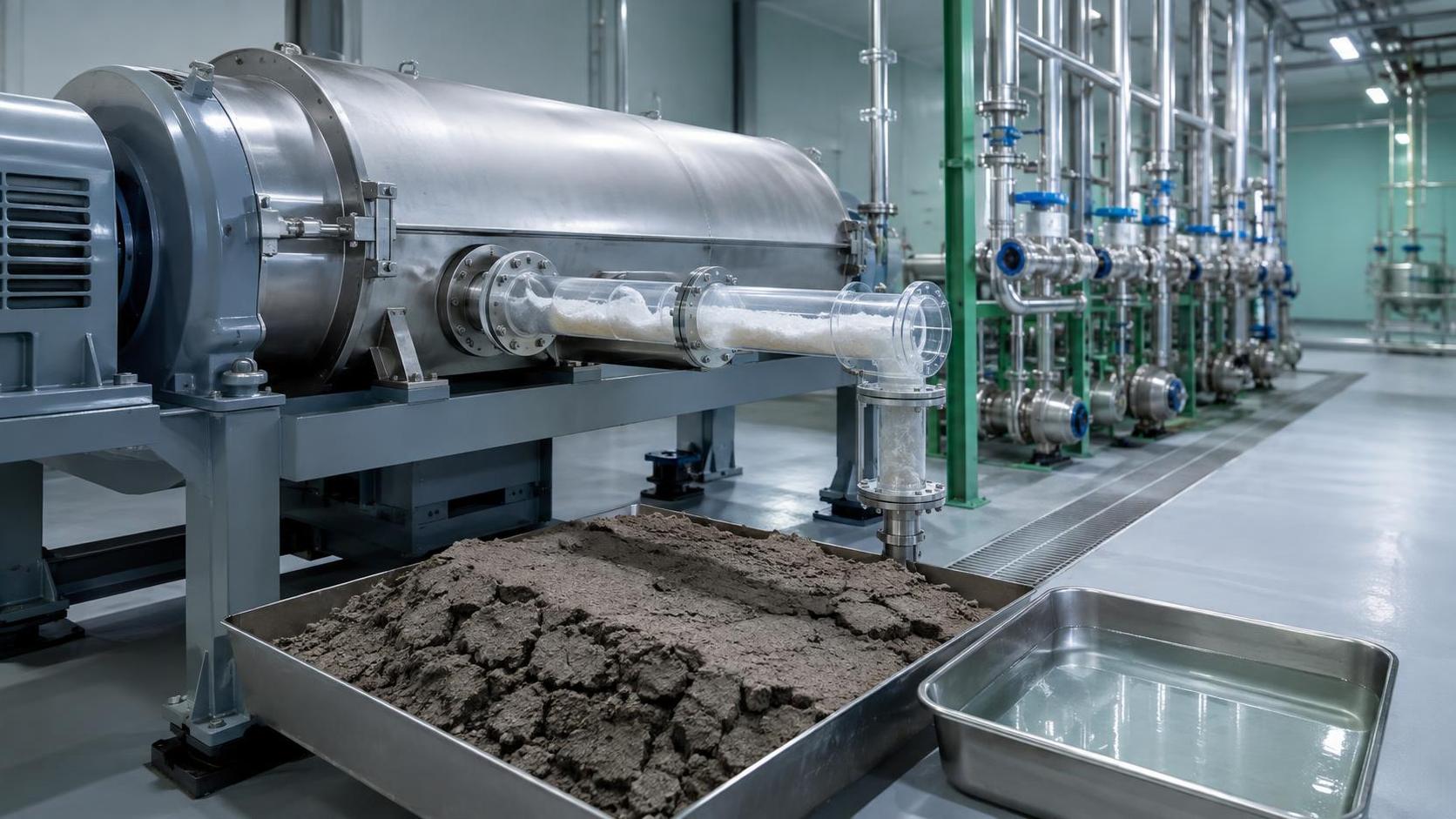
When a sludge dewatering unit starts producing a wetter cake, cloudy centrate, unstable filtrate, or excessive polymer consumption, the cause is often not the dewatering machine alone. A centrifuge, belt press, screw press, or filter press can only perform well when the sludge has been conditioned into strong, shear-resistant flocs. Selecting the right Polyacrylamide Flocculant is therefore a process decision, not a simple purchasing choice.
The practical starting point is to match polymer charge type, charge density, molecular weight, and product form to the actual sludge and the operating equipment. For most dewatering applications, the best candidate is not necessarily the polymer that creates the largest visible flocs in a beaker. It is the one that produces a stable cake, acceptable filtrate clarity, manageable dosage, and reliable performance under normal changes in sludge feed.
Start with the sludge, not the polymer label
Sludge is not a uniform material. Its particle size, organic content, mineral fraction, pH, alkalinity, salinity, temperature, residual coagulants, and biological activity all influence how a flocculant performs. A product that works well on one wastewater line may perform poorly after a process change, even when the dewatering equipment remains the same.
Before screening products, define where the sludge originates and how it has already been treated. Primary sludge, waste activated sludge, mixed sludge, chemically precipitated sludge, and industrial process sludge usually require different conditioning approaches. The same applies to sludge that has been thickened, digested, lime-treated, oxidized, or blended with another stream.
- Primary sludge often contains larger, more readily settleable solids and may respond well to moderate polymer treatment.
- Waste activated sludge is usually more difficult to dewater because of fine biological solids, extracellular polymeric substances, and high bound-water content.
- Mixed primary and biological sludge can change significantly as the mixing ratio shifts.
- Inorganic or metal-hydroxide sludge may need a different charge profile from biological sludge and can be sensitive to pH and dissolved salts.
- Oily, surfactant-rich, or high-organic industrial sludge may show poor floc strength unless upstream chemistry is controlled.
A project team should request representative samples over more than one operating condition where possible. One sample collected during a calm, steady period may not represent the sludge generated during peak production, stormwater intrusion, batch discharge, cleaning cycles, or changes in upstream chemical dosing. The goal is to select a polymer with a workable operating window rather than one that performs only under ideal laboratory conditions.
Choose the charge class before fine-tuning the grade
Polyacrylamide flocculants are commonly grouped as cationic, anionic, nonionic, and amphoteric products. The correct class depends mainly on the surface charge and composition of suspended particles, but it must be confirmed through testing because sludge behavior is affected by more than charge alone.
For dewatering, cationic polymers are often evaluated first when handling waste activated sludge, but “cationic” is not a complete specification. Cationic grades can range from low to very high charge density. Too little charge may leave colloidal solids insufficiently destabilized. Too much charge may lead to overdosing, charge reversal, fragile flocs, or poor filtrate quality. The correct grade is the one that achieves aggregation without making the system overly sensitive to dosage changes.
Molecular weight determines bridging, but it is not automatically better when higher
Molecular weight affects polymer chain length and the ability of the polymer to bridge particles together. Higher-molecular-weight products can produce large, robust flocs at low dosage when the sludge responds well to bridging. This can be valuable for belt presses and other systems where drainage through a moving cake is important.
However, very high molecular weight can also create mixing problems. If the polymer is not dispersed quickly and uniformly, localized overdosing can form gelatinous masses or uneven flocs. In equipment with intense shear, large flocs may break apart before water is released. A lower or medium molecular weight grade may then give a more stable result, even if the initial floc size appears smaller.
Evaluate molecular weight together with the mixing arrangement. A product cannot compensate for inadequate polymer injection, poorly designed static mixing, excessive pump shear, or insufficient maturation time. When operators report that flocs form in the conditioning tank but disappear before reaching the press or centrifuge, the problem may be mechanical shear rather than polymer chemistry.
Match the flocculant to the dewatering equipment
Each dewatering technology imposes different demands on floc size, drainage behavior, and shear resistance. The selection process should include the complete path from polymer make-down to final cake discharge.
Belt filter presses
Belt presses usually require visible, well-formed flocs that drain freely during the gravity zone and remain intact through compression. A suitable polymer should release water rapidly without allowing excessive fine solids to pass through the belt. Flocs that are too small may produce cloudy filtrate; flocs that are too large, soft, or sticky can blind the belt and reduce throughput.
Centrifuges
Centrifuges expose conditioned sludge to substantial shear. The preferred product creates dense flocs that retain their structure during acceleration and conveyance. Cake solids, centrate clarity, torque, differential speed, and polymer dosage should be reviewed together. A grade that improves cake dryness but sharply worsens centrate quality may simply be shifting solids loss downstream.
Screw presses and rotary drum systems
These systems often benefit from flocs that release water steadily and do not smear or clog the screen surface. Polymer selection should consider cake texture and release characteristics, not only solids capture. Sticky cake can increase cleaning frequency and reduce effective operating time.
Filter presses
Filter presses generally rely on a more compact cake-forming mechanism. The polymer should support filtration without creating compressible, low-permeability solids that slow the cycle. When chemical precipitation is involved, the interaction between the flocculant, coagulant, pH adjustment chemicals, and feed pressure requires close review.
Run screening tests in the right order
Jar testing is useful for narrowing the candidate range, but it should not be treated as final proof of dewatering performance. A jar test reveals whether a polymer can form flocs, how quickly settling begins, and whether the supernatant becomes clear. It does not fully reproduce belt drainage, centrifuge shear, screw press filtration, or cake release.
A more reliable evaluation sequence begins with basic sludge characterization, moves through bench screening, and then confirms the result under representative equipment conditions.
- Record the baseline. Measure or document feed solids, pH, conductivity where relevant, sludge source, current chemical treatment, existing polymer dosage, cake solids, filtrate or centrate appearance, and operating limitations.
- Prepare candidate polymers consistently. Use the same dilution water, concentration, aging time, and mixing procedure for each sample. Inconsistent make-down can make one grade appear better or worse than it actually is.
- Screen charge and dosage range. Compare several charge densities and molecular-weight ranges rather than testing only similar grades. Observe floc formation, supernatant clarity, settling behavior, and sensitivity to small dosage changes.
- Assess shear resistance. After flocs form, apply mixing that reasonably represents pumping or equipment entry. Fragile flocs can look promising during gentle jar testing but fail in operation.
- Conduct a pilot or controlled plant trial. Test the leading candidates on the actual dewatering unit while holding feed conditions and equipment settings as steady as possible.
- Compare total operating impact. Review cake dryness, solids capture, polymer consumption, throughput, cleaning burden, filtrate handling, and process stability. Do not select solely by the lowest dose.
During a plant trial, change one main variable at a time. Altering polymer grade, polymer dose, feed rate, belt speed, centrifuge differential speed, and dilution settings simultaneously makes the result difficult to interpret. A short test may also miss the effect of changing sludge characteristics, so results should be checked against the feed conditions present during the trial.
Do not overlook product form and preparation quality
A flocculant can be supplied as dry powder, inverse emulsion, dispersion, or ready-to-use liquid depending on the product range and application. Product form affects storage, handling, dissolution time, automation needs, and the risk of preparation errors.
Dry polymer often requires controlled wetting and sufficient aging to achieve full activation. Poor powder dispersion can create fish-eyes: partially hydrated lumps with dry polymer trapped inside. These lumps waste active material and may plug lines or reduce flocculation consistency. Emulsion products may offer faster preparation, but they require appropriate inversion, dilution, and storage practices. The preferred form should fit the site’s available equipment, operator routines, water quality, and space constraints.
Make-down water deserves attention. Water with unsuitable pH, excessive hardness, suspended solids, or incompatible residual chemicals can reduce polymer hydration or alter performance. The same polymer may appear inconsistent simply because the preparation water or dilution ratio has changed. Confirm the recommended preparation concentration, aging time, dilution range, and feed-point arrangement before judging a product unsuitable.
Read operating symptoms as selection clues
Visible symptoms can help distinguish a polymer mismatch from an operational problem. They should not replace testing, but they provide useful direction.
- Cloudy filtrate or centrate with apparently adequate floc size: the flocs may be porous, dosage may be excessive, or fine particles may be escaping because of equipment settings.
- Large, gelatinous flocs and poor drainage: this can indicate overdosing, poor polymer distribution, or a grade that produces overly compressible flocs.
- Fine flocs with slow settling or weak capture: charge density may be too low, molecular weight may be unsuitable, or upstream coagulation may be inadequate.
- Good results at low feed rate but failure at higher throughput: examine mixing energy, polymer feed capacity, maturation time, and shear exposure before changing the polymer.
- Sudden performance loss after upstream treatment changes: check pH adjustment, metal salt dose, biological process condition, surfactant entry, and the proportion of sludge streams being blended.
Define the purchasing specification around performance boundaries
Once a preferred grade is identified, the project specification should state more than the polymer’s charge type. It should define the sludge source, expected solids range, equipment type, product form, preparation requirements, trial method, and the performance measures used for acceptance. This avoids ambiguity when sludge characteristics change or when a substitute grade is proposed later.
It is also useful to identify acceptable operating limits rather than expecting one fixed dosage. A practical specification may require stable conditioning across a defined solids range, with clear instructions for solution preparation and dosage adjustment. Storage compatibility, packaging, shelf-life requirements, transport conditions, safety documentation, and applicable local handling requirements should be confirmed before final procurement.
The strongest selection decision comes from combining representative sludge samples, disciplined polymer preparation, equipment-specific trials, and a balanced review of cake quality, solids capture, and operating stability. That approach prevents a Polyacrylamide Flocculant from being judged by a single visual test and makes the dewatering system easier to control when feed conditions inevitably change.
Send Us Your Inquiry Today
