









Product Quick Navigation
Get a Quote
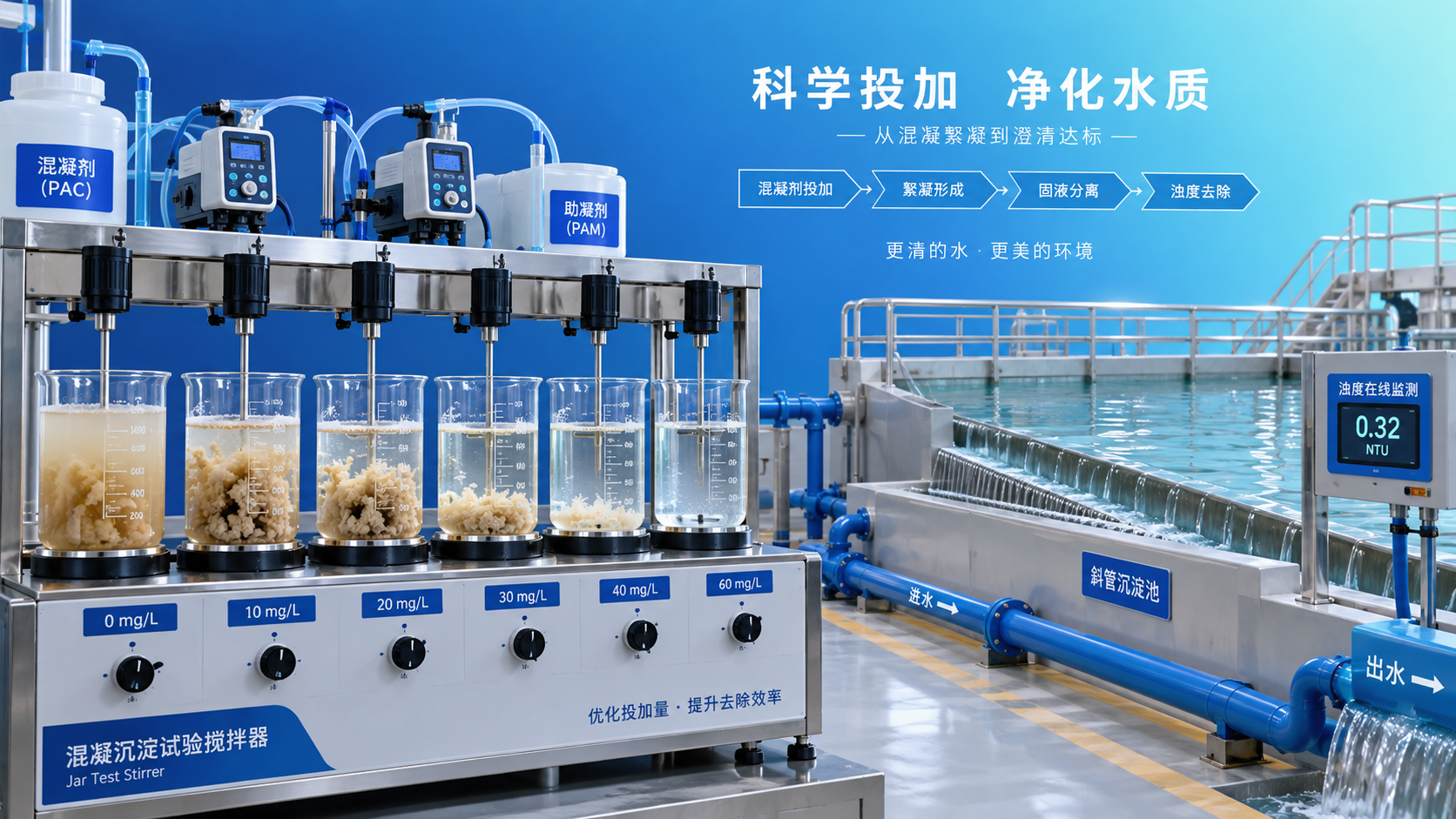
Start With a Dose Range, Not a Fixed Number
Reliable turbidity removal rarely comes from finding one “correct” coagulant dose and applying it indefinitely. Raw-water quality changes with rainfall, source-water turnover, upstream activity, temperature, and treatment-process conditions. A dose that produced clear settled water yesterday may leave residual haze, carry solids into filters, or create excessive sludge today.
For operators, the practical objective is to identify the lowest dose that consistently delivers the required settled-water and filtered-water quality under the present conditions. That target must include more than visible clarity. A coagulant setting that appears effective in the clarifier can still perform poorly if it creates weak floc, depresses pH excessively, shortens filter run time, or increases residual metal concentrations.
Water Treatment Coagulants work by destabilizing fine suspended and colloidal particles so they can collide, form flocs, and settle or be filtered. Dose optimization therefore depends on the water chemistry and on the physical process surrounding the chemical feed point. More chemical does not automatically mean better removal.
Understand What Is Driving Turbidity Before Adjusting the Pump
Turbidity is an operating indicator, not a complete description of the particles in the water. Two water samples with a similar turbidity reading can require materially different treatment. One may contain easily settled mineral solids; the other may contain low-density organic matter, algae, finely dispersed clay, or particles carrying a strong surface charge. Their response to alum, ferric salts, polyaluminum chloride, or blended coagulant systems will differ.
Before changing dosage, review the operating conditions that are most likely to explain a shift in performance:
- Raw-water turbidity and its rate of change. A gradual seasonal increase can often be managed through planned dose adjustments. A sudden spike after runoff may require a new jar-test series and closer monitoring of settled water.
- pH and alkalinity. Many inorganic coagulants consume alkalinity during hydrolysis. If the water has limited buffering capacity, higher doses may lower pH enough to reduce coagulation efficiency or create downstream corrosion concerns.
- Temperature. Cold water slows particle movement and floc formation. A dose that worked at moderate temperature may need adjustment, but longer flocculation or settling time may be more effective than a large chemical increase.
- Color, natural organic matter, and algae. These constituents can consume coagulant demand and change floc character. Turbidity alone may underestimate the dose needed for acceptable finished-water quality.
- Process hydraulics. Poor rapid mixing, damaged flash-mix equipment, short-circuiting in flocculation basins, or overloaded clarifiers can resemble a chemical-dose problem.
- Chemical preparation and feed condition. Incorrect dilution, aged polymer solution, crystallization, feed-pump calibration drift, or inconsistent chemical concentration can make a nominal dose unreliable.
A useful operating discipline is to record raw-water turbidity, pH, alkalinity where available, water temperature, coagulant dose, polymer dose, settled-water turbidity, filter influent turbidity, and filter run behavior on the same log. The pattern across these readings is usually more informative than a single high turbidity result.
Use Jar Testing to Find the Working Window
Jar testing remains the most direct way to translate raw-water changes into a defensible dosing decision. It is especially important after major rainfall events, source-water changes, seasonal temperature shifts, or when operators observe higher filter loading despite apparently acceptable clarifier performance.
The purpose is not to identify a visually impressive beaker. It is to identify a repeatable operating window where floc forms promptly, settles well, and leaves an acceptable supernatant without excessive chemical use. A test should mimic plant conditions as closely as practical: the same raw water, similar coagulant feed sequence, representative rapid-mix intensity, realistic flocculation time, and comparable settling time.
A practical jar-test sequence
- Collect a representative raw-water sample. Avoid relying on a sample taken before a rapid quality shift or from a stagnant sample point.
- Measure and record starting turbidity, pH, temperature, and any other routine water-quality indicators available at the plant.
- Prepare a dose series around the current operating dose. Include lower and higher points rather than testing only one alternative. The spacing should be wide enough to reveal a trend but narrow enough to locate the useful range.
- Apply coagulant under a short, vigorous rapid-mix period. Add pH adjustment or coagulant aid in the same order used in the plant.
- Reduce to a gentle, controlled mixing phase to allow floc growth. Observe the timing of floc appearance, floc size, density, and tendency to shear apart.
- Allow settling for a time that reflects the actual clarification process. Measure supernatant turbidity consistently from each jar rather than judging only by appearance.
- Where polymer is used, repeat the selected coagulant doses with a controlled polymer screen. Optimize the primary coagulant first unless the plant operates a tightly integrated coagulant-polymer program.
Choose the dose based on the full response, not simply the lowest final turbidity in one jar. If two doses produce similar supernatant turbidity, the lower dose may be preferable when it maintains pH, limits sludge volume, and performs consistently across repeat tests. If the lowest turbidity occurs only at a narrow point, operating at the center of a broader acceptable range may provide better protection against raw-water variation and feed-pump error.
Read the Floc, but Verify It With Measurements
Visual observation is valuable because it can reveal failure mechanisms quickly. Pin floc, slow floc formation, fluffy floating solids, and floc that breaks under gentle mixing each point to different corrective actions. Still, visual judgment should support instrument readings rather than replace them.
Overdosing is frequently misunderstood. It may produce an initially impressive floc, yet the floc can become unstable or the water chemistry can move outside the coagulant’s effective range. In some systems, excess cationic charge can restabilize particles. In others, the primary penalty is lower pH, increased dissolved residuals, or unnecessary sludge production. A dose increase should therefore be treated as a hypothesis to test, not a default response to rising turbidity.
pH, Alkalinity, and Coagulant Chemistry Must Be Managed Together
Aluminum- and iron-based coagulants do not act independently of pH. Their hydrolysis products, precipitation behavior, and ability to capture particles are influenced by the water’s pH and alkalinity. This is why a coagulant dose can appear inconsistent even when the raw-water turbidity has barely changed.
When a higher dose is needed, test whether alkalinity or pH adjustment improves the result. In low-alkalinity water, an alkali addition may stabilize the treatment window and reduce the amount of primary coagulant required. Conversely, adding alkali without a jar-test basis can create a new problem by moving conditions away from the effective range of the selected coagulant.
Operators should watch for a pattern in which turbidity removal declines as coagulant use rises and treated-water pH falls. That pattern suggests the plant may be treating a chemistry limitation as a dosage limitation. The correction may involve changing the dose, adjusting pH, changing the coagulant product, or improving mixing; the right choice depends on jar-test results and the process constraints of the plant.
Do Not Optimize the Clarifier at the Expense of the Whole Plant
The optimum dose should be judged downstream. Settled-water turbidity is an important control point, but it is not the only one. High chemical use can increase sludge handling demand. Poorly conditioned floc can pass to filters and accelerate headloss. Excess residual coagulant can affect finished-water compliance requirements or interfere with later treatment steps, depending on the facility.
For that reason, dose changes should be followed through the system. After selecting a candidate setting, compare it with the previous condition using routine operating indicators: settled-water turbidity, filter influent quality, filter run length, backwash frequency, final-water turbidity, pH, and sludge behavior. A change that improves one number while degrading several others is not an optimization.
This wider view also helps distinguish chemical issues from capacity issues. During an extreme turbidity event, the plant may have reached the practical limit of its rapid mixing, flocculation volume, clarifier loading, or filtration capacity. Adding more coagulant can sometimes provide short-term assistance, but it cannot permanently compensate for inadequate contact time or solids-separation capacity.
Build Operating Rules From Trends, Not From a Single Test
Jar tests provide a snapshot. A useful operating program turns repeated tests into simple decision rules. For example, an operator can establish dose bands for normal, elevated, and storm-affected raw water, with separate guidance for low-temperature conditions or low-alkalinity water. These bands should remain subject to verification because the same turbidity range can behave differently when the particle source changes.
Feed equipment deserves the same attention as water chemistry. Confirm the actual stroke, speed, delivery rate, solution strength, and calibration of each dosing pump. A carefully derived target dose is of limited value if the actual chemical feed varies from shift to shift. For polymers, prepare and age solutions according to the supplier’s handling requirements, and avoid excessive shear between make-down, storage, and injection.
When changing coagulant products or supply batches, treat the transition as a controlled process change. Product concentration, basicity, acidity, density, and recommended dilution can affect the dose delivered and the treatment response. Verify the active basis used for dose calculations, repeat jar testing, and adjust pump settings rather than assuming that equal volumetric feed rates are equivalent.
A Defensible Daily Dosing Decision
A sound coagulant-dose decision can be expressed simply: use the lowest tested dose that provides stable turbidity removal under current water chemistry and plant hydraulics, then confirm its effect through clarification and filtration. When performance changes, first determine whether the cause is raw-water quality, pH and alkalinity, chemical feed accuracy, mixing, flocculation, or solids-separation capacity.
This approach prevents two expensive habits: holding a historical dose long after the water has changed, and responding to every disturbance by increasing chemical feed. Consistent records, representative jar tests, calibrated equipment, and downstream verification give operators a more reliable basis for clear water than any fixed dosage number.
Send Us Your Inquiry Today
