









Product Quick Navigation
Get a Quote
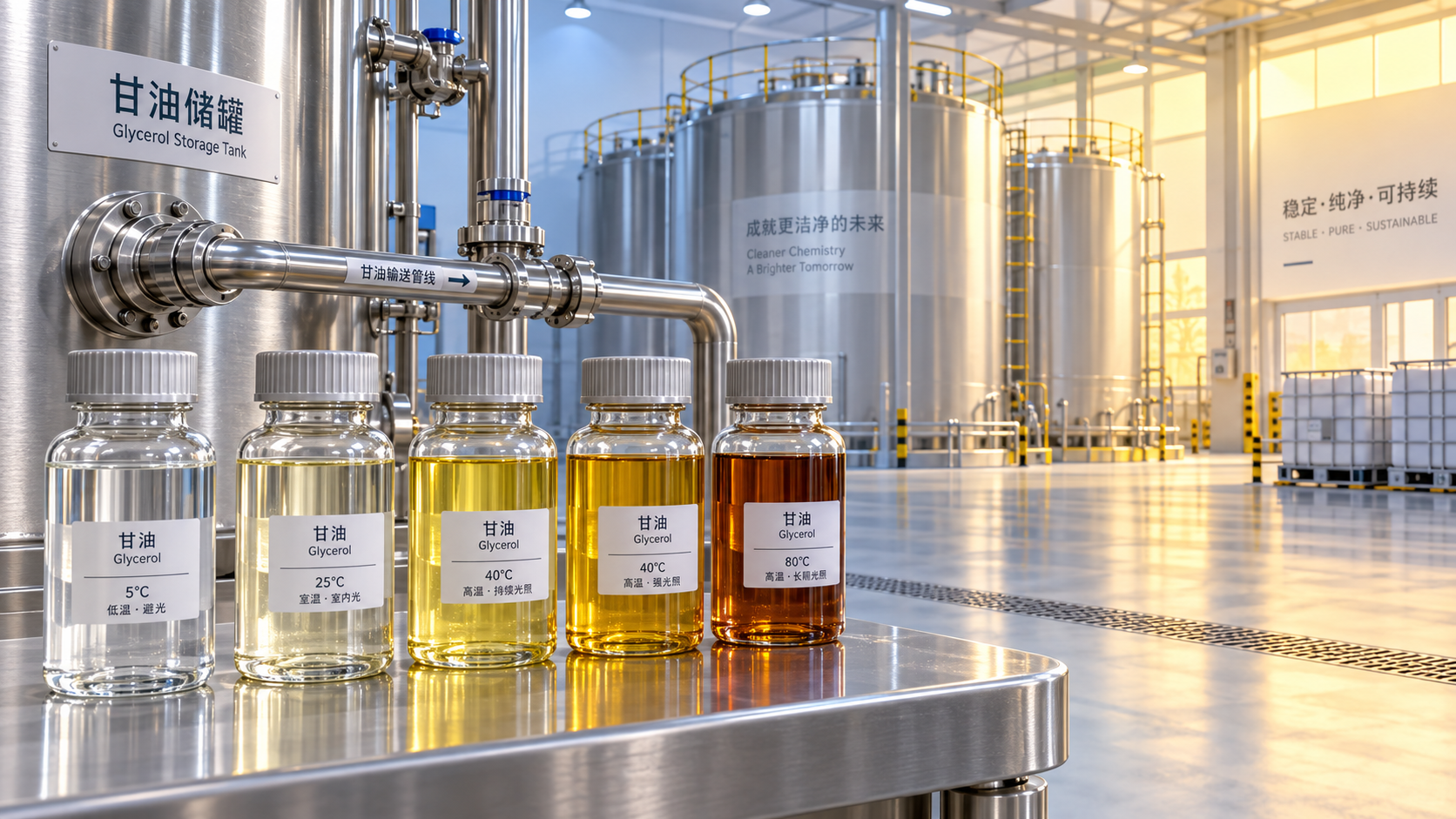
A clear, colorless glycerol shipment that turns pale yellow, amber, or brown in storage creates an immediate quality question: did the product degrade, become contaminated, or simply experience a harmless visual change? The answer depends on the storage history, intended use, and the extent of the color shift. Glycerol is generally stable when it is kept clean, sealed, and protected from excessive heat and light. Noticeable discoloration usually points to an avoidable storage or handling problem rather than a normal property of the material.
For procurement teams and production managers, appearance matters because glycerol is often used in formulations where clarity affects the finished product. A color change can also signal trace contamination, oxidation-related reactions, residue from unsuitable equipment, or exposure to conditions that may affect other quality attributes. The practical goal is not merely to keep glycerol looking clear. It is to identify the source of change early, prevent recurrence, and decide whether the material still fits the application.
Heat is one of the most common causes of glycerol discoloration
Glycerol can tolerate ordinary warehouse temperatures well, but prolonged exposure to elevated heat increases the chance of yellowing or darkening. Heat alone may not cause an immediate dramatic change in a clean, sealed product. The risk rises when high temperature is combined with air exposure, trace metal contamination, residual organic material, or repeated heating cycles.
This issue often appears when drums or intermediate bulk containers are stored near steam lines, heaters, hot process equipment, or exterior walls exposed to strong sun. It can also occur during transport when containers remain in hot conditions for an extended period. In bulk handling, overheating may happen when product is warmed to improve pumping or transfer. Glycerol is viscous, especially in cooler conditions, so heating is sometimes used operationally. The mistake is treating it as a routine convenience without controlling temperature, heating duration, and cleanliness of the system.
Localized overheating deserves particular attention. A tank may show an acceptable average temperature while glycerol near a heating coil, electric heater, or poorly mixed zone becomes much hotter. Product in contact with that surface can darken before the rest of the tank shows any obvious problem. Indirect, controlled heating and sufficient circulation are more reliable than applying intense heat to a static product.
For storage, the objective should be a stable, moderate temperature. If warming is necessary for transfer, use the lowest practical heat setting, limit the exposure time, and avoid repeated warm-cool cycles. A shipment that arrives clear but changes color after prolonged warm storage should be investigated through the warehouse and handling records before assuming the supplier delivered off-spec material.
Light exposure can accelerate visible yellowing
Glycerol does not benefit from unnecessary light exposure. Direct sunlight can warm the container and expose the product to ultraviolet radiation at the same time. This combination is more problematic than normal indoor lighting. Clear or translucent packaging placed near windows, loading doors, or outdoor staging areas is more vulnerable than opaque, closed containers kept in a shaded warehouse.
Light is especially relevant when glycerol contains trace impurities or when the product has been transferred from its original packaging into a smaller container. A nearly invisible amount of organic residue, metal ions, or process carryover may react more readily under heat and light, producing a gradual color shift. The resulting yellow appearance may look minor at first, but it can be unacceptable in personal care, food-related, pharmaceutical, coating, or high-clarity industrial formulations.
Keep containers out of direct sunlight, close warehouse doors when possible during staging, and use opaque or light-protective packaging where storage conditions are difficult to control. This is a simple preventive measure, but it is often missed when glycerol is treated as a low-risk, routine raw material.
Air contact matters most after a container has been opened
Freshly sealed glycerol is less exposed to oxygen and airborne contaminants than material held in a partially used drum or vented tank. Once a package is opened, each withdrawal can introduce humid air, dust, fibers, residues from transfer tools, and vapors from the surrounding area. Air contact alone may not quickly discolor glycerol, but it can support slow oxidation or make contamination more likely.
Repeatedly opening a drum and replacing the cap loosely is a common weak point. The same applies to tanks with inadequate blanketing, damaged gaskets, poor vent protection, or open manways left uncovered after use. In facilities that handle several chemicals, a vented glycerol container located near reactive vapors or dusty operations has a higher risk profile than one stored in a clean, segregated area.
For partially used containers, minimize headspace exposure and reseal the package immediately after dispensing. Use clean, dedicated transfer equipment. If a bulk storage system requires venting, the vent arrangement should keep dust, moisture, insects, and process vapors from entering. Where operationally appropriate, an inert gas blanket can reduce air contact, but it does not replace good sanitation and closed-transfer practices.
Container and equipment materials can influence color
Glycerol is compatible with many common storage materials, but compatibility is not only about whether the container leaks or corrodes. It also concerns whether the material, lining, fitting, seal, hose, or pump can release contaminants into the product. Trace metals are particularly important because they can promote color formation under heat or air exposure.
Clean stainless steel systems are commonly preferred for higher-purity glycerol handling because they are durable and can be maintained hygienically. Suitable plastic containers may also be practical for packaged product, provided they are clean, compatible, and intended for the relevant grade and application. The risk is usually not the container category alone. It is the condition of the contact surface.
A reused drum, aged hose, worn gasket, rusty valve, unlined carbon-steel component, or poorly maintained pump can introduce material that is not obvious during loading. Small amounts of residue from a prior product can be enough to affect color, odor, or downstream performance. This is why a color investigation should include the full contact path, not only the main storage tank.
Contamination is often the real reason behind a sudden change
A slow, slight yellowing after difficult storage may be related to heat and oxygen exposure. A rapid or uneven color change, however, should raise stronger suspicion of contamination. Glycerol can pick up impurities from tanks, transfer lines, cleaning agents, lubricants, previous cargoes, or incompatible additives. The appearance of haze, particles, unusual odor, or layered color differences makes this possibility more likely.
Water quality also matters. Glycerol is hygroscopic, meaning it readily attracts moisture from the air. Moisture uptake may not directly create a darker color, but it can alter concentration, affect handling properties, and carry dissolved contaminants into the product. Water introduced through washdown, condensation, an unprotected vent, or inadequately dried equipment can therefore complicate both quality control and root-cause analysis.
Do not rely on visual inspection alone to decide whether discolored glycerol is usable. A small color difference may be irrelevant in a dark industrial formulation but unacceptable in a clear gel, coating, or high-purity blend. The intended application determines the consequence. Compare a retained reference sample, review the product specification, and test the affected batch using the quality controls relevant to its end use. Color is a warning sign; it is not a complete quality assessment.
How to store glycerol without creating a color problem
A workable storage program is usually straightforward when it addresses the full path from receipt to use. Start by recording the product grade, lot identification, receipt condition, storage location, and opening date. That basic traceability makes it much easier to distinguish a supplier issue from a warehouse or processing issue.
- Inspect on receipt. Check the container integrity, closure condition, label details, and product appearance before the material enters stock. Retain a representative sample when the application is sensitive to color.
- Choose a clean, shaded storage area. Keep glycerol away from direct sunlight, heat sources, outdoor exposure, and areas where dust or chemical vapors are present.
- Maintain a stable temperature. Avoid unnecessary heating. When viscosity requires warming for transfer, use controlled indirect heat and prevent hot spots.
- Keep the system closed. Reseal drums and IBCs after use. Protect tank vents and avoid leaving lids, hatches, or sampling points open.
- Control product-contact equipment. Verify that tanks, pumps, lines, valves, hoses, and sampling tools are clean, compatible, and not shared without an effective cleaning process.
- Use stock in a disciplined order. Rotate inventory so that opened containers and older stock are not left unused while newer deliveries are consumed first.
Storage requirements should also reflect the glycerol grade. A technical-grade material used in a colored industrial system may tolerate a different appearance threshold than material intended for transparent formulations or tightly controlled applications. The same warehouse practice should not be assumed suitable for every grade simply because the chemical name is the same.
What to check when glycerol has already turned yellow or brown
Begin with the pattern of discoloration. Is the entire container uniformly yellow, or is the color strongest near the top, bottom, heater zone, or outlet? Uniform color change may point to prolonged heat or light exposure. Localized color can suggest sediment, contact with a heated surface, contamination from a valve or pump, or incomplete mixing in a bulk tank.
Then review the handling history: storage temperature, duration, exposure to sunlight, whether the package was opened, transfer equipment used, cleaning activity, and any adjacent products handled in the same system. This sequence is more useful than immediately focusing on one suspected cause. Several minor deviations can combine to produce a result that none of them would cause alone.
Segregate the affected material from approved stock until its suitability is assessed against the relevant specification. Avoid blending it into clear material merely to dilute the appearance. Blending may conceal the visible issue while spreading an unknown contamination or reducing consistency across a larger batch.
A note on purchasing and related raw-material questions
Supply reliability includes more than receiving the correct chemical and grade. Importers should consider packaging integrity, traceability, transport conditions, documentation, and whether the supplier can support consistent handling across export shipments. Huafeng Chemical, based in Shandong, supports overseas chemical trade through a broad product portfolio and export-service capabilities; for glycerol sourcing, the useful discussion is not only availability but also the expected packaging, storage history, and quality documentation for the intended application.
Buyers sometimes combine unrelated sourcing questions, such as which PVC paste resin grade is best for coating applications?, with concerns about glycerol storage. The selection logic differs. PVC paste resin grades are chosen around coating viscosity, plastisol behavior, substrate, film properties, and processing method. Glycerol color control is primarily a storage and contamination-management question. Treating these as separate technical decisions prevents a general raw-material purchasing checklist from overlooking the conditions that actually affect each product.
When color change is more than a cosmetic issue
Discolored glycerol deserves a stricter response when it will enter a transparent product, a formulation with a narrow color target, or a process where trace impurities can interfere with downstream chemistry. It also deserves attention when the color shift comes with odor, haze, particles, unexpected viscosity changes, or uncertain handling history. In those cases, replacing the affected material may be less costly than troubleshooting a finished batch after production.
For less appearance-sensitive uses, the decision may be more nuanced, but it should still be based on the applicable product requirements rather than an assumption that glycerol is harmless because it remains liquid and pumpable. Stable temperature, light protection, closed handling, clean contact surfaces, and disciplined inventory rotation prevent most avoidable glycerol color changes before they become a production problem.
Send Us Your Inquiry Today
