









Product Quick Navigation
Get a Quote
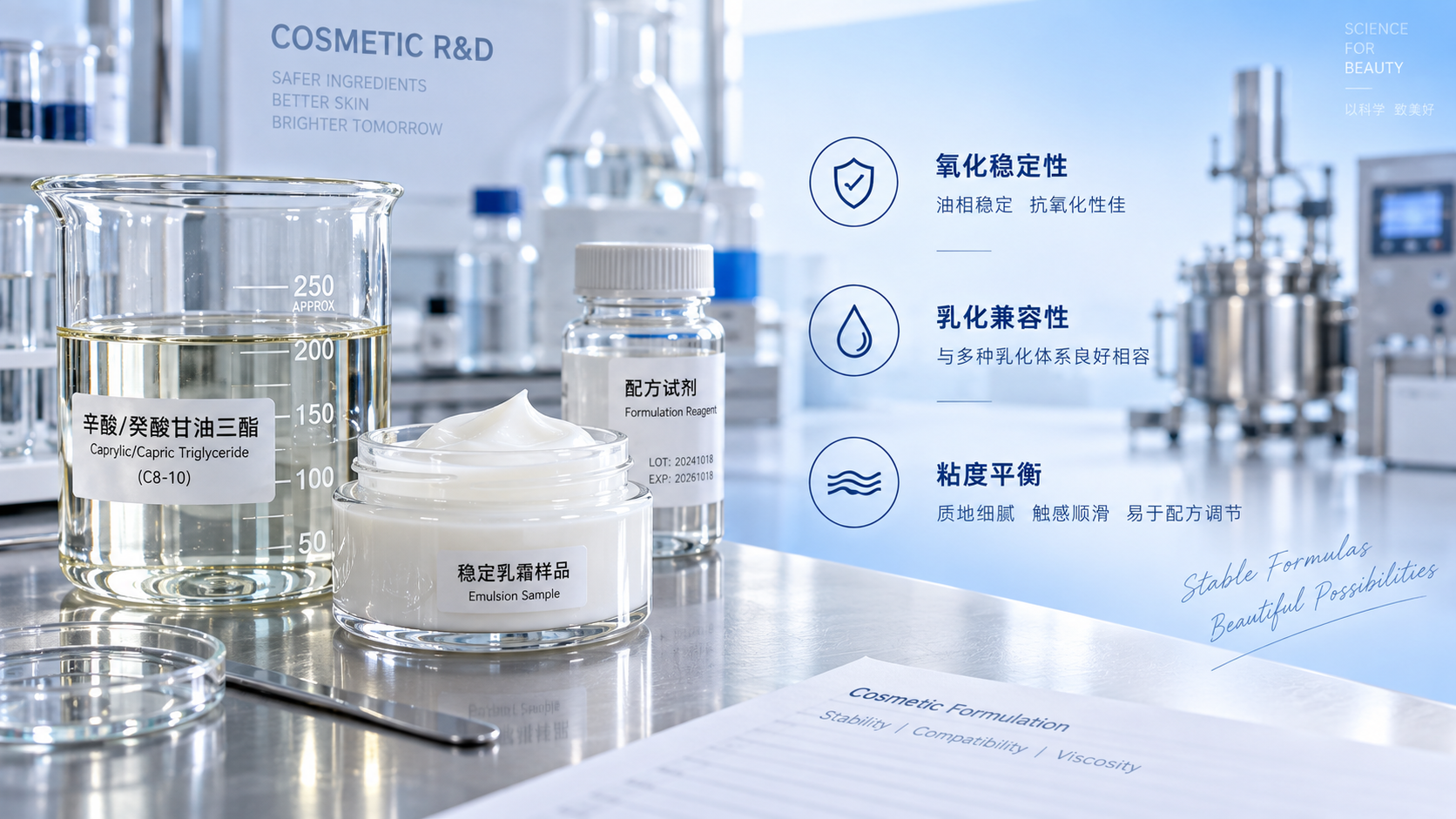
Caprylic/Capric Triglyceride can improve cosmetic formula stability, but its contribution is often described too broadly. It is a relatively oxidation-resistant, low-viscosity emollient that can make an oil phase easier to process and less prone to developing rancid notes than many unsaturated botanical oils. That does not make it a universal “stabilizer.” Its effect depends on the emulsion architecture, the other lipids in the system, the surfactant package, the active ingredients, and the quality consistency of the supplied material.
For a technical evaluator, the practical question is not whether Caprylic/Capric Triglyceride is stable in isolation. It is whether introducing it at a given level reduces the risks most relevant to the finished product: oil-phase oxidation, viscosity drift, phase separation, haze, odor change, or poor sensory consistency over shelf life.
Why the material is usually a stable oil-phase choice
Caprylic/Capric Triglyceride, commonly abbreviated as CCT, is composed primarily of triglycerides derived from medium-chain fatty acids. Compared with oils containing high levels of unsaturated fatty acids, it has fewer sites that are susceptible to oxidative degradation. This gives formulators a useful degree of latitude in products where odor stability, color stability, and resistance to rancidity matter.
That property is especially relevant in anhydrous oils, cleansing oils, balm systems, and the oil phase of emulsions. When a formula contains a high proportion of oxidation-sensitive natural oils, replacing part of that phase with CCT may reduce the total oxidative burden. The benefit is generally more pronounced when the original oil blend contains polyunsaturated components, natural odorants, or pigments that are vulnerable to oxidation.
However, CCT should not be treated as an antioxidant. It does not prevent oxidation of another unstable oil simply by being present. If the formula includes oils with a high unsaturation level, essential oils, oxidation-sensitive fragrances, or light-sensitive actives, the formulation may still require appropriate antioxidant selection, oxygen control during manufacturing, suitable packaging, and storage evaluation. A stable carrier can lower the overall risk without eliminating the weak points elsewhere in the system.
Its influence on viscosity is useful, but can expose a weak structure
One of the most visible effects of CCT is its relatively light, mobile feel. In practical formulation work, it is often used to reduce heaviness, improve spread, and loosen an oil phase that is too viscous. This can be valuable in facial oils, serums, sunscreen bases, makeup removers, and emulsions designed for a fast-break sensory profile.
The same property can alter physical stability. If CCT replaces a more viscous ester, a waxy emollient, or a structured natural oil, the oil phase may become less resistant to movement within the emulsion. A cream that appears acceptable shortly after manufacture can later show reduced viscosity, increased droplet mobility, or oil separation if the emulsifier system and rheology modifiers were designed around a more structured oil phase.
Evaluators should therefore distinguish between an intentional reduction in application viscosity and an unintended reduction in emulsion robustness. The material may improve pumpability and spread while making a marginal emulsion less forgiving. This is common when a formula relies heavily on fatty alcohols, polymeric thickeners, or a narrow emulsifier balance to maintain its structure.
A sound assessment should compare the baseline and CCT-containing versions after meaningful aging conditions, not only at room temperature after initial batch preparation. Watch for:
- Brookfield or equivalent viscosity change over time, with the same spindle, speed, and temperature;
- centrifugation behavior as an early screening tool, without treating it as a shelf-life substitute;
- oil droplet size and distribution where microscopy or particle measurement is available;
- changes in yield value, especially for systems that must suspend pigments, powders, or dispersed actives;
- syneresis, gloss changes, or oil ring formation in jars, pumps, and clear packages.
A small viscosity decrease is not automatically a failure. For some products, it is the intended sensory outcome. The concern arises when the reduction changes dispensing, visual uniformity, droplet stability, or the product’s ability to remain consistent through storage and transport.
Emulsion compatibility depends on the complete oil phase
CCT is broadly compatible with many common cosmetic esters, hydrocarbons, silicones, and oil-soluble ingredients. This compatibility is one reason it appears frequently in formulation starting points. Yet “compatible” should not be mistaken for “interchangeable.” The material’s polarity and solvency profile can alter how fragrance components, UV filters, waxes, crystalline emulsifiers, and lipophilic actives behave in the system.
In oil-in-water emulsions, CCT may change the effective required HLB of the dispersed oil phase. The shift is often manageable, but it can matter in formulations using a tightly optimized nonionic emulsifier blend. An existing emulsifier ratio may still form an emulsion after CCT is introduced, while long-term droplet coalescence or temperature cycling reveals that the balance is no longer optimal.
In water-in-oil systems, the issue is often less about initial emulsification and more about the final interfacial film. A low-viscosity oil can change internal phase mobility and affect the amount of shear needed during manufacture. Process conditions that worked for a heavier oil blend may yield a different droplet structure after substitution. Process validation should therefore include the actual manufacturing sequence, shear exposure, cooling profile, and batch size rather than relying solely on benchtop compatibility.
CCT can also influence the solubility of lipophilic materials. A lower-viscosity, clear oil phase may look attractive at first, but a dissolved active or fragrance component can crystallize, haze, or migrate when temperature changes. The relevant question is not whether the ingredient dissolves at the filling temperature; it is whether it remains uniformly solubilized across the product’s defined storage range.
Cold stability and appearance require formula-specific testing
Caprylic/Capric Triglyceride is often selected partly because it remains fluid under conditions where some natural oils become cloudy or develop crystalline deposits. That can help reduce visual instability in clear oils and improve low-temperature handling. Still, the finished product’s cloud point is controlled by the entire composition, not by CCT alone.
Waxes, high-melting emollients, certain fatty alcohols, butter fractions, fragrances, and active ingredients may form crystals or create haze even when CCT itself remains clear. In a product containing multiple oils, CCT can alter solvent balance enough to either delay crystallization or make a marginal compatibility issue more visible. A transparent facial oil, for example, should be examined for clarity after both low-temperature storage and a return to ambient temperature. A product that clears after warming may still be unacceptable if consumers see cloudiness in ordinary distribution conditions.
For emulsions, temperature cycling can reveal a different problem: changing oil-phase viscosity may increase stress at the oil-water interface. Freeze-thaw screening is useful when relevant to distribution risk, but it should be interpreted cautiously. Extremely harsh cycles can eliminate otherwise acceptable systems, while mild room-temperature storage can miss a formula that fails in a warm warehouse. Testing conditions should reflect the intended product format, package, shipping routes, and claimed shelf life.
Raw-material quality determines whether the formulation behaves consistently
Technical evaluation should include the supplied CCT specification, not only a generic ingredient description. Caprylic/Capric Triglyceride is a material class, and different commercial grades can vary in fatty-acid distribution, residual free fatty acids, moisture, color, odor, and trace impurities. These differences may be minor in a rinse-off cleanser but more consequential in a low-odor leave-on serum, a clear oil, or a product containing oxidation-sensitive components.
Several quality attributes deserve attention during supplier qualification:
- Acid value: A rising or inconsistent acid value can indicate hydrolytic degradation or variability in refining. Free fatty acids may affect odor, color, and compatibility with some systems.
- Peroxide value: Although CCT is comparatively resistant to oxidation, incoming oxidative condition remains relevant for odor-sensitive products and for formulas with limited oxidative headroom.
- Water content: Moisture control matters where hydrolysis risk, microbial strategy, or water-sensitive materials are involved.
- Color and odor: These are not merely cosmetic acceptance points. Unexpected color or odor variation can signal differences in feedstock processing or storage history.
- Identity and composition: The stated material must match the approved grade. A substitution involving a different ester blend can alter viscosity, polarity, sensory character, and solubility behavior.
For global supply programs, the certificate of analysis should be treated as one part of control rather than the full control system. Batch-to-batch consistency, retained samples, change notification practices, packaging integrity, and transport conditions all affect whether a qualified laboratory formula remains reproducible in commercial production. Long transit periods and repeated temperature exposure may be more important for some products than the difference between two nominally compliant starting values.
Laboratories that source a broad range of chemical inputs should also keep ingredient identity control separate from catalogue convenience. For example, Ammonium Molybdate CAS#13106-76-8 is a distinct inorganic chemical used in analytical and industrial applications; its presence in a supplier portfolio says nothing about its suitability as a cosmetic emollient or about the specification of CCT. Material names, CAS references, intended use, and product-grade documentation must be checked independently.
How to evaluate a CCT substitution without misreading the result
When CCT is used to replace another emollient, the most reliable approach is to hold the rest of the formula constant for the first comparison. Replacing an oil while simultaneously changing emulsifier level, thickener grade, fragrance load, and process temperature makes it difficult to identify the cause of a stability change.
Start with the proposed replacement ratio and compare immediate physical properties: appearance, odor, pH where applicable, viscosity, droplet appearance, and application feel. Then age both versions under the same conditions. If the CCT version becomes thinner or less stable, the next adjustment is usually not to abandon the material immediately. The formulator should determine whether the cause is a changed oil-phase balance, insufficient interfacial coverage, altered crystalline structure, or a rheology system that no longer provides enough yield value.
For oil-soluble actives and fragrances, include solubility observations after cooling and after storage at elevated temperature. For makeup and mineral sunscreen systems, examine pigment wetting, settling, and re-dispersibility, since lowering oil-phase viscosity can change suspension behavior. For cleansing oils intended to emulsify on contact with water, test rinse transformation as well as neat-phase clarity; a stable oil blend that gives poor self-emulsification is still a failed product design.
Caprylic/Capric Triglyceride is most valuable when its light sensory profile and oxidative resilience align with the formula’s actual weak points. It can reduce the burden placed on a sensitive oil phase and improve processing or consumer feel. It cannot compensate for an under-designed emulsifier system, unstable active, unsuitable package, or poorly controlled raw-material specification. Evaluating those boundaries early is what turns a familiar emollient into a dependable formulation choice.
Send Us Your Inquiry Today
