









Product Quick Navigation
Get a Quote
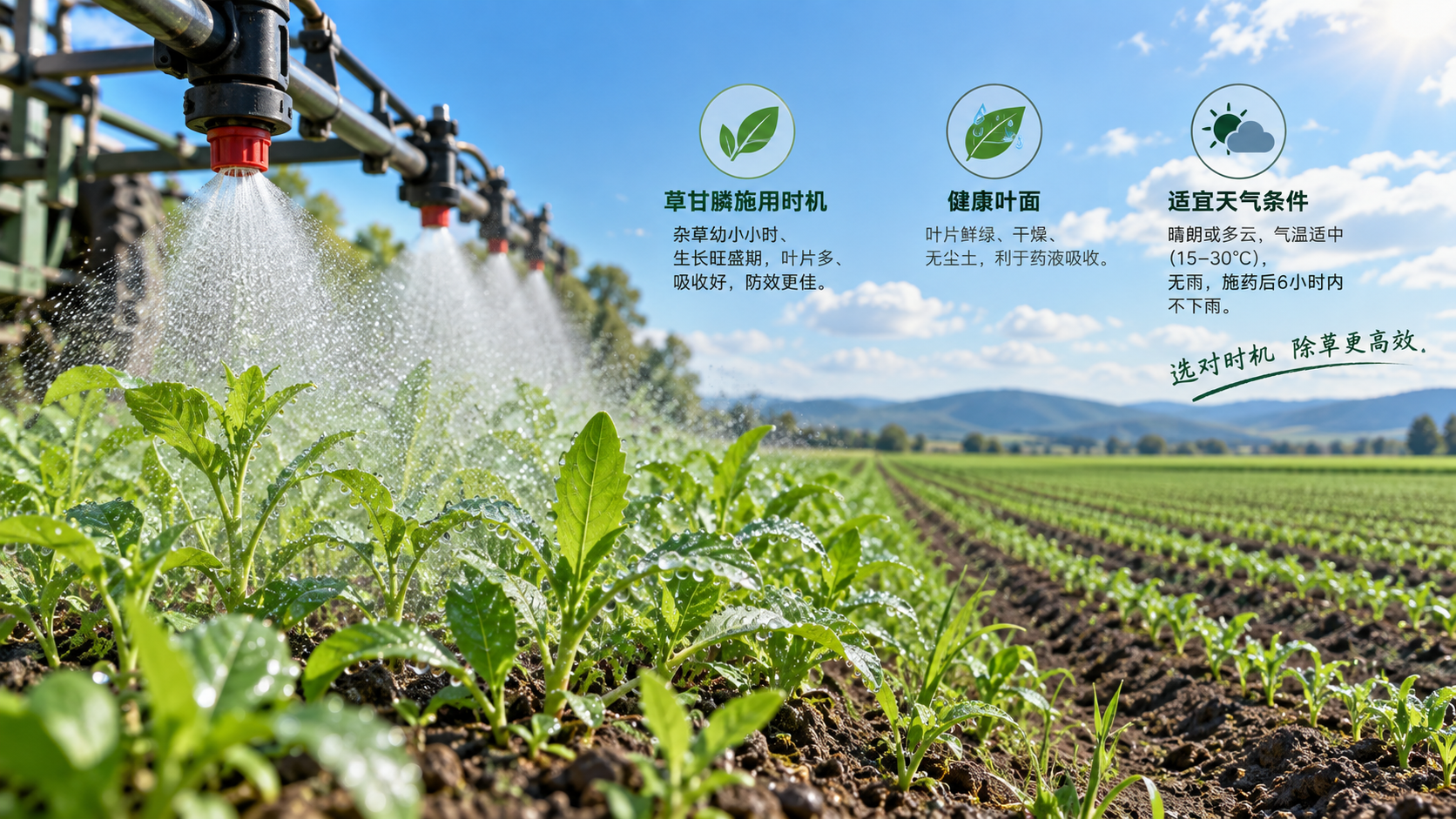
Glyphosate can give poor weed control even when the spray mix, rate, and equipment appear correct. In many cases, the limiting factor is timing: the weed may not be actively growing, the leaf surface may not retain enough spray, rain may interrupt uptake, or the plant may be too mature to move the herbicide effectively into its growing points.
Because glyphosate is a systemic herbicide, it must be absorbed through living foliage and translocated within the plant. It does not reliably control weeds simply by touching green tissue. The best application window is usually when target weeds have enough exposed leaf area to intercept the spray and are growing steadily without stress. This principle matters more than choosing the first available dry day.
Start with the weed, not the calendar
Calendar timing is useful for planning, but weed growth stage is the more practical decision point. A field can be treated on the same date in two different years and produce very different results because emergence, rainfall, temperature, and crop competition change how weeds develop.
Small, actively growing annual weeds are commonly easier to control than large, hardened plants. They have less stored energy, less leaf area hidden below other vegetation, and fewer growing points to reach. Waiting until an annual weed population looks dense and obvious often means some plants have already become too large for a simple burndown decision.
Perennial weeds require a different judgment. Their underground structures, such as roots, rhizomes, or crowns, are part of the control problem. A very early spray may brown visible leaves without delivering enough glyphosate to the underground system. For established perennials, treatment is generally more effective when there is sufficient healthy foliage and the plant is moving sugars toward its roots. This is often seen later in the growth cycle, but the useful window depends on the species, local season, and label directions.
A common mistake is treating every green plant as equally ready. Green color alone does not show whether the plant is metabolically active. A weed that has stopped growing because of drought, cold, flooding, or mechanical injury may remain green while taking up and moving less herbicide than expected.
Weather affects uptake before it affects comfort
Operators often focus on wind because drift is visible and immediate. Wind matters, but temperature, moisture status, humidity, and rainfall after application can have just as much influence on weed control results.
Glyphosate performs best when leaves are functioning normally. Moderate conditions that support growth usually favor uptake. Under hot, dry conditions, weeds may close stomata, develop thicker cuticles, roll leaves, or slow movement of sugars through the plant. A later application after recovery can outperform an application made during a heat or moisture stress period, even when the later treatment feels less urgent.
Cold weather creates a similar problem through a different mechanism. Plants grow slowly when temperatures are low, and a sudden cold event can disrupt absorption and movement. Frost-damaged foliage should not be treated as normal target tissue. Wait until the weed has resumed clear, active growth and has enough undamaged leaf area to intercept the spray.
Humidity can improve the working environment for a foliar spray by slowing droplet drying. When droplets dry extremely quickly, there may be less time for active ingredient to enter the leaf. That does not mean spraying in damp conditions is always appropriate. Heavy dew can dilute droplets or encourage runoff, and wet foliage may make coverage less predictable. The goal is a dry leaf surface with conditions that do not cause rapid evaporation or plant stress.
Rainfall is not only a same-day issue
Rain soon after spraying can wash material from foliage before adequate absorption occurs. The required rain-free period differs among glyphosate products and formulations, so the label is the operating standard. Do not rely on a general rule from a different formulation, tank mix, or market.
Rain before application also changes the decision. After a dry period, rainfall may restart weed growth and create a much better treatment opportunity, but only after the plants have had time to respond. Spraying immediately after rain is not automatically better. Check that leaves are dry, the field is accessible without causing damage, and the weeds are showing renewed growth rather than merely sitting in wet soil.
Growth stage and weather must be read together
The strongest glyphosate application window is created by the combination of plant stage and plant condition. A weed at an ideal size is still a poor target if it is drought-stressed. A well-watered weed may still be difficult to control if it has become overgrown, covered by crop canopy, or started reproductive development.
In pre-plant or pre-emergence burndown work, the pressure to finish ahead of planting can lead to poor timing decisions. When the target weeds are stressed or when rain is expected before the label’s rain-fast interval, postponing may be more efficient than applying and then needing rescue treatment. Conversely, delaying too long can allow a new flush to emerge or existing weeds to become larger. The practical answer is not simply “spray early” or “wait for better weather.” It is to prioritize a usable interval where emerged weeds are exposed, actively growing, and unlikely to be interrupted by rain or severe stress.
In non-crop areas, orchards, industrial sites, and fence lines, weed populations are often mixed. One species may be small and suitable for treatment while another has become established and tough. A single application may suppress the whole area visually but leave the harder weeds alive. Before treating, identify which species actually drive repeat work. Timing should be chosen for those target weeds, not for the easiest broadleaf seedlings in the same area.
What happens after application matters
Glyphosate is not an instant-contact treatment. Visible symptoms can take time, particularly in perennial weeds or under cool conditions. Rapidly judging a treatment as unsuccessful can lead to unnecessary reapplication, crop or site-management conflicts, and poor recordkeeping.
Give the herbicide time to move through the plant before mowing, cultivating, grazing, or otherwise removing treated foliage. The required interval depends on the product label and the intended operation. Cutting plants too soon removes the pathway through which glyphosate reaches growing points and underground structures. In perennial vegetation, this is one of the clearest ways to turn a potentially useful treatment into a short-lived burnback.
Do not assess control only by yellowing at leaf tips. Look for whether the growing point is affected, whether new growth appears, and whether the target species recovers after an appropriate observation period. A plant can look injured but survive; another may show slow symptoms and still be controlled. Assessment should be matched to weed species, weather after application, and the treatment objective.
Tank mixing and water quality can change the timing decision
Application timing is not separate from the spray solution. Water that contains certain dissolved minerals can reduce glyphosate availability, and label-approved conditioning practices may be needed where hard water is a known issue. Poor water quality does not always create an obvious spray problem, but it can make an otherwise well-timed treatment less consistent.
Tank mixes also require caution. A partner herbicide may alter the preferred weed stage, required crop interval, spray coverage, or weather restrictions. It may produce fast foliar symptoms that are visually satisfying while changing the systemic movement needed for the glyphosate component. Compatibility is more than whether products physically mix in the tank. The full label directions for each product determine whether the combination fits the target weeds and timing window.
For the same reason, do not add materials merely because they are available on site. Industrial alkaline materials and process chemicals are not interchangeable with agricultural adjuvants or water conditioners. A spray solution should contain only components permitted by the relevant product labels and local use requirements.
A field check before committing the sprayer
A short inspection can prevent most timing errors. Walk more than one area of the field or site, especially edges, compacted zones, low spots, and areas shaded by crop residue or established vegetation. These locations often reveal whether the weed population is at one workable stage or several different stages.
- Identify the target weeds that need long-term control, rather than judging the field by the most visible species.
- Check plant size, new growth, leaf damage, flowering status, and whether foliage is exposed enough for coverage.
- Look for stress from drought, cold, waterlogging, mowing, dust, insects, or recent cultivation.
- Confirm that the expected weather supports the product’s labeled rain-free interval and drift-management requirements.
- Review the intended next operation, such as planting, tillage, mowing, or grazing, so treated plants have adequate time before disturbance.
- Use the product label for approved rate, adjuvant, carrier volume, application method, crop restrictions, and personal protective equipment.
This check is especially useful when a treatment has failed before. Repeating the previous rate on the same schedule may repeat the same error. Separate the possible causes: wrong weed stage, stressed plants, incomplete coverage, rainfall, premature disturbance, unsuitable water, or a species that needs a different management approach. Resistance may be one explanation, but it should not be assumed before basic application conditions have been examined.
When waiting is the better decision
Delay glyphosate application when target weeds are visibly moisture-stressed, frost-injured, freshly cut, heavily coated with dust, or likely to be washed by rain before the label interval has passed. Also pause when dense canopy or residue prevents the spray from reaching the weeds that matter. Spraying under these conditions can consume labor and product without reducing the next treatment requirement.
Waiting does have limits. If the field is nearing planting, the crop or site schedule may narrow the available window. In that case, the decision should be based on label restrictions and the actual weed burden, not on the expectation that glyphosate will compensate for poor plant condition. Where a delayed application may no longer fit the operation, a revised weed-control plan may be more realistic than forcing a marginal spray.
Keep records that improve the next pass
Useful application records do more than document that a field was sprayed. Record the dominant weeds, their approximate growth condition, visible stress, weather pattern, product and adjuvant used, water source, and what happened before and after treatment. At assessment, note whether surviving plants were scattered escapes, regrowth from established perennials, or an entire species that was not controlled.
Over time, these notes make timing decisions less dependent on memory. They show whether a recurring failure follows a drought pattern, an early mowing schedule, a particular field zone, or a weed species that requires a different approach. Reliable glyphosate control is usually built from that kind of operational discipline: treat actively growing, appropriately sized target weeds; protect the absorption period; and avoid disturbing plants before the systemic action has done its work.
Send Us Your Inquiry Today
