









Product Quick Navigation
Get a Quote
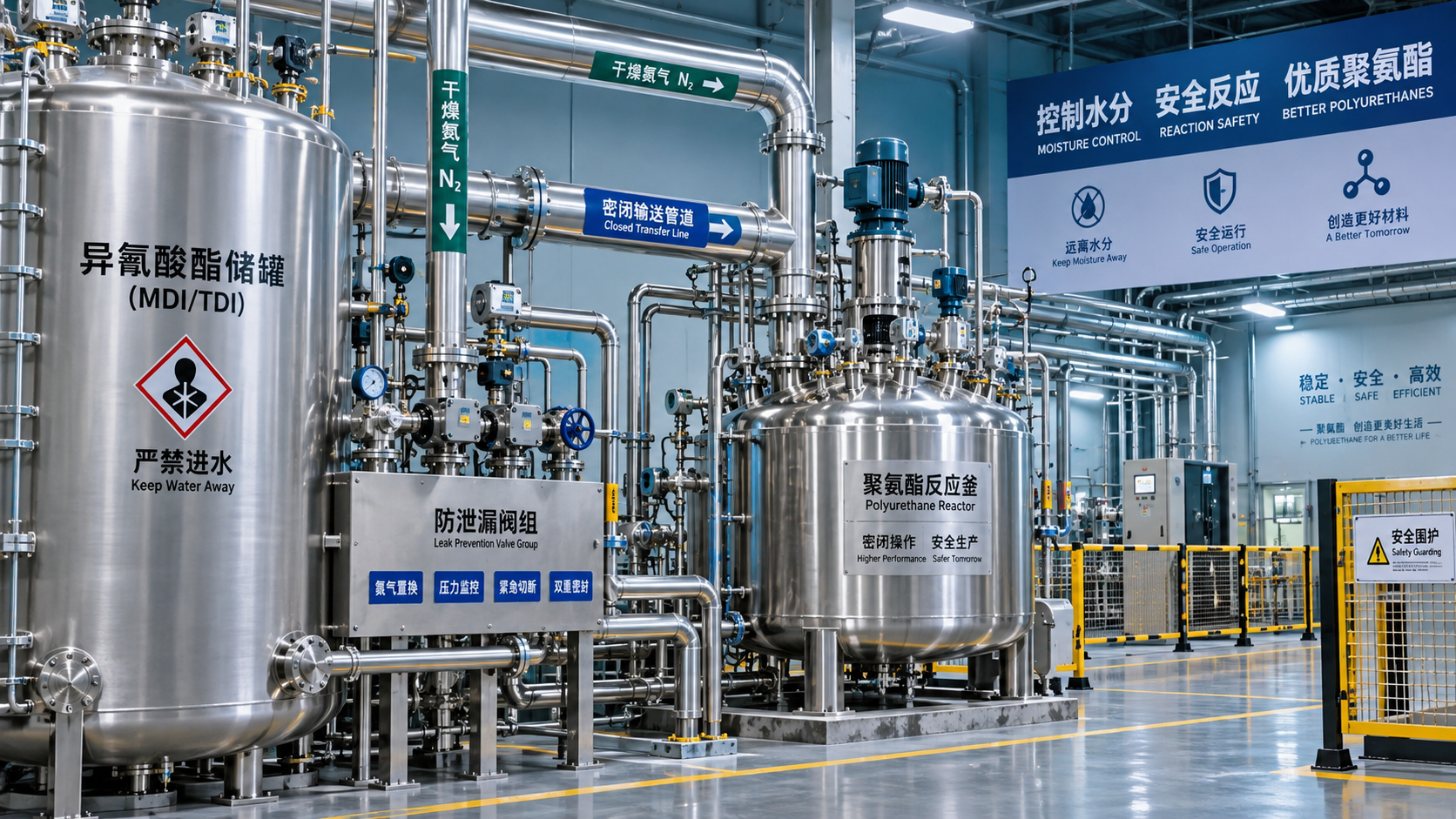
Isocyanates in Polyurethane Production: Controlling Moisture and Reaction Safety
Introduction: Isocyanates are essential to polyurethane production, but their sensitivity to moisture and reactive nature demand rigorous quality and safety controls.
For quality control and safety managers, preventing water contamination, managing storage conditions, and maintaining compliant handling procedures are critical to protecting product performance and personnel.
The central operational conclusion is straightforward: moisture control and reaction safety must be treated as one connected system, not as separate quality and EHS tasks.
Search intent centers on practical risk reduction: identifying where water enters the process, verifying material condition, preventing uncontrolled reactions, and documenting defensible controls.
Quality and safety teams need decision criteria, inspection points, escalation triggers, and supplier documentation rather than generic descriptions of polyurethane chemistry or theoretical hazard statements.
Why Moisture Creates a High-Consequence Isocyanate Risk
Isocyanates react readily with water, producing unstable intermediates that release carbon dioxide and form urea-containing structures within the polyurethane reaction system.
In a controlled formulation, limited water may be intentionally used as a blowing agent. Unintended moisture, however, changes chemistry without being accounted for in formulation calculations.
Excess water consumption lowers available isocyanate functionality, shifts the effective NCO index, and can cause poor curing, density variation, weaker mechanical properties, or surface defects.
Carbon dioxide generation can also create foaming irregularities, pressure buildup in closed equipment, overflow from vessels, and unpredictable expansion in reactive mixtures.
For quality personnel, moisture is therefore not merely an incoming-material specification. It is a process variable that can alter both batch acceptance and finished-product performance.
For safety managers, the same reaction can create immediate operational hazards when contaminated isocyanates are heated, confined, transferred incorrectly, or exposed during cleanup activities.
Moisture control should begin with a documented material-flow map showing every location where isocyanates contact storage air, hoses, pumps, tanks, containers, additives, or cleaning equipment.
Identify the Moisture Entry Points Before Setting Controls
The most effective prevention programs start by locating likely water sources rather than relying solely on final batch testing after defects have already appeared.
Common sources include humid air entering partly used drums, wet transfer lines, inadequately dried tanks, leaking seals, uncured coatings, contaminated additives, and incorrect cleaning practices.
Bulk storage systems require particular attention because breathing through vents can introduce atmospheric humidity during temperature changes, unloading, withdrawal, or prolonged idle periods.
Drum handling also presents avoidable risks. Leaving bungs open, using wet tools, transferring material in rain-exposed areas, or returning unused material can compromise product integrity.
Polyols, pigments, catalysts, fillers, solvents, and recycled materials should be assessed for moisture contribution before being introduced into an isocyanate-containing formulation.
Quality teams should define moisture specifications for each relevant component, including internally reclaimed streams, rather than assuming supplier certificates cover actual plant conditions.
A practical risk register should rank each point by likelihood, possible water load, detectability, process consequence, and the effectiveness of existing preventive barriers.
Build a Storage Standard That Controls Both Product Quality and Exposure
Isocyanate storage procedures should specify approved temperature ranges, closed-container requirements, inerting practices where appropriate, inspection frequency, labeling, and segregation arrangements.
Temperature stability matters because repeated heating and cooling cycles can increase breathing, affect viscosity, complicate pumping, and contribute to condensation risk around poorly controlled systems.
Storage areas should remain dry, protected from direct weather exposure, and arranged to prevent water from firefighting systems, roof leaks, washdown activities, or adjacent operations.
Containers should be kept tightly closed when not actively connected to a controlled transfer system. Open handling should be minimized and justified by written procedures.
For moisture-sensitive bulk installations, dry nitrogen blanketing may reduce atmospheric moisture contact, provided pressure control, vent design, and operating responsibilities are clearly defined.
Managers should avoid treating inerting as a complete solution. It cannot compensate for wet hoses, poor unloading discipline, contaminated tank bottoms, or incorrect maintenance work.
Routine checks should include seals, desiccant systems, filters, vent condition, tank temperature, visible leaks, condensation, drum damage, and the status of transfer connections.
Use Testing to Confirm Control, Not to Replace Prevention
Testing provides evidence that controls are working, but laboratory results arrive after materials have already moved through parts of the supply chain or production process.
Incoming inspection plans should verify identity, packaging integrity, batch traceability, certificate consistency, storage history, and any agreed moisture or NCO-content requirements.
For isocyanates, NCO content is a particularly valuable quality indicator because unexpected reduction can indicate reaction, degradation, contamination, or improper storage conditions.
Viscosity, color, acidity, insoluble content, and appearance can provide additional warning signs, although they should never be interpreted without considering product-specific specifications.
Water determination methods must be suitable for the sample matrix and expected concentration range. Teams should validate sampling methods, containers, handling time, and laboratory repeatability.
Sampling equipment must be dry and compatible. A reliable analytical method cannot correct a sample contaminated by damp bottles, wet valves, or improperly conditioned sampling points.
Trend charts are more useful than isolated results. Monitor incoming lots, storage tanks, pre-batch samples, and finished batches to reveal gradual drift before a serious deviation occurs.
Control Reactive Operations Through Clear Process Discipline
Reaction safety depends on controlling charging order, temperature, agitation, addition rates, vessel capacity, cooling capability, and the compatibility of every introduced material.
Batch instructions should state whether water is intentionally included, where it enters, how its amount is calculated, and which formulation adjustments are prohibited without authorization.
Operators need clear hold points before charging isocyanates, especially after maintenance, equipment cleaning, line changes, abnormal shutdowns, or extended production interruptions.
Before startup, teams should confirm equipment dryness, correct raw-material identity, available emergency capacity, working temperature instrumentation, and functional ventilation or local exhaust systems.
Automated interlocks can reduce dependence on memory. Useful examples include high-temperature alarms, maximum addition-rate limits, agitator permissives, and emergency cooling activation logic.
Where uncontrolled gas generation is credible, engineering reviews should assess vessel venting, relief paths, collection systems, occupancy around equipment, and emergency isolation capability.
Process changes involving suppliers, recycled content, packaging, equipment, ambient conditions, or cleaning agents should pass through formal management-of-change review before implementation.
Protect Workers From Inhalation and Skin Contact
Isocyanates can present serious respiratory and skin sensitization risks. Exposure control must address routine work, nonroutine work, spills, sampling, maintenance, and emergency response.
Closed transfer systems are generally preferable because they reduce vapor, aerosol, splash, and manual handling opportunities that can expose operators or contaminate materials.
Local exhaust ventilation should be designed around actual emission points, including drum opening, sampling ports, mixing vessels, spray or foam operations, and waste handling stations.
Personal protective equipment should be selected through a documented hazard assessment. Gloves, protective clothing, eye protection, and respiratory protection must match task-specific exposure potential.
Respiratory protection programs require fit testing, cartridge-change policies where applicable, training, medical evaluation, inspection, and clear criteria for when supplied-air protection is required.
Personnel must understand that odor is not a reliable exposure indicator. Sensitized workers may react at low concentrations, and some hazardous conditions may not be readily noticeable.
Training should use actual workplace scenarios, including a wet hose connection, a leaking drum valve, unexpected foaming, incorrect material charging, and contaminated disposable equipment.
Prepare for Spills, Contamination, and Abnormal Reactions
Emergency procedures should distinguish between a small controlled spill, a leak requiring isolation, and a potentially reactive event involving heat generation, pressure, or gas evolution.
Spill response materials must be compatible with isocyanates and available near handling areas. Absorbents, tools, waste containers, and decontamination instructions should be preapproved.
Water should not be used casually for cleanup of isocyanate releases because it can intensify reaction behavior and generate carbon dioxide under unfavorable conditions.
Response plans should identify who may intervene, when evacuation is required, how ventilation will be managed, and when external emergency support must be contacted.
Waste containers require particular care. Residual isocyanate, absorbent, and incompatible materials can continue reacting after collection if waste streams are mixed without evaluation.
Every abnormal event should trigger a structured investigation covering material condition, water sources, operating conditions, equipment integrity, human factors, and procedural gaps.
Corrective actions should be verified through follow-up inspections and data review. Reissuing a procedure without confirming changed behavior rarely prevents recurrence.
Strengthen Supplier Control and Documentation
Reliable isocyanate control begins before delivery. Procurement, quality, logistics, and EHS functions should align supplier requirements instead of reviewing shipments independently.
Supplier qualification should consider technical specifications, safety data sheets, packaging design, transportation controls, batch traceability, regulatory status, and response capability for quality complaints.
Purchase specifications should define acceptance parameters, packaging condition, labeling, storage instructions, shelf-life expectations, and notification requirements for formulation or manufacturing changes.
For imported materials, shipping duration and port conditions can affect material condition. Receiving teams should review container integrity and temperature exposure where relevant.
Documentation discipline also supports audits and customer confidence. Retain certificates of analysis, receiving records, storage logs, test reports, deviation records, and disposal documentation.
Companies sourcing multiple chemical categories can apply similar supplier-control principles to functional ingredients, including Cosmetic/Pharmaceutical Grade Modified Starch, where moisture, packaging integrity, and traceability also influence downstream quality.
The exact controls differ by chemistry, but the management principle remains consistent: specifications are useful only when receiving, storage, testing, and production practices preserve them.
Measure Performance With Leading Indicators
Quality and safety managers need indicators that reveal weakening control before a rejected batch, injury, customer complaint, or significant release occurs.
Useful quality indicators include incoming moisture deviations, NCO-content trends, failed pre-use inspections, storage temperature excursions, rework rates, and formulation adjustments caused by raw materials.
Useful safety indicators include open-container observations, ventilation inspection completion, near misses, overdue training, PPE nonconformities, spill-response drill findings, and maintenance permit deviations.
Review indicators jointly whenever possible. A rise in moisture-related quality deviations may expose the same poor storage or handling practices that increase reaction risk.
Audits should include field observation, not only document review. Many meaningful failures involve behaviors such as bypassed covers, unsealed samples, improvised hoses, or poorly stored tools.
Management review should assign owners and deadlines for significant trends. Controls remain ineffective when deviations are repeatedly discussed but not translated into equipment or process improvements.
A mature program makes it easy for operators to report uncertain conditions without blame, while maintaining firm escalation requirements for unsafe or out-of-specification situations.
Conclusion: Treat Moisture Control as Reaction-Safety Control
In polyurethane production, moisture contamination and isocyanate reaction safety are inseparable. Both affect formulation accuracy, product consistency, equipment reliability, and worker protection.
The strongest control strategy combines dry and closed handling, disciplined storage, representative testing, engineered safeguards, exposure prevention, emergency readiness, and qualified supplier oversight.
Quality teams should focus on identifying water-entry pathways and trending meaningful data. Safety teams should ensure that abnormal reactions and exposures can be prevented, detected, and controlled.
When these responsibilities are managed as one operating system, manufacturers can reduce variability, protect personnel, support compliance, and make more confident decisions about isocyanate use.
Send Us Your Inquiry Today
